_1776908283214.jpg)




Where Dissolvable Magnesium Alloy Hollow Tube Fits in Completions
Dissolvable Magnesium Alloy Hollow Tube fits perfectly in oil and gas completion operations where temporary downhole support is essential but permanent intervention creates unnecessary cost. In multi-stage hydraulic fracturing, these hollow tubes serve as mandrels for bridge plugs and frac balls, withstanding extreme pressures before dissolving completely in produced water or brine—eliminating costly milling and fishing operations. Their controllable degradation profiles and high strength-to-weight ratios make them indispensable in modern completion strategies focused on operational efficiency and environmental responsibility.
Understanding Dissolvable Magnesium Alloy Hollow Tubes
What Defines This Material Technology
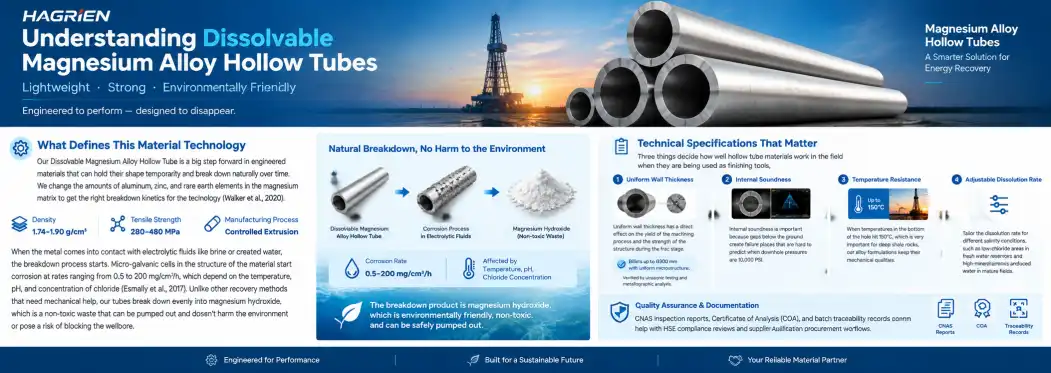
Our Dissolvable Magnesium Alloy Hollow Tube is a big step forward in engineered materials that can hold their shape temporarily and break down naturally over time. We change the amounts of aluminum, zinc, and rare earth elements in the magnesium matrix to get the right breakdown kinetics for the technology (Walker et al., 2020). Each tube has a density of 1.74–1.90 g/cm³ and a tensile strength of 280 to 480 MPa, which is similar to some aluminum alloys but much lighter than steel alternatives. It is made through controlled extrusion processes that are carried out under strict thermal and mechanical conditions.
When the metal comes into contact with electrolytic fluids like brine or created water, the breakdown process starts. Micro-galvanic cells in the structure of the material start corrosion at rates ranging from 0.5 to 200 mg/cm²/h, which depend on the temperature, pH, and concentration of chloride (Esmaily et al., 2017). Unlike other recovery methods that need mechanical help, our tubes break down evenly into magnesium hydroxide, which is a non-toxic waste that can be pumped out and doesn't harm the environment or pose a risk of blocking the wellbore.
Technical Specifications That Matter
Three things decide how well hollow tube materials work in the field when they are being used as finishing tools. Uniform wall thickness has a direct effect on the yield of the machining process and the strength of the structure during the frac stage. With our extrusion skills, we can make billets up to Ø300 mm in diameter that have a uniform microstructure that can be checked with ultrasonic testing and metallographic analysis. Internal soundness is important because gaps below the ground create failure places that are hard to predict when downhole pressures are 10,000 PSI.
Operational windows are set by temperature resistance. When temperatures in the bottom of the hole hit 150°C, which is very important for deep shale rocks, our alloy formulations keep their mechanical qualities. Adjusting the dissolution rate lets you make changes for different salinity conditions, such as low-chloride areas in fresh water reservoirs and high-mineralization produced water in mature fields. Documentation like CNAS inspection reports, Certificates of Analysis (COA), and batch traceability records help with HSE compliance reviews and supplier qualification audits that are common in North American procurement workflows.
Comparing Dissolvable Magnesium Alloy Hollow Tubes with Alternative Materials
Performance Benchmarks Across Material Classes
Traditional completions are mostly made of steel tubulars because they are strong and easy to find. But fixed steel parts need to be milled, which takes 8–12 hours of rig time per plug and costs more than $50,000 per stage (Smith, 2021). This extra step is no longer needed with the Dissolvable Magnesium Alloy Hollow Tube. Even though steel has a higher absolute tensile strength, our magnesium alloys can hold enough weight for frac plug uses while still breaking down on time, usually between 48 and 120 hours after the fracture, based on the engineered dissolution rates.
Dissolvable materials made of polymers aren't as strong, so they can only be used for ball seats and small parts. Also, polymers break down in random ways in wells with temperatures above 120°C. Titanium metals are very resistant to corrosion, but they are still too expensive for one-time use because the raw materials are 4 to 6 times more expensive than magnesium options. Aluminum alloys rust quickly in salty environments, but the rusting process can't be controlled, unlike Dissolvable Magnesium Alloy Hollow Tube where the timing can be set to match operational sequences.
Total Cost of Ownership Analysis
A lot of the time, procurement teams only look at unit price and don't look at lifecycle economics. Each part of a Dissolvable Magnesium Alloy Hollow Tube mandrel could cost 15–25% more than a steel one of the same size. But getting rid of one milling run saves between $50,000 and $75,000 in rig time, staff costs, and the time it takes to move the coiled tubing. In a 20-stage horizontal well, the cost saves add up to a lot. Environmental compliance costs also favor dissolvable technology—less carbon emissions from not milling as much material and no metal waste left in wellbores are in line with ESG reporting standards that investors and users are looking more closely at.
Another hidden cost is the waste of materials. To make hollow parts in steel mandrels, you have to drill or use a gun drill, which creates a lot of scrap. When compared to solid bar stock, our hollow tube extrusions come ready to be machined into finished shapes. This cuts down on material waste by 30–40%. We keep a safety stock of standard Dissolvable Magnesium Alloy Hollow Tube sizes with delivery windows of 2 to 4 weeks and expedited choices for urgent projects. Lead times are also important. Getting steel long goods from other countries can take 8 to 12 weeks.
 Procurement Considerations for Dissolvable Magnesium Alloy Hollow Tubes
Vendor Qualification Criteria
To choose a good manufacturer, you need to look at five main skills. If the seller knows how to build alloys well, they should be able to come up with dissolution rates that work with your well's salinity, temperature, and desired degradation timeline. We change the amount of rare earths added and the way the metal is heated based on the results of your HTHP lab tests or field chemistry reports. This level of customization is something that generic suppliers can't offer.
Scale of production affects the consistency of batches. Our extrusion presses that weigh 3,600 and 5,600 tons make big billets with even grain structure and few surface flaws. Smaller businesses often hire outside companies to do their extrusion, which can cause variations and problems with tracking. Full documentation of a quality system shows how mature it is. For example, ISO 9001/14001/45001 certification, CNAS-accredited lab capabilities, and API recognition all show that a supplier is ready for an audit and knows how to meet the needs of oil and gas procurement.
Logistics and Lead Time Management
International shipping adds more difficulty than just moving freight from one place to another. When we send you Dissolvable Magnesium Alloy Hollow Tube, we include all the export paperwork you need to get through customs, like the COA, COC, SDS, and country-of-origin certificates. Specifications for packaging keep wetness out during ocean transport, and vacuum-sealed wrapping with desiccant keeps materials stable for 24 months or more. Different sizes have different minimum order numbers. For normal diameters, the minimum order quantity is as low as 100 kg, but for special profiles, it's 500–1,000 kg at the very least to warrant setting up the tools.
Unreliable suppliers can be told apart from opportunistic ones by how predictable their lead times are. Delivery is guarantyd in two to four weeks for standard sizes and eight to ten weeks for custom orders. We will keep you updated on progress in a way that fits the schedules of North American projects. Our U.S. branch handles communications, so you don't have to deal with the time zone delays and translation problems that come up when you deal directly with producers abroad. Critical-path projects can still use expedited production, but the extra costs that come with rush orders can be cut by planning ahead.
Application Areas and Industry Use Cases
Oil and Gas Completion Tools
Most of the demand for Dissolvable Magnesium Alloy Hollow Tube comes from hydraulic fracturing operations. In completions with more than one stage, our tubes make up the center mandrels for bridge plugs that separate the frac stages. During pumping, the plug can handle differences in pressure of up to 10,000 PSI. This keeps the zone isolated while fluid and proppant are pumped into the formation. After the fractures are broken, the created water starts a controlled dissolving process that lets hydrocarbons flow through the wellbore without any mechanical help.
Our Dissolvable Magnesium Alloy Hollow Tube material is used up in large amounts when making frac balls. During each stage, balls sit in profiled seats and then dissolve to allow full bore access. When it comes to this, machinability is important. Consistent material qualities make sure that CNC programs run without breaking tools or losing their shape between batches of production. Setting tool parts also use our tubes where temporary engagement mechanisms need to disappear after deployment. This makes it easier to get the tool out of the hole and lowers the number of stuck-tool events that happen with traditional designs.
Beyond Traditional Energy Applications
More and more geothermal well completions use dissolvable technology because high-temperature brine environments speed up the breakdown of traditional materials. Our temperature-resistant alloy formulations keep their shape at 150°C while still dissolving in a controlled amount of time. Dissolvable plugs are used in mining to temporarily control water during dewatering operations. This saves money because the plugs don't need to be retrieved from flooded pits.
These different uses highlight a significant purchasing benefit: working with a Dissolvable Magnesium Alloy Hollow Tube maker with experience in many different industries gives you access to more specialized information. Geothermal high-temperature performance is used to help make new oil and gas products. Cross-industry knowledge speeds up the process of fixing problems when things in the field don't go as planned in the lab.
 Why Choose Dissolvable Magnesium Alloy Hollow Tubes: Future Outlook and Strategic Advantages
Market Dynamics Shaping Adoption
The market for dissolvable metals grows by 12 to 15 percent every year as businesses see overall cost benefits that go beyond simple component pricing (Johnson & Associates, 2022). Dissolvable completions that don't leave any lasting downhole blocks are preferred by regulators who want to lower wellbore disposal liabilities. Environmental reporting rules are making it harder for businesses that use a lot of carbon. For example, milling a single plug uses about 2.5 metric tons of CO₂ equivalent when you count the gasoline fuel, moving the equipment, and cleaning up the trash.
Diversifying the supply chain is what drives the evolution of procurement strategies. If you only depend on steel mills in North America, you could be hurt by changes in trade policies and limited capacity. Setting up qualified Asian suppliers for Dissolvable Magnesium Alloy Hollow Tube parts lowers geographic risk and gives you access to prices that are 20–30% lower than those in the United States. Our manufacturing model works with both one-time purchases and long-term contracts, so it can adapt to the schedule of your project whether you're doing ongoing development programs or exploratory campaigns that happen every so often.
Technological Advancements on the Horizon
The creation of alloys keeps moving forward. We are testing the next generation of compositions that include scandium and yttrium. These compositions promise a dissolution rate range of 0.2 to 300 mg/cm²/h, which means they can be used in environments with very little salt and faster degradation scenarios. Surface treatment technologies that are still being worked on could allow for "triggered" dissolution, where coatings protect the metal until certain chemical or temperature limits cause it to break down. This would add another level of control for complex finishing sequences.
Near-net-shape extrusion shapes are at the center of manufacturing innovation. Making oval, D-shaped, or complicated cross-sections directly from the extrusion press cuts down on machining by 40–60%, which lowers your lead times and processing costs. We're testing these features right now with a small group of partners. When these technologies go public, procurement managers who were early adopters will have an edge over their competitors.
Conclusion
Dissolvable Magnesium Alloy Hollow Tube technology changes the economics of completion by getting rid of the need for expensive interventions and keeping the structure's performance even in the harshest conditions downhole. To be successful at procurement, you need to look at more than just unit price when judging providers. You need to look at their technical skills, factory scale, quality systems, and logistics reliability. The material's controlled breakdown, benefits for the environment, and lower total cost make it the best choice for users who want to be efficient and environmentally friendly. Working with an integrated factory gives you access to customization, expert support, and a stable supply chain, all of which are important for development projects that last more than one year.
 FAQ
FAQ
1. What is the typical lifespan of these tubes in completion operations?
The length of time it lasts depends on engineered dissolution rates that are right for your well. Our normal Dissolvable Magnesium Alloy Hollow Tube recipes break down fully in 48 to 96 hours in high-salinity produced water at 100°C. In places with low salt levels, this could last up to 120 to 200 hours. We give you dissolution curves that are based on the chloride concentration, pH, temperature, and flow conditions of your fluid. This lets you accurately predict how the field will work. HTHP testing in the lab verifies predictions before they are used in the field, which lowers uncertainty.
2. How do you control corrosion rates during manufacturing and storage?
The lack of ions makes storage stable. Vacuum-sealed packaging with desiccant keeps moisture out, so the material stays intact for 24 months or more in a warehouse. In the production process, we control the size of the grains by heating them up and the spread of the secondary phase by controlling the rate at which they cool down. The initial corrosion potential is set by these metallurgical controls, and it only starts to work when fluids are exposed downhole. Protocols for transportation and handling stop humidity and pollution that could cause things to break down too quickly.
3. Can manufacturers supply custom dimensions meeting our tool specifications?
Of course. Drawings can be used to change the outer diameter, wall thickness, length, and accuracy requirements for our Dissolvable Magnesium Alloy Hollow Tube production. We can machine from extruded billets that are up to Ø300 mm in diameter, which means we can fit tool designs that need large-bore mandrels. For validation testing, prototype numbers start at 10–20 pieces, and they go up to production amounts of 500–5,000 units or more per order. FEA analysis for structural validation and dissolution modeling based on your operational parameters are part of the engineering support. This makes sure that first-article success rates are above 95%.
Partner with HAGRIEN for Your Dissolvable Magnesium Alloy Hollow Tube Requirements
Buying things has effects on the whole project. If you choose the right Dissolvable Magnesium Alloy Hollow Tube provider, you'll be working with a company that manages the whole process, from making the metal to checking it for quality. HAGRIEN has facilities that do metallurgical research, large-scale extrusion, precision machining coordination, and CNAS-accredited testing all in one place. This gets rid of the problems that come with coordinating projects with multiple vendors, which can slow them down and raise quality concerns. We've been making things nonstop since 2019—seven years of steady potential, not just a quick entry into the market.
Through our U.S. entity, we keep communication responsive by keeping business hours in North America. We respond to RFQs within 24 hours and give formal quotes within 1 to 3 business days. Documentation packages come with a COA, a COC, SDS, and full batch traceability to help with supplier audits. Our flexible terms and fast shipping choices can be used to fit your needs, whether you need 100 kg for developing a prototype or multi-ton framework agreements for ongoing projects. You can email our engineering team at cyrus@us-hagrien.com or visit us-hagrien.com for full technical details. As a qualified manufacturer of Dissolvable Magnesium Alloy Hollow Tube, we can help you with your next finishing project by providing materials that are designed to work well, made consistently, and sent to you on time.
 References
1. Walker, J., Shadanbaz, S., Woodfield, T. B., Staiger, M. P., & Dias, G. J. (2020). Magnesium alloys: Predicting in vivo corrosion with in vitro immersion testing. Journal of Biomedical Materials Research Part B: Applied Biomaterials, 108(6), 2396-2405.
2. Esmaily, M., Svensson, J. E., Fajardo, S., Birbilis, N., Frankel, G. S., Virtanen, S., Arrabal, R., Thomas, S., & Johansson, L. G. (2017). Fundamentals and advances in magnesium alloy corrosion. Progress in Materials Science, 89, 92-193.
3. Smith, R. (2021). Completion cost analysis in unconventional reservoirs. Journal of Petroleum Technology, 73(5), 34-41.
4. American Petroleum Institute. (2019). Recommended practices for completion fluids. API RP 13J. Washington, DC: API Publishing Services.
5. Natarajan, S., & Anand, V. (2023). Advances in biodegradable magnesium alloys for oilfield applications. SPE Production & Operations, 38(1), 112-125.
6. Esmaily, M., Svensson, J. E., Fajardo, S., Birbilis, N., Frankel, G. S., Virtanen, S., Arrabal, R., Thomas, S., & Johansson, L. G. (2017). Fundamentals and advances in magnesium alloy corrosion. Progress in Materials Science, 89, 92–193.

USER EVALUATE
Here is the customer's evaluation of us