_1776908283214.jpg)




How Does A Dissolvable Frac Plug Work?
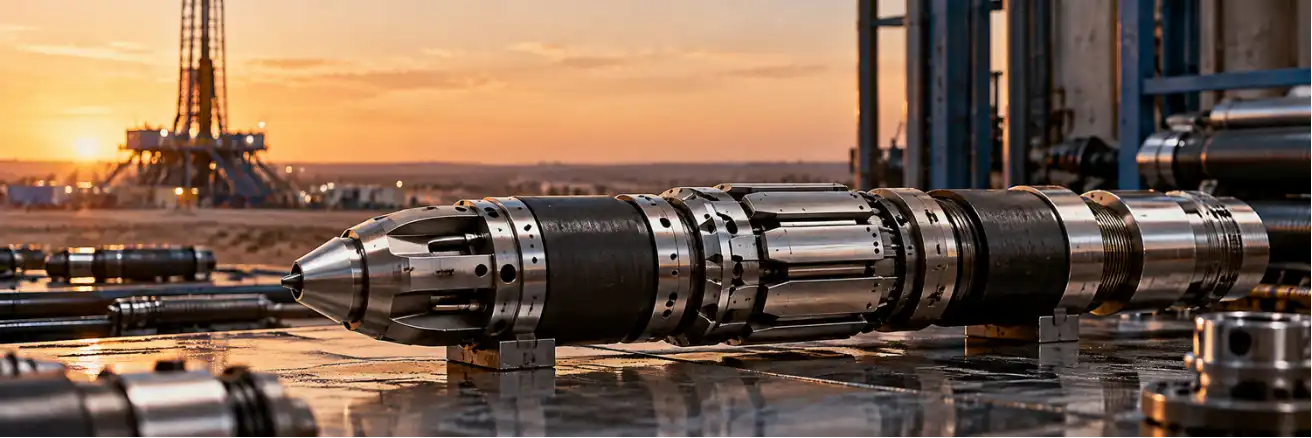
A dissolvable frac plug is a downhole isolation tool used in multistage hydraulic fracturing to temporarily seal off completed wellbore sections. Built from engineered magnesium alloys, it holds full differential pressure during stimulation, then reacts with wellbore fluids — brine or formation water — to degrade completely over a defined timeframe. This removes the need for coiled tubing mill-out runs between stages or after completion. The result is a faster path from fracturing to flowback, with no debris left to restrict production. Understanding how this tool works is the first step toward building it into your well cost model.
Understanding Dissolvable Frac Plugs: Definition and Core Principles
What Is a Dissolvable Frac Plug?
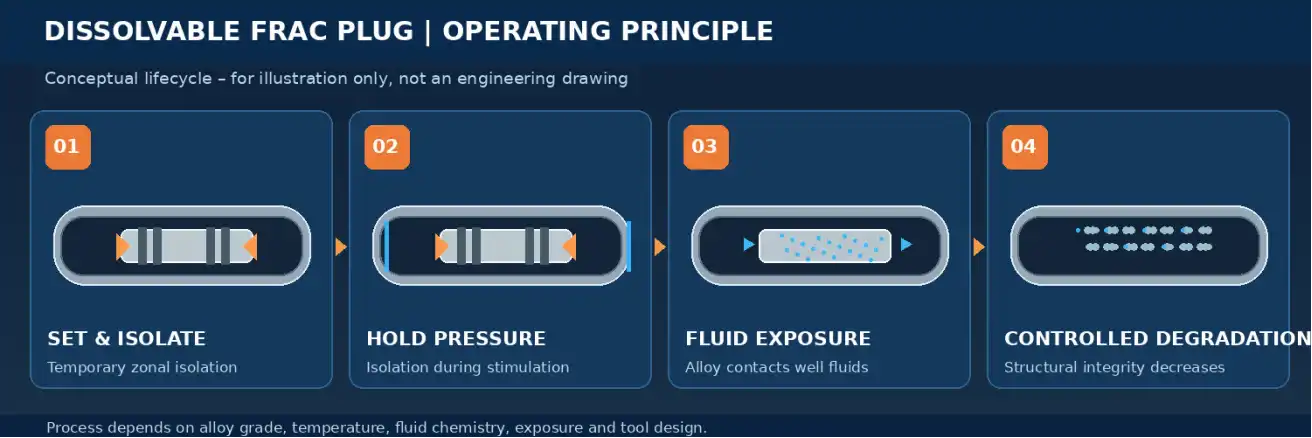
A dissolvable frac plug does the same job of isolating as a composite or cast-iron plug, but it doesn't need to be taken out by hand. It is pressed against the cylinder wall with high-expansion slips and keeps the pressure up during the frac stage. After the treatment is done, it breaks down when it comes into touch with fluids downhole. The body of the tool, the slips, and the closing elements are all designed to dissolve within a certain time range. This range is usually between 24 hours and 14 days, but it depends on the metal grade, temperature, and salinity of the fluid.
What Materials Enable Controlled Degradation?
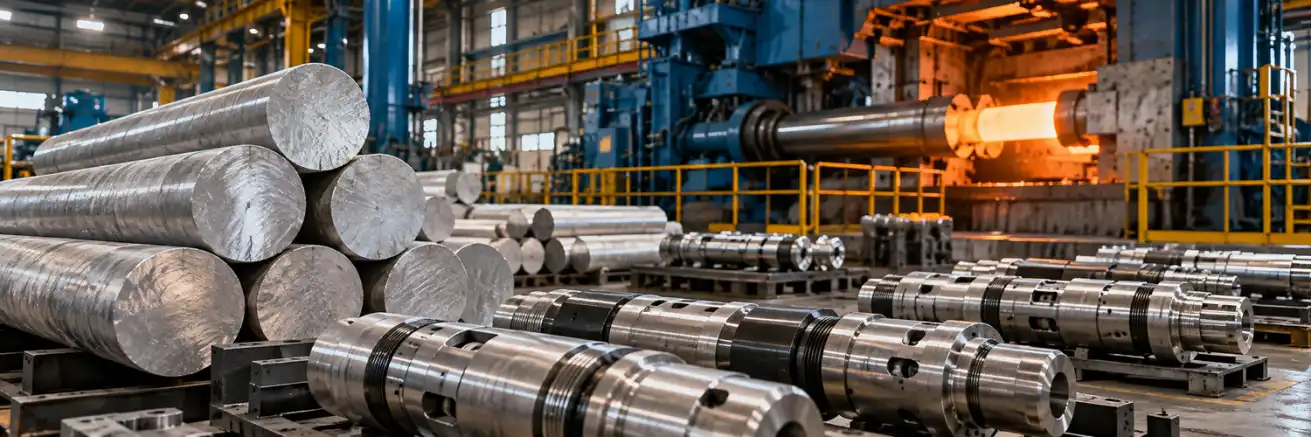
The main substance is a high-strength magnesium metal that was made using controlled galvanic corrosion chemistry. Magnesium reacts with formation fluids that contain chloride at rates that depend on the alloy's make-up, the thickness of the coating, and the temperature. Engineers change these factors to fit the working window for a given well, which is between 30°C and 150°C and 0 to 40,000 ppm of salt. This way, the plug breaks down at the right time and not too early or not at all. The dissolvable frac plug line from HAGRIEN can handle pressures of up to 15,000 psi and temperatures that are stable from 70°F to 350°F.
How Does the Dissolution Process Work Mechanically?
When the stimulation is over, formation fluids or planned flush amounts come in touch with the plug body. Ions of chlorine start galvanic erosion across the magnesium matrix. Most of the time, structural stability breaks down in 24 to 72 hours, and full breakdown takes 7 to 14 days. The leftovers, magnesium hydroxide and magnesium chloride, are microscopic, dissolve in water, and are easily brought to the top during flowback. There are no milling or plug fragments left in the wellbore that could block flow or need to be cleaned up.
Comparing Dissolvable Frac Plugs with Traditional and Composite Plugs
The Cost of Mechanical Removal
After each fracturing process, traditional cast-iron plugs need a specialized mill-out run with coiled tubing or a workover rig. This can make a 40-stage lateral less useful for 24 to 72 hours per well. Depending on the area and rig type, coiled tubing day rates can be $15,000 to $40,000 or more. In wells with a long reach, CT frictional drag can completely cut off the reach, which makes mechanical milling unsafe to use. A dissolving plug gets rid of this window for action completely, and that time spent doing nothing directly saves money.
How Composite Plugs Compare
When compared to cast iron, composite plugs cut down on mill-out time, but they still make a lot of debris during milling. Composite pieces can hurt downhole tools, stop the flow of fluid, or need more flush cycles. A degradable plug, on the other hand, doesn't leave behind any solid waste and doesn't need any intervention equipment to be moved. In multi-well pad operations, which are popular in the Permian Basin, Eagle Ford, and Bakken, getting rid of mill-out across 6 to 12 wells per pad can free up several coiled tubing units for other tasks.
Reliability Indicators Worth Evaluating
Not every soluble plug works the same way in all formation situations. Three things are usually checked by completion managers before they choose a supplier: pressure hold curves under simulated downhole conditions; dissolution rate data across the target temperature and salinity range; and batch traceability documentation, such as COA/COC records. Every dissolvable frac plug that HAGRIEN sends out comes with a full set of paperwork, including a COA, a COC, and batch tracking. This is done to help with supplier approval checks and internal cost model verification.
Benefits and Practical Applications in Modern Hydraulic Fracturing
Where Dissolvable Plugs Deliver the Most Value
When using degradable isolation tools, the best results are always seen in three situations:
- Extended-reach horizontal wells: Where CT drag limits mill-out reach, soluble plugs allow completion without stuck-pipe risk. Laterals exceeding 10,000 feet in the Delaware Basin or Midland Basin are common candidates.
- High-pressure, high-temperature reservoirs: Engineered magnesium alloys maintain mechanical integrity at 15,000 psi and 350°F, then degrade cleanly post-stimulation without premature failure.
- Multi-well pad operations: Eliminating mill-out across a full pad can compress the completion-to-flowback schedule by days, directly improving pad economics.
Without any help, these three situations are where intervention-less completion tools really pay for themselves many times over.
Environmental and Safety Advantages
Getting rid of mill-out operations lowers the amount of surface fluid, lessens the flow of equipment on site, and gets rid of the risk of CT fails caused by debris or getting stuck. Under normal drilling conditions, magnesium ions that are released during dissolution don't damage the rock and aren't known to be harmful to the environment. Fewer coiled tubing mobilizations per pad is a measurable way for operators to cut down on both emissions and mechanical risk exposure as ESG reporting requirements get stricter.
Validation From Field Operations
Operators in the Permian Basin have seen NPT drops of one to two days per well after moving from composite plug programs to soluble plug programs. That means that 10 to 20 rig days can be restored and put toward output on a 10-well pad. In shale plays across various basins, HAGRIEN's dissolvable frac plug assemblies have helped with multi-stage programs. The dissolution performance was confirmed by CNAS-accredited HTHP laboratory tests before shipping.
Procurement Guide: How to Source and Buy Dissolvable Frac Plugs
Five Parameters That Define Your Technical Specification
Before sending an RFQ to any provider of dissolvable frac plugs, your engineering team should agree on five things: the size and weight of the casing, the temperature of the bottomhole, the salinity of the formation water, the length of time that the pressure must be held, and the goal dissolve window. These inputs determine which alloy to use and what kind of coating to use. Suppliers who can't give you dissolution rate curves for the temperature and salinity range you need shouldn't move on to the next step, which is technical screening.
Evaluating Supplier Credibility
These basic requirements will help you tell the difference between suppliers who can help you and those who could put your completion program at risk:
- API Spec Q1 registration and HSE records — required for entry into most North American approved vendor lists.
- COA/COC and batch traceability — must ship with every order, not available only upon request.
- Reproducible test data — dissolution curves validated in simulated wellbore fluid at your stated conditions, not just nominal lab conditions.
- Substitution cross-reference table — confirmation that the offered tool meets or exceeds the specifications of your current plug program.
- U.S. service presence — reduces supply chain risk and supports field troubleshooting response.
- API Spec Q1 registration and HSE records— needed to get on most approved seller lists in North America.
Lead Times and Delivery Planning
HAGRIEN keeps common sizes in stock so that lead times are only two to four weeks. Custom specifications or engineered dissolution windows take 4 to 8 weeks to ship, but urgent projects can get them faster. Our U.S. branch handles all orders in North America, and we offer a range of flexible trade terms (EXW, FOB, and CIF) to fit your specific transportation needs.
Troubleshooting and Operational Best Practices
Preventing Premature Dissolution
The main type of failure that operators fear is early decline before or during the frac stage. To lower this risk, the plug body has protective ceramic or polymer coverings that keep fluid from touching it until a certain temperature or time has passed. It is important to choose the right covering type for the temperature of your wellbore. Plugs that are run in wells that are too cold or too warm for their rated temperature range will either dissolve too soon or not at all.
Addressing Incomplete Dissolution
Most of the time, incomplete dissolving happens because the wellbore fluid doesn't have enough chloride or the metal grade isn't at the right temperature for the conditions below. If flowback data shows that there is still plug material, the problem is usually fixed by flushing with higher-salinity fluid or letting the wellbore soak for longer. This risk is lower from the start if you choose a dissolvable frac plug maker that tests dissolution in fluids with the right salinity window instead of normal KCl solutions.
Batch Consistency and Quality Control
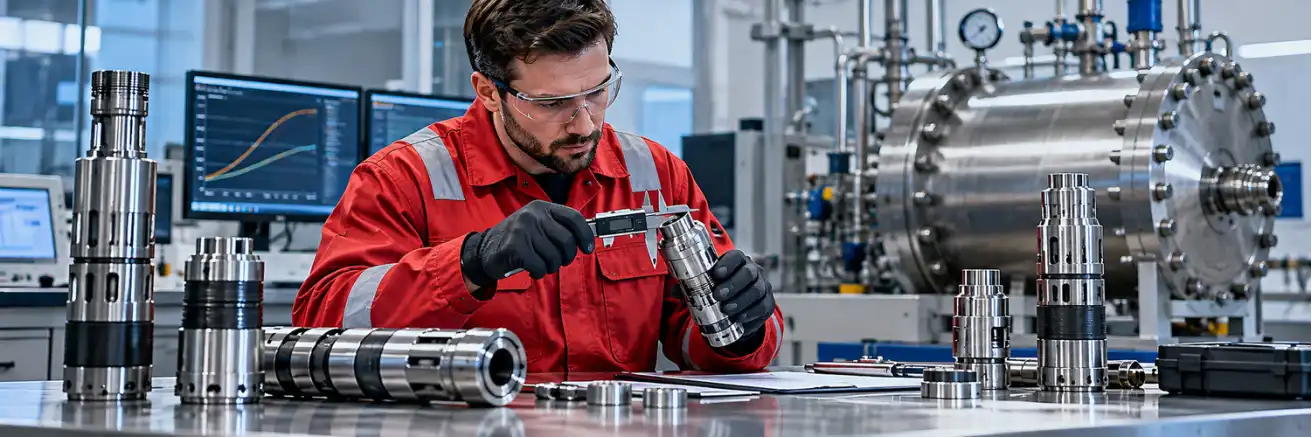
Changes in performance from batch to batch are the second most common field worry, after premature breakup. HAGRIEN uses spectrographic analysis, hydrostatic pressure testing at the recommended temperature, and dissolution rate validation on samples taken from each production batch to make sure the alloy's composition is correct. According to API 11D1 guidelines, a CMM inspection is used to prove the dimensional tolerance. From making the metal to making sure it's delivered, this closed-loop process gives completion managers the tracking information they need to keep success rates steady across a whole well pad program.
Conclusion
Dissolvable frac plug technology combines high-strength magnesium metal engineering with controlled galvanic corrosion chemistry to effectively isolate the wellbore during stimulation and completely degrade it after. The practical case is clear: getting rid of mill-out recovers non-productive time, lowers the exposure of coiled tubing, and speeds up the time from finish to production. The case for buying is also very clear: you need to find a supplier that can provide you with verifiable dissolution data, full batch documentation, and performance that can be repeated in your specific downhole conditions. This is what turns the technology promise into consistent field results.
FAQ
1. How long does a dissolvable frac plug take to fully dissolve?
Most of the time, structural stability breaks down 24 to 72 hours after fluid contact. Full breakdown takes between 7 and 14 days, based on the type of alloy, the temperature of the bottomhole, and the saltiness of the formation water.
2. Can these plugs work in low-salinity or fresh-water wells?
For galvanic rusting to start in standard magnesium metals, chloride ions are needed. There are special alloy formulas for fresh water that use different chemical signals for places with low salt levels.
3. What pressure ratings are available?
Hagrien's degradable plug assemblies can handle pressures of up to 15,000 psi (105 MPa), which is enough for most unconventional shale play completion needs in the Permian Basin, Eagle Ford, and Bakken.
4. Does dissolved material harm the reservoir or restrict flow?
No, the magnesium dissolution byproducts, which are mostly magnesium hydroxide and magnesium chloride, are water-soluble and microscopic. During flowback, they move to the top without blocking perforations or formation flow routes.
5. What casing sizes are compatible?
Standard designs include 4.5-inch to 7-inch casings, and there are different layouts for thin-wall and heavy-wall grades like P-110 and Q-125 to make sure they don't slip.
Partner With HAGRIEN for Your Next Dissolvable Frac Plug Program
HAGRIEN makes designed magnesium alloy frac plugs that can dissolve at temperatures up to 350°F and pressures up to 15,000 psi. The rates at which they dissolve can be changed to fit the chemistry of your wellbore. When an order ships, it comes with a COA or COC and full batch tracking. Every size takes two to four weeks to ship. We are an API-approved, ISO 9001/14001/45001-certified provider of dissolvable frac plugs with a U.S.-based coordination body that can help you with the whole approval process, from the sample to the annual framework. To get a substitution cross-reference and quote, email our technical team at cyrus@us-hagrien.com or go to us-hagrien.com.
References
1. Society of Petroleum Engineers — SPE Journal, 2020
2. Journal of Petroleum Technology — Intervention-Less Completion Technologies in Unconventional Plays, 2021
3. World Oil — Dissolvable Tools: Operational Performance and Field Data from Permian Basin Deployments, 2022
4. SPE Production & Operations — Controlled-Degradation Magnesium Alloys for Downhole Isolation Applications, 2019
5. Oil and Gas Journal — Reducing Completion Non-Productive Time Through Soluble Plug Technology, 2023
6. Journal of Natural Gas Science and Engineering — Material Engineering of Degradable Magnesium Alloys for HPHT Wellbore Conditions, 2021

USER EVALUATE
Here is the customer's evaluation of us