_1776908283214.jpg)




Completion Tools: What Drilling and Procurement Teams Need to Understand
If you work in drilling or procurement for oil and gas, you already know that choosing the right completion tools is not a simple line-item decision. These downhole assemblies—packers, bridge plugs, sliding sleeves, setting tools, and zonal isolation devices—determine whether a well performs as designed or becomes a costly intervention project. Getting this selection right requires both technical clarity and a structured supply chain approach. This article walks through the core challenges, tool categories, evaluation methods, and forward-looking procurement strategies that help teams make better decisions.
Common Challenges in Selecting Completion Tools
Specification Complexity and Compatibility Risk
There is a different pressure profile, fluid chemistry, and temperature window for each wellbore. To match finishing tools to those conditions, API, ISO, and NACE standards must be met across a number of different tool types. Interface failures, like a packer elastomer that doesn't work with H₂ exposure, can stop a whole finishing program if the specs aren't right.
Vendor Fragmentation and Quality Inconsistency
A lot of procurement teams still deal with five to ten different suppliers for things like materials, machined parts, seals, and tools that have already been put together. This structure makes it hard to hold people accountable. They blame each other when a tool breaks on the job site, and the project pays for it. A 2023 SPE study on completion performance says that multi-vendor split is the cause of more than 40% of non-productive time events that happen during completion operations.
Communication Gaps Between Technical and Procurement Functions
Completion engineers choose tools based on information about the reservoir, while category buyers look at price and wait time. When teams don't have a shared evaluation framework, they either ask for too much (which adds cost) or too little (which adds risk). Getting that gap closed early, during the pre-qualification stage, saves time and effort later on.
One way to solve all three of these problems is to work with smaller, more capable providers who can handle materials, machining, assembly, and paperwork all under one roof.
Overview of Completion Tool Types and Core Features
Packers and Zonal Isolation Devices
In wellbore separation, packers do most of the work. They make walls between zones that don't let any pressure through, which lets limited completion tools or injection to happen. You can pull out and re-run retrievable packers after inspecting them, but fixed packers can handle higher pressures in HPHT uses. For multi-zone completions in unconventional basins, zonal isolation tools like inflatable and motorized packers are very important.
Bridge Plugs and Setting Tools
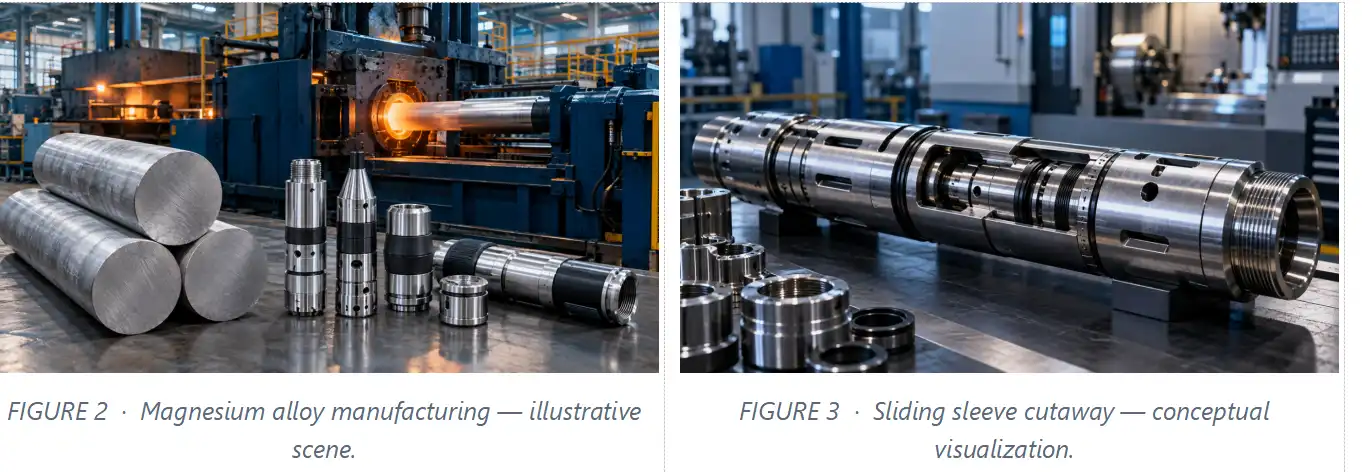
In many multi-stage fracture projects, cast-iron plugs have been replaced with dissolved bridge plugs made from engineered magnesium alloys. Once the frac stage is over, the plug dissolves in the brine without the need for coiled tubing. This cuts down on well costs by getting rid of the need to dig out. HAGRIEN's dissolvable bridge plug assemblies are made from magnesium alloy billets that are extruded on 3,600-ton and 5,600-ton presses. The rates at which they dissolve are adjusted to match the temperature, salinity, and fluid chemistry windows in the well.
Sliding Sleeves and Safety Valves
With sliding sleeves, you can turn on a zone from a distance without using wires or coiled tubing. Keyless multi-stage sleeve systems let operators use shifting tools that are matched to specific profiles to open or close certain zones. API 14A says that subsurface safety valves (SSSVs) must close themselves in case of an emergency. This means that material integrity and functional testing are required for this category.
By knowing about these types of tools, procurement teams can make accurate bill-of-materials frameworks and avoid making mistakes in the specifications that require expensive replacements on-site.
Evaluating and Comparing Completion Tools: A Procurement Perspective
Performance Reliability and Certification Standards
Certification is the first thing that you should look at when looking at any downhole tool or material source. ISO 9001 is about managing quality, ISO 14001 is about managing the environment, and ISO 45001 is about managing health and safety at work. When a producer registers with API Spec Q1, it means that their quality system meets the unique needs of oil and gas equipment. Accreditation by the CNAS, which is needed for in-house HTHP testing, makes sure that test results are checked by a third party. All of these qualifications belong to HAGRIEN, and every package comes with COA/COC paperwork that can be tracked.

Lifecycle Cost and Supplier Consolidation
The price you pay is only one input. When purchasing tools, teams that look at the total cost of ownership—which includes costs for field intervention when a tool breaks, re-inspection costs for retrievable tools, and expediting premiums for emergency resupply—always choose suppliers that offer coverage for materials, parts, and assembled tools from a single source. Getting all of your finishing tools and materials from one source cuts down on interface risk and makes getting ready for an audit a lot easier.
Quotation Package Standardization
Material certification, process routing, an inspection plan, Incoterms, and payment terms should all be part of a standard quote package. When sellers can't give you this package when you ask for it, document gaps can cause problems during operator checks. Within one to three business days, HAGRIEN gives an organized RFQ answer that includes the alloy standard, machining tolerances, testing scope, and delivery schedule. This cuts down on the back-and-forth that usually makes procurement cycles longer.
These review factors help procurement teams move from reactive sourcing to a process that they can defend and use again and again to qualify suppliers.
Best Practices for Tool Adjustment, Maintenance, and Performance Optimization
Calibration and Installation Protocols
Before being used in a hole, completion tools must be tested and calibrated. This includes checking the torque on threaded connections, the hydrostatic strength of packer elements at 1.5 times their rated working pressure, and the condition of the elastomers. Skipping these steps because of time constraints has been shown to cause things to fail early in the field.
Preventive Inspection and Failure Mode Awareness
After a full breakdown, rubber replacement, and re-certification to original API standards, retrievable packers can be run again. Ultrasonic testing (UT) and magnetic particle inspection (MPI) are routine checks that find flaws in forged parts below the surface before they cause problems downhole. Failure modes can be tracked by tool type and run history. This builds institutional knowledge that lowers the chance of failures happening again.
Digital Monitoring and Predictive Maintenance
Intelligent completion systems have sensors that stay in the ground and hydraulic or electric valves that are controlled from the surface. This lets the reservoir be managed in real time without using wirelines. Smart completion design isn't necessary for every well, but the data from instrumented wells helps plan future repair schedules and tool choices. Systematic run-life tracking linked to finishing tool serial numbers is useful for even regular programs.
The value of capital equipment is protected by good upkeep, and unexpected well interventions happen less often.
Strategic Procurement Considerations and Future Trends in Completion Tools
Total Cost of Ownership and Supplier Development
The total cost of ownership models that strategic buying teams make don't just look at unit cost; they also take into account the risk of supply failure. One of the most common procurement risks in deepwater and HPHT projects is a single-point supply failure, which happens when a problem with one vendor's capacity delays the whole completion schedule. It makes sense to use more than one source for common things and only one source for designed tools. Over time, supply chains become more stable when they have annual audits, 8D corrective action closeouts, and joint technical reviews as part of supplier development programs.
Dissolvable and Smart Completion Technologies
The move toward dissolvable frac plugs is part of a larger trend to lower the cost of involvement by making tools that can be used over and over again. In known cases from the Permian Basin, magnesium alloy systems that dissolve reliably in created brine have cut the cost of coiled tubing on horizontal wells with multiple stages by 15 to 25 percent. In offshore areas where it's too expensive to get involved, smart finishing tools with electric inflow control valves are becoming more popular.
Regulatory Alignment and Sustainability Requirements
As a part of the prequalification process, operators in the U.S., the Middle East, and Southeast Asia are asking providers to show that they comply with ISO 14001 for environmental management and ISO 45001 for safety systems. Sustainability data that is linked to the supply chain is also becoming a requirement for big IOCs when they buy things. The buyer's compliance risk is lower if they choose providers with well-established health, safety, and environmental systems and safety production licenses that can be proven.
Teams can judge sellers based on the total value of the program, not just price, if their procurement plans take these trends into account.
Conclusion
Choosing and managing completion tools is both a technical and a business skill. To do this, you need to know the different kinds of tools and how well they can do their job, set up a way to make sure that suppliers are qualified based on credentials and paperwork, and plan for total cost instead of purchase price. The best way to lower the risk of a project is to work with fewer suppliers who can do everything, from making the alloy and extruding it to precision machining, assembly, and testing that has been approved by HTHP. This integration gets rid of the pointing of fingers that comes from having separate supply chains and gives procurement teams the paperwork they need to be ready for audits.
FAQ
1. What is the difference between a V0 and V3 rated completion tool?
For high-risk gas wells, V0 means a gas-tight seal with no bubbles allowed during ISO 14310 testing. V3 is a standard for liquid-tightness that lets some pressure drops happen. V0 is the stricter requirement, and most HPHT packer uses need to meet it.
2. How are completion tools selected for sour service?
The selection process uses NACE MR0175/ISO 15156, and materials are tested for their ability to resist sulfur stress cracking (SSC) and chloride stress corrosion cracking (SCC). It's just as important to choose the right elastomer: NBR for normal conditions, FKM or Aflas for harsh chemical and high-temperature settings.
3. What is a dissolvable completion tool?
When their job is done, dissolveable tools, which are usually bridge plugs made from designed magnesium alloys, break down in generated brine. This gets rid of the need for coiled tubing drill-outs, which cuts down on the time and money needed to finish a well.
4. Can retrievable packers be reused?
Yes, retrievable packers can be put back into service after being completely disassembled, having the rubber replaced, and being re-certified to the original API standards. This process is made possible by run-life tracking and serial number identification.
5. How does API Spec Q1 differ from ISO 9001 for completion tool suppliers?
The ISO 9001 standard is for quality control in general. API Spec Q1 is the stricter standard for companies that make downhole tools because it includes requirements related to oil and gas, such as design validation, product realization controls, and customer notice of nonconformances.
Partner with HAGRIEN for Verified Completion Tools Supply
HAGRIEN makes a wide range of completion tools and dissolvable magnesium alloy parts. These are backed by API approval, ISO 9001/14001/45001 certification, and HTHP lab testing that is recognized by the CNAS. Every batch that ships comes with a COA or COC and can be fully tracked. Standard lead times are two to four weeks, but for important projects, you can get them faster. As a reliable company that makes finishing tools and can coordinate with other companies in the U.S., we can support OEM/ODM programs and delivery schedules that are based on projects. Contact the HAGRIEN team at cyrus@us-hagrien.com or go to us-hagrien.com to ask for a basic quote package.
References
1. Society of Petroleum Engineers. SPE-214983: Completion Tool Performance and Non-Productive Time Analysis in Unconventional Wells. SPE Journal, 2023.
2. American Petroleum Institute. API Spec Q1: Specification for Quality Management System Requirements for Manufacturing Organizations for the Petroleum and Natural Gas Industry. 9th Edition, 2013 (reaffirmed 2018).
3. American Petroleum Institute. API 14A: Specification for Subsurface Safety Valve Equipment. 12th Edition, 2015.
4. NACE International / ISO. NACE MR0175/ISO 15156: Petroleum and Natural Gas Industries—Materials for Use in H₂S-Containing Environments in Oil and Gas Production. 2015.
5. ISO. ISO 14310: Petroleum and Natural Gas Industries—Downhole Equipment—Packers and Bridge Plugs. 2008.
6. World Oil. Dissolvable Frac Plug Technology: Field Performance Review and Cost Impact in Permian Basin Multi-Stage Completions. World Oil Magazine, 2022.

USER EVALUATE
Here is the customer's evaluation of us