




How Does a Key-Activated Sliding Sleeve Enable Selective Activation?
A key-activated sliding sleeve enables selective activation by using a matching key and sleeve profile to identify the intended stage. Upon engaging the key with the target sleeve, the activation mechanism moves the sleeve to expose the flow ports. The remaining sleeves are expected to stay closed, as long as their profiles, sealing arrangements and working circumstances are as planned. HAGRIEN provides key actuated sliding sleeves for placement with the casing string instead of typical wireline stage initiation and perforating guns. This article outlines the selection process, the technical tests you need to do before you can deploy, how to assess an opening event and what evidence you should need when comparing providers.
Reservoir characteristics and reaction to treatment in multistage horizontal wells might vary along the lateral. The design of the completion must consider these variances and at the same time provide the needed stage isolation and pressure integrity. This allows the engineers another method to organize the stage sequence. The efficacy of the selective activation strategy relies upon the full completion design and operating procedure.
How a Key-Activated Sliding Sleeve Works?
Core Components and Their Roles
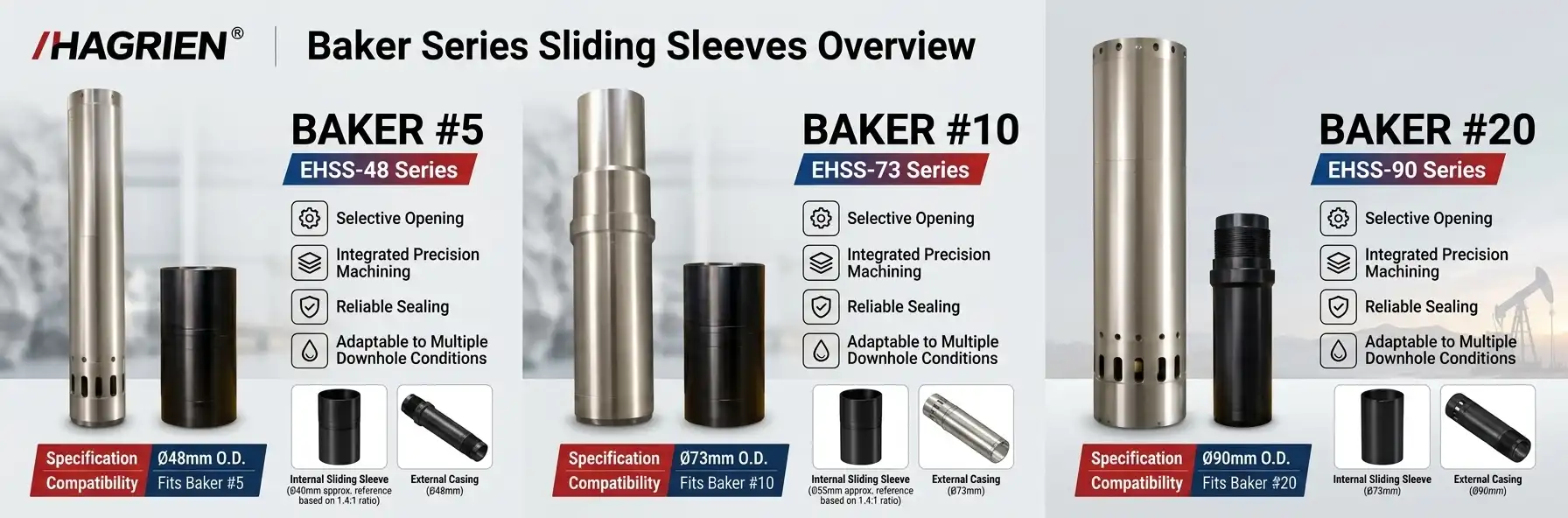
A key-activated sliding sleeve is a downhole flow-control device that is put in a completion string. Depending on the design, it comprises an outer housing, an inner sliding sleeve, sealing elements, flow apertures, and a profile to contact the activation key.
The housing provides the link between the tool and the surrounding completion string. Access to the flow ports is controlled by the sliding sleeve. Seals manage the fluid communication with the design requirements. The activation profile is the mechanical interface used to choose the desired sleeve.
The items differ in size, connections, pressure and temperature ratings, and activation methods. Similar product names may not mean the same working principles or interchangeable components. Before you compare prices ask for the technical design, the operating instructions and a thorough explanation of how the key engages and moves the prescribed sleeve.
These papers should also include the planned operational limitations and requirements for integration of the sleeve with the nearby finishing equipment. From this information, we decide whether a suggested configuration is appropriate for the target well.
Profile Matching Is the Selection Step
Activation is selective, depending on the link between the activation key and sleeve profile. Where the design allows the key to slide through non-target sleeves the key travels along the completion until it meets the intended profile. The activation mechanism then moves the target sleeve to reveal its flow ports.
The precise interaction and changing sequence is a matter of product design. The word “key activated” is too generic and should not be taken for granted. The confirmation should be done by the manufacturer’s drawings, operating instructions and necessary validation documents.
HAGRIEN's key-activated sliding sleeve approach allows the intended sleeve to be selected through the corresponding key and profile arrangement. This can provide flexibility in planning the stage sequence without relying on a conventional sequence of graduated ball seats. The practical stage count and permitted activation sequence remain subject to the completion design, tool configuration, and operating requirements.
To reduce configuration errors, prepare a stage-selection table before mobilization. Record each sleeve's planned depth, corresponding key or profile identification, intended activation order, and verification requirements. Review the table against the completion drawings and approved job program before deployment.
 Confirming an Opening Event
It takes more than watching one surface reaction to confirm a sleeve has opened. Changes in pumping pressure, injection rate, and other accessible operational data may be informative, but their importance relies upon the treatment settings and the particular activation mechanism.
Prior to the task, outline the anticipated reaction and the criteria for acceptance of an opening event. These requirements should be provided by the manufacturer’s documentation, engineering evaluation and authorized operating procedure. The evaluation may integrate surface data with other relevant information, if appropriate, rather than relying on one signal in isolation.
HAGRIEN product information shows a seven-step operating process and gives pressure-holding reference data. These resources may be used to assist a preliminary technical evaluation. Their applicability is dependent upon the tested configuration, circumstances and acceptance criteria. Pressure-holding data do not provide any grounds to believe that successful activation has occurred in another well.
If the answer is not as anticipated (or confusing) use the authorized contingency process. Don’t jump to the conclusion that an increase or reduction in pressure proves any kind of mechanical condition without proof. Record the observed reaction and activities performed so the outcome may be examined after the work.
Selective Activation in Fracturing Programs
Non-Sequential Stage Planning
Reservoir conditions may change laterally on a horizontal scale. Differences in rock characteristics, spontaneous cracks, stress conditions and prior stimulation might affect how engineers arrange the treatment process. If the design of the completion allows the stages to be opened in a planned order rather than a predefined sequence then a selective activation mechanism may provide flexibility.
But just picking a sleeve alone does not guaranty that a certain interval will be broken efficiently or separated from other intervals. The proposed sequence must be in accordance with the completion architecture, pressure conditions, isolations and authorized treatment program.
Before deployment, create a stage table that maps each interval to its corresponding sleeve, activation key, scheduled sequence, and verification requirements. Verify the sequence with the engineering and field teams to ensure consistency between the physical setup and the operational instructions.
In addition to the reaction to a failed or uncertain activation, the pre-job evaluation also must consider the response to an unsuccessful or uncertain activation. The right contingency relies on the instrument used and the circumstances in the well, thus it should be pre-planned, not improvised in the field.
Installed With the Casing, No Wireline or Guns
The HAGRIEN key-activated sleeves are intended for installation along with the casing string. The matching-key system in compatible completion designs may enable opening of individual stages without traditional wireline lines or perforating guns for stage start. The actual operation sequence of the specified configuration should be checked.
Because the stage selection does not rely on a graded succession of ball seats, the design may overcome the unique stage-count limitation of this technique. This does not imply that the completion is not limited in practical stage. Tool size, stage spacing, activation requirements, pressure ratings and overall finishing design have still to be decided.
The design goal of the full-bore arrangement is to have enough internal clearance when it is activated. Check actual minimum drift diameter and any other constraints against product designs and appropriate inspection documents.
HAGRIEN also offers magnesium alloy materials that may be dissolved for downhole applications that are suitable. The isolation performance and dissolving behavior of dissolvable sealing elements built into the completion must be examined according to the actual material, shape, temperature, salinity and fluid chemistry. The compatibility with a dissolvable element is not to be understood as an assurance of a certain isolation period or a particular time of dissolution.
Where the Sleeve Fits Best
A key-activated sliding sleeve would be a strong candidate for examination in horizontal shale wells and other unconventional completions where selective stage activation is a critical design factor, such as multistage fracturing. Other possible applications include toe-stage start, selective re-fracturing operations, and extended-reach wells provided the suggested design meets the parameters pertaining to operation and isolation.
The suitability of the sleeve depends on the well design and operating conditions. These include casing size, number of stages, pressure and temperature, treatment fluids, proppant exposure, required isolation and planned intervention mode.
The effect of removing certain intervention stages in the case of long laterals should be examined based on the actual operating sequence and available project data. In case of re-fracturing, the proposed activation strategy should also include the state of the existing completion and access to the targeted intervals.
Deepwater and other specialized applications require separate engineering assessment. Experience in one type of well does not establish suitability for another with different pressure, temperature, fluid, or intervention requirements. Treat the key-activated sliding sleeve as a completion design option whose fit must be established for each application.
Operating Procedure and Field Verification
Pre-Job Engineering Checks
Check sleeve dimensions, connection type, activation profiles, pressure and temperature ratings, material compatibility and intended activation sequence against the well design before deployment. Make sure the stage-selection table matches the components being installed. Activation technique must be according to manufacturer's specifications.
Consider the risk of choosing the incorrect key, accidental engagement, failure to shift, and ambiguous activation signals. Preventive measures or operational controls must be designed according to the actual design of the instrument and shall be noted in the permitted work program.
The amount of validation should be commensurate with the demands and risk of the project. This may include dimensional inspection, review of material documentation, testing with representative fluids when appropriate, bench validation and a controlled field trial. Each test will be based on the operators procedures and evidence available and the timeframe for approval.
Note the sleeve identification, the target depth, the key or profile it relates to and what you think the response will be. Any discrepancies between the completion drawing and the stage plan will be rectified before mobilization.
Casing, Cementing, and Pressure-Test Compatibility
HAGRIEN's key-activated sleeves are meant to be run with the casing string and compatibility should be checked throughout the appropriate installation and operation stages. The size of the casing, the connections, the requirements for cementing, the pressure tests and the maximum expected treatment conditions must be examined.
Check pressure limits for sleeve, casing, seals, fittings and adjoining tools. Casing test pressure, sleeve activation requirement and fracturing treatment pressure are different operating conditions and should not be confused with one another. The permitted procedure must define the limits imposed on each step of the operation.
It is vital to ensure that the required drift clearance is provided. Also that the activation profile and flow ports are protected from any conditions that might impact their intended performance. If cementing fluids or other materials might affect the tool, request installation instructions and compatibility information unique to the setup.
The final assessment should demonstrate that the sleeve is compatible with the whole casing and completion program, not only that its nominal dimensions match the casing size.
Post-Job Review
Review the operational record for each step after fracturing job. Record desired activation sequence, pressure and rate responses, how this was verified, treatment outcomes and any variations from the authorized program.
Where components are recoverable and examination is acceptable, examine for obvious wear, erosion, damage or debris. All results should be interpreted according to the component design, exposure and operation history.
Compare the findings with the expectations you had before the work and uncover uncertainties that remain unsolved. If it is unclear if the sleeve is opened or closed, do not report it as a successful activation if the outcome is not verifiable.
Having a consistent record of what was done post-job allows engineers to compare settings across wells and helps decide whether further validation is required. Where there are few similar field references, the initial experiment should have a well-defined data-collection strategy and acceptability criteria.
Advantages, Limitations, and Alternatives
What the Design Does Well
The primary potential benefits of a key operated sliding sleeve are selective stage actuation and an alternative to standard graded ball-seat stage selection. The strategy may decrease the need for wireline runs and perforating guns for stage start and allow the freedom to arrange the activation sequence in compatible systems.
It is also possible that a full-bore layout will provide for internal clearance for later operations, providing the actual minimum drift diameter is sufficient for the proposed tools and the remainder of the completion. Where dissolvable sealing components are utilized they may offer temporary isolation as part of the overall completion design – provided that material and operating-condition validation is carried out.
These qualities might be valuable in programs where stage count, intervention needs and subsequent well access affect the completion choice. Values should not be taken at face value from the product description but should be judged against the whole operating sequence, proven technical performance and well-specific needs.
Limits to Plan For
A key-activated sliding sleeve remains a mechanical system whose performance depends on the design, installation, and operating environment. Debris, scale, sand, proppant exposure, erosion, and repeated cycling may affect the shifting profile or sealing elements, depending on the configuration and conditions.
A high pressure rating is not enough to make a well acceptable. The same is true for a low price on a purchase or a general claim of competence in the subject. Before adopting configuration, review acceptable pressure and temperature constraints, material compatibility, activation procedure and test evidence.
If the application is of significant uncertainty, employ representative bench testing and a controlled field trial that meets the operator's validation standards. The test plan should define what is being tested, how success will be judged, and what the data does and does not show.
Real world results for the precise arrangement are not as solid a basis for selection as general marketing claims.
Compared With Other Completion Options
Ball-drop sleeves commonly use graduated ball seats to select stages. This approach can impose stage-count and internal-clearance constraints associated with the seat sequence. A key-activated sliding sleeve instead uses a matching key and profile, avoiding dependence on that particular selection mechanism.
Plug-and-perf commonly starts with using wireline supplied plugs and perforating guns. It is still a relevant choice, the applicability of which depends on the well design, operational demands and intervention resources available.
Hydraulic sliding sleeves are pressure-triggered devices that use applied hydraulic pressure to initiate sleeve movement. Depending on the architecture, intelligent completion systems may offer additional monitoring or control functions. The solutions differ in complexity, control capabilities, installation requirements and operating procedures.
The comparison should cover: stage number, internal cleaning, isolation, activation dependability, pressure & temperature conditions, solids exposure, intervention demands, production objectives. Don’t assume that one strategy is always better than another, or that cost differences can be established without project-specific information.
 Selecting and Qualifying a Supplier
Build the Selection Criteria
Define the desired application such as initial fracturing, re-fracturing or other completion operation. Determine casing and tubing dimensions, required drift clearance, type of connection, pressure and temperature conditions, material specifications and activation sequence.
Verify the mechanism used by the supplier to identify each sleeve, to control the key-to-profile match and to confirm the operating limits suitable for the application. Check the proposed configuration against the whole completion string for compatibility, and ensure that the available technical documentation applies to the intended application.
Unit price has to be considered alongside lifecycle cost. Think about engineering, validation, freight, installation help, intervention needed, spare parts and any maintenance work if necessary. Support your estimates with genuine quotations and documented project assumptions, not with unsupported savings claims.
The supplier’s proposal must include the configuration being offered, how it works and limits, supporting evidence available and unresolved requirements. This enables for easier comparison of suppliers on both technical and economic grounds.
Evidence to Request
Ask for drawings, datasheets, appropriate material certifications, pressure-test records, inspection processes and traceability documentation for the precise configuration being quoted. The paperwork should include the type and size, materials, connectors and operating conditions.
Establish acceptance criteria prior to production or qualification testing. Checks may include dimensional inspection, thread verification, pressure testing, seal assessment, key engagement, and functional shifting tests, as suitable to the design and application. Not all tests are applicable to all configurations thus a scope should be set against product design and project objectives.
If engineering calculations are required, specify the scope and assumptions. Examples include evaluation of pressure loads or forces to shift, as long as the analyses are related to the actual activation mechanism.
Compare the observed activation behavior, pressure response and available component inspection findings after a field experiment with the specified acceptance criteria. Evidence of intended usage for each configuration must be available; generic product brochures do not replace configuration specific documentation.
What HAGRIEN Provides
HAGRIEN terms its quality methods as closed-loop quality control, CNAS approved testing, and batch traceability. The business also touts its in-house alloy melting, extrusion and precision machining capabilities for applicable material and downhole-tool uses.
It says it can provide COA and COC documentation, application engineering, remote troubleshooting, and OEM or ODM engineering-to-specification services. Confirm exactly what paperwork and support will be available for the proposed product and project.
For a customized key-activated sliding sleeve, the initial technical review should establish the well parameters, dimensional requirements, activation method, and applicable validation scope. These inputs help determine the specification that can be evaluated and quoted.
HAGRIEN also states that its U.S. entity coordinates North American projects and that EXW, FOB, and CIF trade terms are available. Confirm the applicable contracting entity, delivery arrangements, documentation, and commercial conditions for the specific order.
Before approving a supplier, verify any relevant certifications, testing capabilities, and service commitments against the applicable documentation and project requirements.
Conclusion
A key-activated sliding sleeve enables selective activation through a matching key and sleeve profile. This approach can provide flexibility in stage planning without relying on a conventional graduated ball-seat sequence, while a compatible full-bore configuration may help preserve internal clearance after activation.
Successful operation depends on more than the matching mechanism. Engineers must verify the sleeve configuration, casing and cementing compatibility, pressure limits, isolation requirements, and the criteria used to confirm an opening event. Surface pressure and rate responses can support the assessment but should be interpreted under the approved operating procedure.
When comparing key-activated sleeves with ball-drop, plug-and-perf, hydraulic, or intelligent completion options, evaluate the complete system against the well's requirements. Configuration-specific drawings, test records, traceability, and a defined validation plan provide a sounder basis for supplier selection than broad performance claims.
FAQ
1. Can a key-activated sliding sleeve open stages out of order?
A key-activated design can allow selective stage activation when the sleeve profiles, keys, and completion architecture support the planned sequence. Confirm the permitted sequence and any operating restrictions in the manufacturer's documentation, then record the intended order in the approved job program.
2. Does the system need wireline or perforating guns?
HAGRIEN's key-activated sleeve design is intended to allow stage initiation without conventional wireline runs or perforating guns for that activation step. Confirm the complete operating sequence and any additional equipment requirements for the specific completion configuration.
3. How do I know a sleeve opened?
Use the verification criteria established before the job. Pumping pressure, injection rate, and other available operating measurements may help assess the response, but no single signal should be treated as conclusive unless the approved procedure identifies it as a validated indicator. Follow the specified contingency procedure if the result remains uncertain.
4. What does HAGRIEN need to quote?
Provide the casing and tubing dimensions, connection specifications, pressure and temperature conditions, planned stage count, sleeve depths, activation sequence, application details, and delivery location. Include relevant isolation requirements and fluid conditions where dissolvable elements are part of the proposed design. HAGRIEN can then review the available configuration and identify any additional information needed for a quotation.
Request a Key-Activated Sliding Sleeve Quote From HAGRIEN
To begin a technical review, send your casing and tubing specifications, pressure and temperature range, planned stage count, sleeve depths, activation requirements, and delivery location to cyrus@us-hagrien.com.
HAGRIEN states that it confirms requirements within 24 hours and provides a quotation and delivery plan within one to three business days. Confirm the applicable timeline for your specific project, particularly if customized engineering or additional testing is required.
Providing the relevant drawings and operating conditions at the outset helps establish whether the proposed key-activated sliding sleeve configuration is compatible with your completion design. Visit us-hagrien.com for additional product information.
References
Reservoir Stimulation, 2000.
Well Completion Design, 2009.
Petroleum Engineering Handbook, Volume IV: Production Operations Engineering, 2007.
Unified Fracture Design, 2002.
ISO 14998, Petroleum and Natural Gas Industries — Downhole Equipment — Completion Accessories, subject to verification of the applicable edition and scope.
U.S. Energy Information Administration (EIA), Today in Energy, 2016. The specific article title, publication date, and URL must be identified and verified before this reference is used to support a factual claim.

USER EVALUATE
Here is the customer's evaluation of us