




Full-Bore Sliding Sleeve for Shale Wells: Key Benefits
A full-bore sliding sleeve is designed to preserve internal clearance after activation, helping maintain access for production, logging, and later well interventions. In shale wells, this design can be valuable when the completion must support both multi-stage fracturing and subsequent operations. HAGRIEN supplies key-activated sleeves that enable selective opening of stages without the need for traditional wireline-based stage initiation or perforating guns. Performance will be based on actual tool set up, completion architecture and well conditions. This article examines the design, potential benefits, technical criteria and supplier inspections that are required by finishing and production teams when selecting a system.
 What Is a Full-Bore Sliding Sleeve?
Basic Design and Function
A full-bore sliding sleeve is a downhole completion component installed as part of the completion string. It consists of an outer housing, an inner sliding sleeve, sealing elements, a shifting profile and connections to adjoining tubular components, depending on design.
The closed position of the sleeve is designed to control communication between the well bore and the specified interval. The sleeve is activated to move to expose flow ports. The resulting flow route and isolation performance is determined by the sleeve design, sealing arrangement, pressure conditions and installation quality.
Full-bore is a design that is intended to provide a somewhat unrestricted internal passageway when activated. It does not mean that all completions have the same internal diameter or that there is no constraint anywhere in the completion. Minimum diameter of the drift, dimensions and internal profile of the connection should be verified by the buyer against applicable product designs and inspection records.
How HAGRIEN Key-Activated Sleeves Work
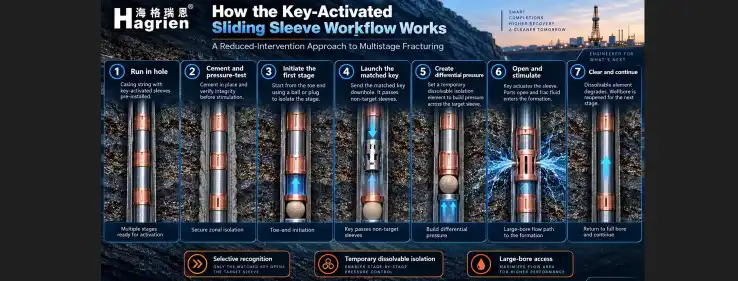
The key-activated sliding sleeves of HAGRIEN use a corresponding key to select and move the required sleeve in the completion string. This activation approach doesn't require a sequence of ever larger ball seats. Depending on the system set up it may reduce wireline runs and perforating weapons when stage starts.
The complete design must describe the identification, activation and confirmation of each sleeve. Before putting the selected assembly into service, check the shifting profile, the connection compatibility, the internal dimensions, the sealing arrangement and the operating constraints.
A keyed actuated design might go beyond the standard graded ball-seat system stage count restriction. However, the ultimate number of stages is dependent on the finishing architecture, tool dimensions, operating techniques and project demands.
HAGRIEN also develops magnesium alloy materials that are dissolvable and might be used in appropriate downhole components. If dissolvable sealing elements are used, the function and expected behavior should be evaluated apart from the mechanical activation mechanism of the sleeve. The rate of dissolution depends on the material composition, the geometry of the component, temperature, salinity and the chemistry of the fluid. Testing and associated material data are necessary to show that the predicted dissolution window meets the well specifications.
Why the Bore Matters After the Frac
The sliding sleeve should be reviewed not only for its performance during stimulation but also for its effect on subsequent well operations. The internal cleaning of the completion after the fracture may interfere with the passage of production logging tools, clean out equipment and other intervention tools.
A tool's outside diameter or its operating requirements can exceed the available clearance and so restrict entry via a small hole. Therefore, designing in an adequate internal diameter can help maintain compatibility with the rest of the completion and preserve operational possibilities after frac.
The access need will vary depending on whether you are undertaking production logging, water-control operations, casing inspection or re-entry. A clear passage through the sleeve does not indicate all procedures can be done. Consideration should also be given to the well trajectory, tool size, connections, other downhole components and the selected intervention technique.
Therefore, the internal profile should be compared with the expected lifespan of the well. If you know you’re designing for completion, assessing the required drift diameter will help you discover potential access constraints before running in with the equipment.
Why Full-Bore Sliding Sleeves Are Valuable in Shale Wells
A Cleaner Step from Frac to Production
Plug-and-perf completions commonly use plugs and perforating guns to isolate and initiate successive stages. Depending on the selected plugs and completion design, restoring access after fracturing may require milling, dissolution, or other remedial operations.
A key-activated full-bore sliding sleeve uses a different stage-selection mechanism. Where the design is compatible with the well, it can reduce reliance on repeated wireline-based stage initiation and avoid the need to mill the sleeve itself. This may simplify the transition from fracturing to production.
The entire advantage, however, relies upon the whole finishing system. Other plugs, interim isolation devices or leftover material may still have to be removed or evaluated. Any stated time or cost savings should be evaluated based on the actual stage sequence, post-fracturing work scope and operational data.
When evaluating completion techniques consider the overall time from the last treatment to production ready, rather than assuming the sleeve design is the deciding factor.
Access for Logging, Cleanout, and Re-Entry
Production logging, cleanout, and re-entry operations require sufficient internal clearance throughout the wellbore. A full-bore sliding sleeve can help preserve access where its minimum drift diameter is compatible with the selected tools and the dimensions of the surrounding completion.
Before accepting a design, verify the confirmed drift diameter to the outside diameter and clearance requirements of the logging tools, cleanout assemblies and intervention equipment to be used. Also consider limits at connectors, packers and other completion components and changes in well path.
Future activities may involve water control work, casing inspection, or sidetrack work. These approaches may be supported by the maintenance of acceptable access but their viability also relies on well integrity, reservoir conditions and the equipment and techniques employed at the time of intervention.
The practical advantage of a full-bore design is not just the open bore; it is whether the validated internal profile can satisfy the access criteria set for the estimated operational lifetime of the well.
Managing Residue and Dissolution Questions
If the completion contains dissolvable materials, consider the treatment of the remaining residue. The key questions include what dissolves, what products or remaining materials may be present, how long dissolution takes, and whether the conditions are conducive to future operations.
A full-bore sliding sleeve isn’t going to address all residual concerns. If dissolvable sealing elements are used, their behavior depends on the alloy or other material, the form of the component, temperature, salinity and chemistry of the fluid. Other soluble constituents in the completion may cause further problems.
HAGRIEN can handle the material evaluation requirements for a certain application. HAGRIEN manufactures dissolvable magnesium alloy materials. Before you choose a material, get the required data on dissolution, mechanical properties and test conditions. If residue has the potential to influence downstream equipment or future well operations, define the acceptable criteria and appropriate validation procedure up front.
Testing should be as close as practicable to the application for which it is intended. Data acquired under different temperature, fluid or material parameters should not be considered to predict performance in the target well.
Full-Bore Sliding Sleeve Applications and Comparisons
Where the Sleeve Fits Best
A full-bore sliding sleeve may be suitable for multi-stage fracturing in horizontal shale wells and other unconventional completions that need selected stage activation and later internal access. Potential applications include toe-stage initiation, select re-fracturing programs and extended-reach wells, if the activation method and isolation requirements are congruent with the proposed design.
When deciding whether a system is right, the whole well design must be looked at. Relevant issues include casing size, stage spacing, pressure and temperature conditions, treatment fluids, proppant exposure, required zonal isolation and planned intervention technique.
For high pressure, high temperature, erosion prone or chemically hostile circumstances, collect configuration specific operating constraints and validation records prior to making a choice. A design may have worked well for one application but it does not ensure that it would be suitable for another under different conditions.
The finishing system engineering needs to make sure that the string is compatible with packers, connections, stage layout and the neighboring equipment before it is finalized. In this assessment a distinction is made between conceivable applications and those that have product evidence available.
Compared with Plug-and-Perf
Generally, wireline setting a plug and perforating guns to commence each step is referred to as plug-and-perf. Repeating these activities across a long lateral might increase equipment needs, coordination and operating time. The plug design may need further labor to regain access once it has been fractured.
A full-bore sliding sleeve moves stage selection into the completion string. In a suitable key-activated system, the operators may pick specific sleeves, instead of a standard perforating-gun sequence. This strategy may result in a reduced number of intervention stages, but the real operational advantage relies on the final design and the work that must be done before production.
Plug and perf is still a viable solution if its operational flexibility and established processes meet the needs of the well. Thus, the comparison should include number of stages, trajectory, isolation requirements, intervention requirements, availability of equipment and overall operational cost.
Don't assume one technique is always superior. Analyze real data from the whole stage cycle, post-fracturing activities and production access. This gives a more solid foundation for the choice of a finishing technique.
Compared with Ball-Drop Sleeves
Ball-drop sleeves often select subsequent stages through the use of graded ball seats. Due to the usage of varied size seats throughout the completion, the interior profile might taper toward the toe. The amount of this constraint and its impact on the number of stages is dependent on system design.
A key-activated full-bore sliding sleeve employs a matched key and changing profile in place of a series of graduated ball seats. This removes the unique stage-selection limitation of that seat sequence, but other design and operational constraints remain.
Compare the two methods and ask for the minimal drift diameter at the most restricted place in the constructed completion. Also check the activation mechanism, pressure limitations, sealing performance and compatibility with the intended equipment for treatment and intervention.
The most meaningful comparison is between the whole configurations, not simply the nominal sleeve sizes. Check each design against the required number of stages, pressure and temperature conditions, isolation needs and future access to the well.
Technical Specifications and Testing to Review Before Selection
Core Dimensions and Ratings
Start with the specifications that determine whether the tool can be integrated into the well. For a full-bore sliding sleeve, these generally include nominal size, minimum drift diameter, connection type, applicable working and test pressure, differential-pressure limits, temperature range, and activation requirements.
These options are particular to the setup. Nominal casing size alone does not determine the internal clearance and the test pressure should not be assumed to represent the operating pressure rating unless the necessary documentation supports that assumption.
Refer to the product design, operating instructions and appropriate test records for the specific configuration in question. Check dimensions are compatible with the casing, neighboring tools and planned intervention equipment.
Fluid compatibility is another issue. Material and seal selection may be subject to CO 2 , H 2 S , chlorides, acids and other chemically hostile conditions depending on concentration, temperature, pressure and exposure. Proppant-laden fluids may potentially impact ports and other exposed surfaces. Compare these circumstances to the manufacturer's specified limitations.
If the application requires API 6A or another industry standard, first verify the standard relates to the product and service in issue. Don’t just take the company’s word for it, ask for the required credentials and test results.
Materials, Seals, and Dissolvable Elements
Material selection should be representative for the desired downhole environment and function of each component. Mechanical properties, corrosion resistance, seal compatibility, temperature exposure, differential pressure and any required dissolving action should all be considered.
HAGRIEN has manufacturing facilities for alloy melting, metallurgy control, extrusion and precision machining. The company says it uses 3,600-ton and 5,600-ton presses and produces extruded rods and billets of dissolvable magnesium alloy, up to Ø300mm.
The abilities provide a framework for material manufacturing but do not in themselves determine the performance of a finished sliding sleeve or its sealing system. Buyers should establish the materials and manufacturing techniques applicable to the configuration they want to purchase, and get the proper inspection and test reports.
If a dissolvable-containing completion is used, evaluate relevant material requirements, component geometry, mechanical-property data, and dissolution results. Test conditions should be representative of the predicted well environment to support the engineering decision.
Also important is identification and traceability of batch. Verify that submitted components can be tracked to the appropriate material records and inspection results.
Testing, Traceability, and Documentation
Supplier documentation should establish what was tested, which configuration was evaluated, and whether the evidence applies to the intended service conditions. HAGRIEN describes its quality processes as including closed-loop quality control, CNAS-accredited testing, and batch traceability. The company also states that it holds ISO 9001, ISO 14001, and ISO 45001 certifications.
Verify the relevant certificates, issuing bodies, validity periods, and scopes. Laboratory accreditation, management-system certification, and product-level qualification are different types of evidence and should be reviewed separately.
Documents available on request may include a certificate of analysis (COA), certificate of conformity (COC), safety data sheet (SDS), and inspection records. Confirm which documents apply to the specific product and batch, and whether additional testing is required by the operator's specifications.
A structured evaluation may include technical document review, dimensional inspection, bench testing, sample validation, and a field trial where appropriate. The required stages and approval timeline depend on the operator's procedures, project risk, and validation scope.
Maintaining traceable records throughout this process helps the engineering and procurement teams compare results, investigate deviations, and establish whether the evidence supports adoption of the selected configuration.
Choosing a Supplier and Avoiding Common Risks
Build Your Selection Criteria
Begin with the well requirements: trajectory, stage count, casing dimensions, pressure, temperature, fluid chemistry, isolation requirements, intervention plan, and anticipated service life. These factors establish the technical basis for evaluating a full-bore sliding sleeve.
Next, compare the minimum drift diameter, activation mechanism, materials, sealing arrangement, port design, connections, operating limits, and available validation records. Review manufacturing capability, relevant field experience, traceability, engineering support, delivery terms, and the supplier's ability to address configuration-specific requirements.
Lifecycle cost should be assessed alongside the purchase price. Potential costs may include installation, activation, treatment operations, remedial work, subsequent interventions, and any restrictions on future access. Use project-specific estimates or documented operating records where possible.
A lower unit price does not establish lower lifecycle cost, just as a larger nominal bore does not prove better access. The preferred supplier should provide sufficient technical evidence for the proposed application and identify any limitations that require further review.
Common Risks to Watch
Several issues deserve attention during technical and procurement reviews.
First, selecting a tool by nominal size alone can overlook restrictions in the actual internal profile. Verify the minimum drift diameter and compare it with the requirements of the intended equipment.
Second, activation behavior depends on the shifting mechanism and operating conditions. Confirm the applicable differential-pressure limits, activation procedure, and method for verifying successful movement.
Third, material and seal choices must be compatible with the intended environment. Review the relevant chemical exposure, temperature, pressure, and material data, especially for sour or corrosive service.
Fourth, a certificate does not automatically prove that a product is suitable for every well. Check the certificate scope and determine whether the available product-level tests cover the intended configuration and operating conditions.
Debris, sand, scale, and proppant may also affect exposed ports, seals, and shifting profiles. Ask the supplier for documented operating limits and the applicable procedures for handling abnormal activation or pressure behavior.
A full-bore design can help preserve internal access, but the overall completion still requires appropriate engineering, installation controls, and contingency planning.
What HAGRIEN Provides
HAGRIEN is based in Xi'an, China, and describes its business as maintaining a company and service presence in the United States. The company offers OEM and ODM cooperation, joint structure and material design, drawing control, and support from prototype development to volume production, including private-label projects.
For dissolvable magnesium alloy bars, HAGRIEN lists typical delivery periods of 2–4 weeks for standard sizes and 4–8 weeks for customized material solutions, with expedite options. These material lead times should not automatically be applied to a complete sliding sleeve assembly or a project requiring additional engineering and testing.
HAGRIEN states that it confirms requirements within 24 hours and provides a formal quotation within one to three business days. Confirm the applicable schedule for the specific inquiry, particularly when technical drawings, special testing, or configuration review are required.
The company also states that it provides weekly progress updates and offers EXW, FOB, and CIF trade terms. Buyers should confirm the delivery location, shipping arrangements, documentation, and contractual responsibilities before placing an order.
For a full-bore sliding sleeve project, the initial technical review should establish the required dimensions, operating conditions, activation method, and validation scope before commercial terms are finalized.
Procurement Checklist
Use a consistent checklist to compare suppliers against the same technical and commercial requirements.
Technical requirements
- Application and completion type.
- Nominal size and verified minimum drift diameter.
- Pressure, differential-pressure, and temperature limits.
- Activation method and verification procedure.
- Material specifications, seal details, and connection type.
- Compatibility with the planned fluids and intervention equipment.
- Applicable test reports and dissolution data, where relevant.
Supplier and quality requirements
- Manufacturer identity and relevant production capabilities.
- Configuration-specific operating documentation.
- Applicable certifications and their scopes.
- Batch traceability and inspection records.
- Relevant field records and engineering support.
- Agreed delivery schedule and documentation requirements.
Commercial requirements
- Unit price and any additional testing or certification charges.
- Packaging, freight, and delivery terms.
- Payment conditions, warranty, and spare-parts arrangements.
- Customization scope and drawing-approval responsibilities.
Send the same specification to each shortlisted supplier and request written confirmation against the relevant drawing. Record any unanswered items or deviations so they can be resolved before purchase approval.
This approach helps procurement teams compare suppliers on a consistent basis and reduces the risk of discovering dimensional, operational, or documentation gaps after delivery.
Conclusion
A full-bore sliding sleeve can be valuable in shale completions when the design preserves sufficient internal clearance for production and future well operations. A key-activated system also provides an alternative to conventional graduated ball-seat stage selection and may reduce reliance on certain wireline-based operations.
Suitability depends on more than the product name. Engineers should verify the minimum drift diameter, pressure and temperature limits, activation method, material compatibility, sealing performance, and any dissolution requirements. The complete completion must also accommodate the tools and operations planned for the well's service life.
When comparing full-bore sliding sleeves with plug-and-perf or ball-drop systems, assess the complete operating sequence and the evidence available for each configuration. Review test reports, traceability, and relevant field records before relying on performance claims.
The strongest selection is the one supported by verified technical documentation, compatible completion architecture, and a clear validation plan—not simply the lowest price or the largest nominal bore.

FAQ
1. What is a full-bore sliding sleeve used for?
A full-bore sliding sleeve is used to control access to selected intervals in a completion, including during multi-stage fracturing. Its internal profile is designed to preserve suitable clearance after activation, subject to the dimensions and configuration of the tool. HAGRIEN offers key-activated sleeve designs for evaluation in compatible horizontal shale well completions.
2. Does it need milling after fracturing?
The need for milling depends on the specific sleeve and the overall completion design. A sleeve designed to open without leaving a restrictive ball seat may not require milling of the sleeve itself. Other components, including plugs or temporary isolation devices, may have separate removal requirements. Confirm the complete post-fracturing work scope before comparing completion methods.
3. What data should I request first?
Start with the product drawing, minimum drift diameter, connection specifications, applicable pressure and temperature limits, activation procedure, material specifications, and seal details. If dissolvable elements are included, request relevant dissolution and material-test data. Batch traceability and configuration-specific inspection records are also useful for technical review.
4. How long does delivery take?
Delivery depends on the product, customization, quantity, testing requirements, and destination. HAGRIEN lists typical lead times of 2–4 weeks for standard dissolvable magnesium alloy bars and 4–8 weeks for customized material solutions. These periods do not necessarily apply to a complete sliding sleeve assembly. Submit the required specifications to confirm the schedule for your project.
Request a Full-Bore Sliding Sleeve Quotation
To evaluate a full-bore sliding sleeve for your shale well, provide the well type, casing or liner dimensions, required minimum drift diameter, stage count, pressure and temperature conditions, activation requirements, and delivery location.
HAGRIEN can review the available configuration against your stated requirements and identify the technical documentation needed for further evaluation. For applications involving dissolvable sealing elements, include the relevant fluid chemistry and intended dissolution window.
Email cyrus@us-hagrien.com with your project details. HAGRIEN states that it confirms requirements within 24 hours and provides a formal quotation within one to three business days; confirm the applicable timing for your specific inquiry. Visit us-hagrien.com for additional company and product information.
References
1. Reservoir Stimulation, 2000.
2. Petroleum Engineering Handbook, Volume IV: Production Operations Engineering, 2007.
3. Modern Fracturing: Enhancing Natural Gas Production, 2007.
4. Well Completion Design, 2009.
5. American Petroleum Institute, API Guidance Document HF1: Hydraulic Fracturing Operations – Well Construction and Integrity Guidelines, 2009.
6. U.S. Energy Information Administration, Annual Energy Outlook 2023.

USER EVALUATE
Here is the customer's evaluation of us