_1776908283214.jpg)




How to Choose the Right Sliding Sleeve for Well Completion
Choosing the correct sliding sleeve for your well completion begins with knowing your well design, fracturing program and long-term production objectives. A sliding sleeve is a downhole flow control device that is put in the casing string to open or shut certain intervals at will. The proper choice relies on pressure rating, type of actuation, zonal isolation requirements and whether dissolvable sealing parts are required. With multi-stage horizontal programs, the time and expense savings of using key-activated designs (which do not need wireline runs) are obvious when compared to traditional bridge plug and perforating gun methods.
Understanding Sliding Sleeves and Their Role in Well Completion
Before a comparison of products it is useful to know what a sliding sleeve accomplishes downhole, and why the design aspects are necessary.
What Is a Sliding Sleeve?
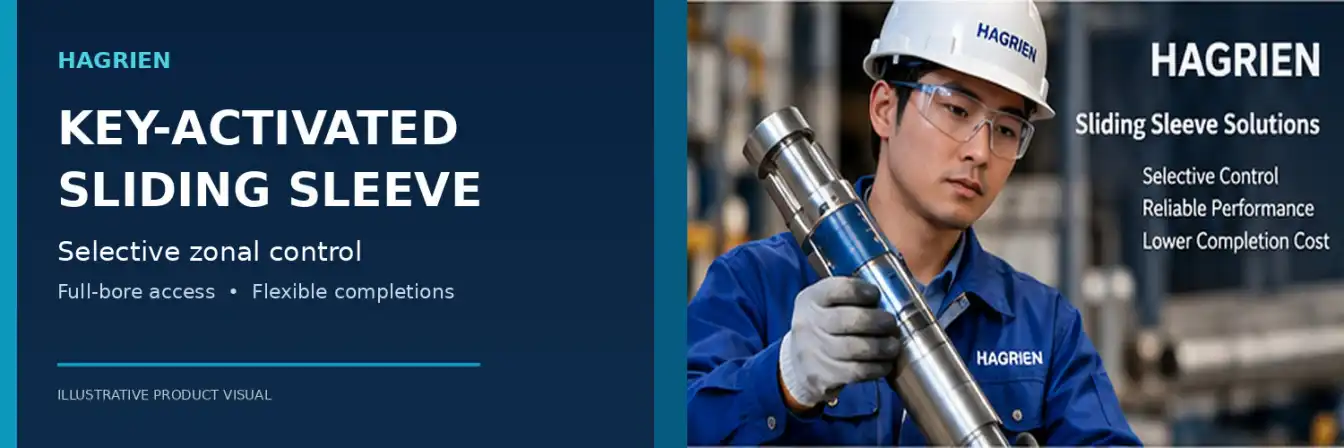
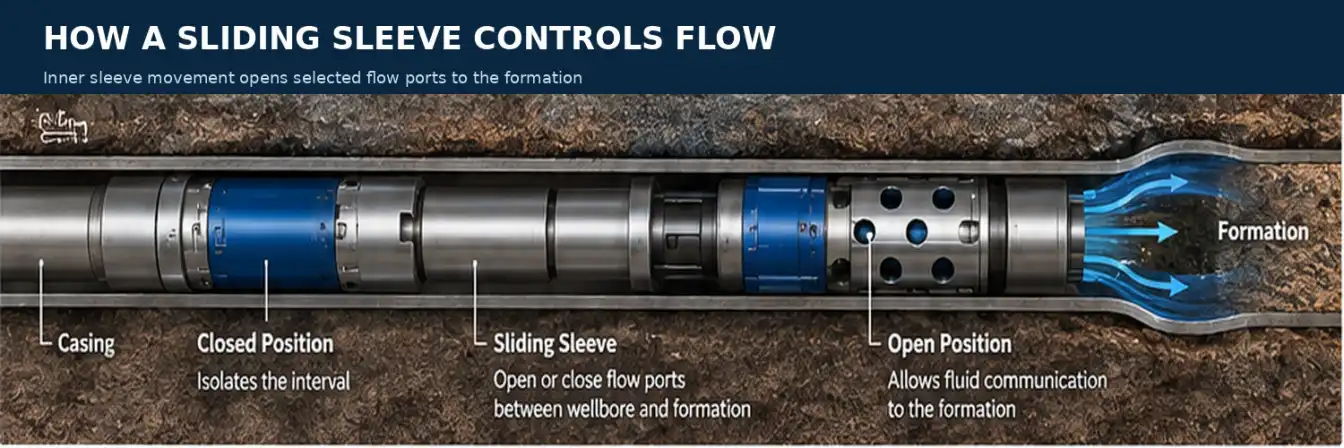
It comprises an outer housing and an inner sleeve which may be moved axially to open or shut communication apertures between the tubing string and the formation. This is termed a sliding sleeve. It may be used instead of or with perforating guns for multi-zone programs, meaning you can choose the zones you want to stimulate without additional wireline journeys.
How Actuation Methods Differ
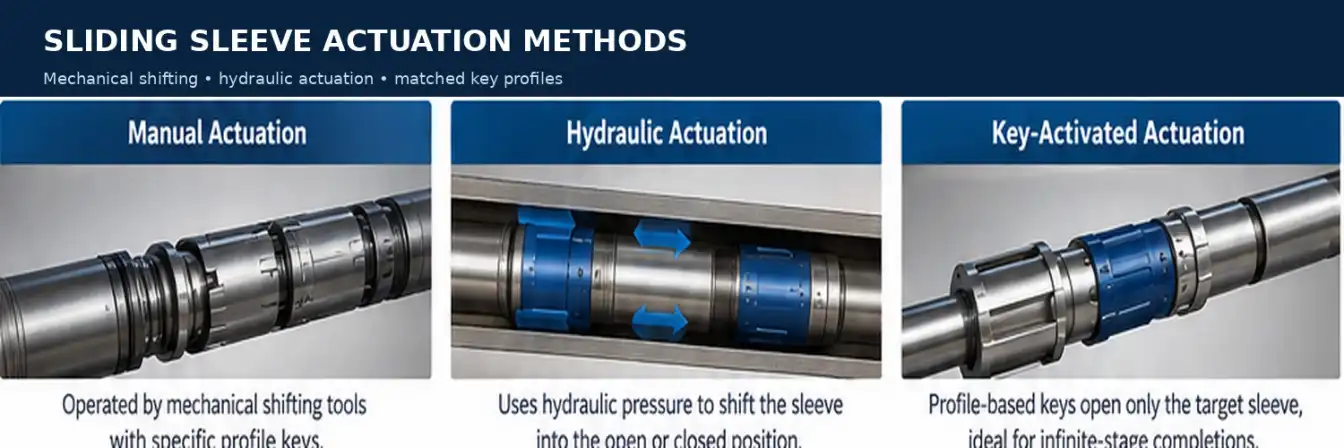
The sliding arms may be operated manually, hydraulically or with a key operated shifting tool. In key-actuated designs, the moving tool carries contoured collet keys which contact just the corresponding sleeve profile. This lets you open only certain stages in infinite-stage completions. Since each profile ID is linked to a different sleeve, the tool skips over any sleeves that don't match until it gets to the goal period.
Material and Seal Ratings
Most casing-installed sleeves are made of P110, Q125, or 13Cr metals that can handle working pressures of 10,000 to 15,000 psi and temperatures of up to 200°C (392°F). The choice of seal elastomers—Viton, Aflas, or Chemraz—is based on the temperature and H₂S/CO₂ partial pressures. When high-pressure gas is used, PEEK backup rings stop gas from decompressing quickly. Seal systems that are rated to ISO 14310 V0 make sure that the gastightness stays the same during downhole cycles.
Key Criteria for Choosing the Right Sliding Sleeve
If you choose the wrong cover for a well program, you might miss intervals, have problems with the well's integrity, or have to pay for expensive repairs that hurt the campaign's overall profitability. That risk is cut down a lot by using a structured screening process.
Selective Identification Reliability
In programs with more than one stage, each sleeve must be able to open only when told to. Profile-based selectivity, which uses different X, R, XD, or custom profile shapes, makes sure that the moving tool keys only interact with the right sleeve. Make sure the provider can show profile discrimination in a lab test using the real tool string before putting it to use in the field.
Full-Bore Diameter After Activation
The opening of the sleeve exposes an interior diameter that has a direct impact on wellbore entrance post-stimulation. Full-bore designs maintain the ID over the whole completion string so production logging tools, coiled tubing or workover equipment may still pass through. Reducing the breadth of the drift at the sleeve point restricts any further interventions.
Dissolvable Sealing Elements and Customizable Dissolution Windows
Dissolvable balls or bands are typically employed to isolate zones momentarily during pumping and then are broken down in the brine that is generated following fracturing. The dissolving rate has to be suitable for the well temperature, the fluid salinity, and the time span between stimulation and the initial production. Suppliers should provide you with validated dissolution rate data for the particular chemistry of your well brine and temperature range, not simply generic figures.
Comparing Sliding Sleeve Solutions for Well Completion
The market offers a range of systems from major service companies and specialized manufacturers. Understanding the trade-offs helps completion engineers make rational choices rather than defaulting to brand familiarity.
Major Service Company Offerings
Halliburton’s RapidFrac system, Schlumberger’s BroadBand Sequence service and Baker Hughes’s StageFRAC products all use unique ball-drop or key-shifting logic combined with sliding sleeves. These platforms are widely documented and validated in the field at scale. But they frequently include service contracts that might restrict flexibility in tool selection or raise unit prices in price-competitive industries.
Key-Activated Infinite-Stage Systems
HAGRIEN’s key-activated sliding sleeve technology is run with the casing string and opens various fracturing stages without wireline runs or perforating guns. The system has infinite stage capacity, full bore internal diameter when activated and is compatible with dissolvable sealing parts for predicted temporary zonal isolation. The system is manufactured via HAGRIEN’s closed-loop quality control process with CNAS-accredited testing and full batch traceability and is suited for multi-stage fracturing of horizontal shale wells, interventionless completion programs, re-fracturing of legacy wells, toe-stage initiation, and deepwater or extended-reach laterals where intervention cost is a governing factor.
Here are the core performance attributes that differentiate this approach:
- Selective stage control: The keys of the sliding sleeves are uniquely profiled such that the shift tool opens just the desired interval without the possibility of misfiring neighbouring stages.
- Full bore ID retention – Following activation the sleeve retains a constant internal diameter, keeping the wellbore available for future access tools.
- Works with dissolvable components: Sealing balls or sleeve inserts dissolve in a controlled window appropriate to your well’s temperature and brine chemistry, restoring wellbore continuity without retrieval.
- Closed-loop manufacturing: HAGRIEN manages alloy melting, extrusion, precision machining and assembly in-house, therefore minimising the risk of multi-vendor interfaces, and enabling batch-level traceability.
These attributes directly address the two failure modes that concern most completion engineers: a sleeve that fires when it shouldn't, and a temporary seal that either fails early or never dissolves.
Sliding Sleeve vs. Sliding Gate Valve
Sliding gate valves offer precise throttling for production flow management in permanent completions but add mechanical complexity and cost unsuitable for single-use stimulation applications. For multi-stage fracturing where each zone is opened once and left open, a sliding sleeve with a simpler open/close mechanism and dissolvable isolation is typically the lower-risk and lower-cost path.
Practical Procurement and Maintenance Considerations
Good product selection accounts for less than half of a successful completion program. Procurement execution and field readiness determine whether the sleeve performs as specified.
Supplier Qualification and Traceability
Request API-recognized manufacturing documentation, CNAS or equivalent lab certification, and batch-level traceability records before awarding an order. A supplier that can provide COA/COC/SDS packages and supports your internal qualification review reduces audit exposure and accelerates the tool into your approved vendor list.

Lead Times and Delivery Planning
Standard sleeve configurations with safety stock typically ship within two to four weeks. Custom dissolution windows, special alloy grades, or non-standard port configurations extend lead times to four to eight weeks. Build supplier delivery commitments into your completion schedule rather than treating tool arrival as a given.
Installation Compatibility and Field Crew Acceptance
Key-activated systems require shifting tool strings that differ from conventional plug-and-perf equipment. Work with your supplier to confirm that the shifting tool profiles are compatible with your coiled tubing or slickline BHA and that your field crew has reviewed the operating procedure. A one-day tabletop review with the completion team typically resolves most procedural questions before the first run.
Case Studies and Best Practices
Field data from the Eagle Ford and Permian Basin regularly shows that interventionless sliding sleeve programs cut stage-to-stage cycle time by 30–50% compared to plug-and-perf operations. This is mostly because they get rid of the need to move wirelines and move perforating guns. The cost of each wireline trip adds up quickly in extended-reach laterals longer than 10,000 feet; key-activated sleeves get rid of that cost completely after the casing is installed.
Lessons from Misapplications
The most common problems in the field are profile misidentification (when workers use the wrong shifting tool key size) and dissolve failures, which happen when a standard dissolvable element is used in a well that is much cooler or saltier than the design base. Both types of failure can be avoided by checking the tool strings before the job and having the supplier test the dissolution rate in a real well.
Best Practice Checklist
Before moving a sliding sleeve string to a new location, make sure that the profile key sizes match the as-run order, that the dissolution rate data covers your specific brine and temperature, that there is a pressure equalization path in case differential shifting is needed, and that the emergency shear-release mechanism on the shifting tool works.
Conclusion
To pick the correct slide sleeve, you need to make sure that the mechanical, chemical, and operating features of the tool meet the needs of your well program. Some of the things that set a reliable system apart from an expensive risk are profile selectivity, full-bore ID, dissolution window accuracy, and source traceability. The steps in this article will help you evaluate new tools and follow an organized path from concept to field deployment, whether you are planning a 40-stage Permian lateral or making sure a new tool fits into your approved vendor library.
FAQ
1. What actuation method works best in deviated wells?
Coiled tubing or hydraulic shifting tools are better than standard slickline in wells that are highly deviated or horizontal because they give the sleeve more consistent axial force. For long-reach laterals, key-activated systems with coiled tube BHAs work well.
2. How do I verify that a dissolvable sealing element will fully dissolve?
Ask the provider for dissolution rate test data that includes the exact salinity of the formation brine and temperature of the bottomhole. Suppliers with a good reputation give tested curves instead of just nominal ratings. The dissolvable elements in HAGRIEN have been tested in a lab that is accredited by the CNAS.
3. What sleeve profile should I specify?
Your shifting tool provider needs to be involved in profile choice (X, R, XD, or special). The goal is for each stage to have its own profile, so that no two bands in the string have the same shape. This will stop co-activation by mistake.
4. What is the expected seal lifespan?
Most elastomers, like Viton, Aflas, and Chemraz, are rated to last 10 to 15 years under normal use. When the seal is exposed to temperatures or chemical amounts that are higher than what it was designed to handle, its service life is greatly reduced.
5. Can these sleeves support re-fracturing programs?
Yes, full-bore ID retention after initial activation means that production recording tools and re-fracturing strings can freely pass through the sleeve. This means that key-activated systems can work with existing well re-stimulation processes.
Connect with HAGRIEN for Your Next Completion Program
Key-activated sliding sleeves are made by HAGRIEN, which has closed-loop quality control, CNAS-accredited testing, and full batch tracking. This makes it a reliable sliding sleeve source for operators and completion engineers who need performance proof, not just product claims. When people ask us about technology, our engineering team answers them within 24 hours. Visit us-hagrien.com or email us at cyrus@us-hagrien.com to look at product details and ask for a quote that is tailored to your project.
References
1. Society of Petroleum Engineers — SPE 194361: Evaluation of Interventionless Completion Systems for Multi-Stage Fracturing in Unconventional Reservoirs, 2019.
2. API — API Spec 19AC: Specifications for Wellbore Mechanical Barrier Equipment, American Petroleum Institute, 2021.
3. Journal of Petroleum Technology — Advances in Sliding Sleeve Technology for Horizontal Well Completions, JPT, 2020.
4. SPE — SPE 174892: Dissolvable Frac Plug and Sliding Sleeve Performance in Eagle Ford Shale Operations, 2015.
5. World Oil — Infinite-Stage Completions: Operational Efficiency Gains in Extended-Reach Laterals, World Oil, 2022.
6. ISO — ISO 14310: Petroleum and Natural Gas Industries — Downhole Equipment — Packers and Bridge Plugs, International Organization for Standardization, 2008.

USER EVALUATE
Here is the customer's evaluation of us