




Key-Activated Sliding Sleeve for Hydraulic Fracturing: A Guide
A key-activated sliding sleeve is a downhole completion tool designed to control access to selected fracturing stages through a mechanical key-and-profile mechanism. Once the matching key is in the desired sleeve the inner sleeve may be moved to open the desired route of flow. This may enable operators to choose phases in an order that is supported by the complete design, rather than a rigidly predetermined sequence.
This handbook covers the working principle, technological comparisons, installation concerns, field verification and supplier assessment aspects for a key-activated sliding sleeve. It is aimed for completion engineers, program leaders and technical partners who need to analyze the suitability of this sort of mechanical selective-opening system for a certain well. The final decision should be based on the particular tool configuration, well conditions, authorized operating procedures and accompanying technical documents.
Core Mechanism and Technology ComparisonWhat Is a Key-Activated Sliding Sleeve?
A key-activated sliding sleeve is a mechanical downhole completion component that controls communication through designated ports in the completion string. Depending on its design, the assembly may include a housing, an internal sliding sleeve, seals, a shifting profile, a locking mechanism, and connection ends.
Three terms help explain its function:
- Mechanical describes how mechanical force moves the sleeve.
- Selective describes the ability to target a particular sleeve within a completion string.
- Key-activated describes the engagement method: a compatible shifting key interacts with the sleeve's designated profile.
Selectivity relies on compatibility of key and profile, arrangement of sleeves, accuracy of depth identification. The model chosen has to have its real opening sequence and way of operation verified.
The product configuration and installation procedure of HAGRIEN will be verified against the relevant product drawings and technical documentation. Compatibility with the connection design, running method and other down-hole components must be determined before deployment when a sleeve is to be inserted as part of the casing or completion-string installation.
How Does a Key-Activated Sliding Sleeve Work?
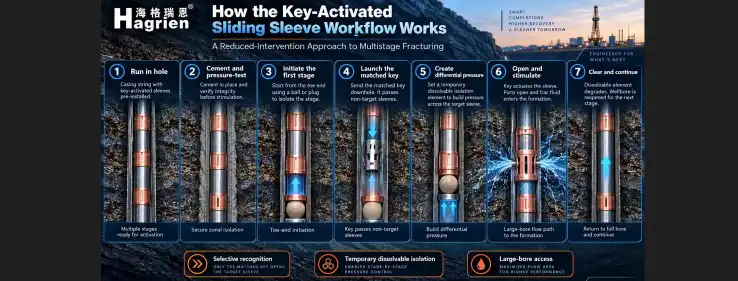
The working principle is that the matching key reaches the necessary sleeve. When the key engages the corresponding shift profile, the resulting mechanical force generated moves the inner sleeve to change the position of the flow ports. Different keys may have different profiles . This helps to prevent unintentional contact with other sleeves ( providing the system was created and set appropriately ) .
A variety of parameters such as profile form, sleeve spacing, depth correlation, key condition and wellbore cleanliness impact reliable selection. The operational method must clarify how the key is implemented, how engagement is recognized and what steps are to be taken if the required response is not obtained.
The personnel must then ensure after the moving process that the sleeve is at the intended place. This may include an analysis of pertinent operational data such as pressure, pump rate and fluid acceptance to ensure the response is compatible with the expected opening event. However, pressure variations may not necessarily indicate that the sleeve is fully expanded. Verification criteria should be in accordance with the tool manufacturer’s instructions and the permitted completion program.
The sleeve design and finally the position at the end also finally define the internal diameter accessible after shifting. If subsequent instruments or interventions will have to pass through the completion, evaluate minimum effective drift or internal diameter against the required designs and operating requirements, rather than assume all configurations would provide unrestricted full bore access.
Key-Activated Sliding Sleeve vs. Alternative Technologies
A key-activated sliding sleeve is one of several approaches to controlling access to fracturing stages. Its suitability depends on the required stage-selection sequence, completion architecture, operating conditions, and intervention strategy.
Ball-drop sleeves feature seats and balls that operate the sleeves. The ball sizes available and the seat arrangement influence the activation sequence and the possible stage-count design of systems with increasing ball and seat sizes. The restrictions are system dependant thus you will want to check the capacity of the stage against the standards of the manufacturer.
Plug-and-perf completions typically use wireline-deployed plugs and perforating guns to isolate and perforate later stages. There is a definite completion and intervention procedure this way than in a mechanically keyed sleeve. Its suitability is dependent on the good design, operational objectives, and the equipment and services provided for the project.
Hydraulic sleeves are manipulated by hydraulic pressure or hydraulic control system. Depending on the design, they may be operated remotely or by pressure, but may require additional control system components and operating procedures.
A key is mechanically coupled to a moving profile and couples a sliding sleeve. Selective mechanical actuation and a correct intervention approach might be useful to be considered. But we should not take it for granted that it is necessarily more flexible, simpler or more reliable than all the other options.
Think about the number of stages, the opening sequence needed, the well form, the pressure and temperature conditions, the fluid compatibility, the intervention choices available to you and the contingency procedures. The system of choice is one that meets the functional parameters of the well, has an established operating procedure and an appropriate overall completion complexity.
 Applications, Installation, and Field Operation
Key-Activated Sliding Sleeve Applications in Hydraulic Fracturing
Hydraulic fracturing is a common method used in U.S. oil and natural gas production. In 2016, hydraulic fracturing accounted for around half of U.S. crude oil production, according to the U.S. Energy Information Administration. This is industry historical information and not evidence that any one finishing approach is right for all fractured wells.
Key-activated sliding sleeve may be investigated for multi-stage horizontal wells when selective mechanical access to the various stages is needed in the completion design. Other potential applications include selected intervention reduction programs, toe stage start arrangements or extended reach wells where the operator is to restrict particular intervention stages. For each application there is a study of the actual tool setup and the bigger completion design.
Selective opening may be useful if the sequence you wish to use is not a conventional fixed order method. But it does not in itself prove that phases may be opened in any order and in any scenario. The order that may be employed depends on the shifting profiles, the sleeve arrangement, the access route and the operating manner.
The tool has also to be tested with packers, plugs, dissolvable sealing elements and other finishing equipment. These parts have different jobs to do. Zonal isolation may be established using a sliding sleeve to control a flow path and separate sealing element. Thus the system level performance is function of interaction of all essential components, their pressure and temperature constraints and fluid chemistry of the well.
As with a heterogeneous reservoir, re-fracturing program or other specialist application, consult with the completion designer and supplier as to the required function, what stage sequence is essential, what the pressure differential is and how it will be verified before selecting a sleeve.
Key-Activated Sliding Sleeve Installation Procedure
Installation should start with an engineering examination of the well and the configuration of the product chosen. Important information includes well depth and trajectory, casing size and connections, minimal drift requirements, operating and test pressures, temperature range, fluid conditions, and compatibility with other completion components.
If the chosen HAGRIEN sleeve is to be run in conjunction with the casing or finishing string, dimensions, connections and handling requirements must be consistent with the authorized running and installation schedule. The exact technique of installation of the product should be checked by the necessary drawings and manufacturer's instructions.
Personnel should examine the components covered by the authorized process prior to deployment. Depending on design and inspection needs this might comprise the housing, ports, threads, seals, shifting profile and locking features. Function checks when applicable must be conducted using the prescribed equipment and acceptance criteria.
During operating the crew should follow the authorized handling technique, protect connections from damage, prevent unnecessary contamination and keep proper records of sleeve position and profile identification. These records allow to link the actual installation with the intended stage sequence.
Required pressure tests, depth checks and other verification operations after installation should follow the well program and appropriate product specifications. A casing or completion pressure test does not always verify that each shifting mechanism will perform as anticipated. As such, installation acceptance and sleeve actuation verification should be seen as linked but separate processes.
The last step should be customized to the chosen model, well design and project requirements. General advice should not substitute manufacturer-approved instructions or operator well-control and completion procedures.
Key-Activated Sliding Sleeve Operating Instructions
The team works in a settled way, meaning they follow the expected order of shifts and respond consistently to unexpected incidents. Stage plan. Identify next sleeve objective. Evaluate suitable key and equipment. Determine continuation or termination criteria.
The operational plan will detail the expected key to profile match, the running and shifting operations to be performed, the data to be monitored and how the result will be documented. And the architecture may allow for a changing order of phases, demanding extra prep from staff accustomed to the set toe-to-heel sequence.
The crew should use the approved approach throughout the operation and compare the observed reaction to the expected response for the selected tool. Relevant information may include depth, pressure, pump rate and any other monitoring necessary in the completion phase. Interpretation should not be based on a single pressure change or other isolated indicator, but on the whole operating state.
If the key does not turn as expected, stop and begin the contingency process. Check the recorded sleeve position, key identification, operating conditions and any other factors given by the manufacturer before deciding whether another attempt is suitable. If pressure or flow behavior is abnormal then stop the operation when the permitted procedure needs and investigate the likely causes before continuing.
HAGRIEN’s product information may have model specific operational flow in us-hagrien.com. Before field work, verify applicability of method to the particular sleeve model, finishing configuration and operating conditions. The crew must have the permitted procedure and contingency instructions available.
Benefits, Limits, and Selection
Benefits and Limitations of Key-Activated Sliding Sleeves
The major advantage of a key-activated sliding sleeve is selective mechanical activation. If the complete design and operating sequence allows for it, the crew may target a specific sleeve with the correct key and shifting profile.
Depending on the system design, this strategy may decrease the requirement for certain wireline or perforating procedures associated with alternate finishing approaches. It might also enable a designed opening sequence not locked into one traditional order. These advantages should be considered when the whole operational process, not assumed based on tool type alone.
There are caveats, of course. Selective engagement requires right profile design, accurate sleeve position data, appropriate equipment and adequate wellbore conditions. Operation may be affected by debris, sand, scale, wear, erosion, seal damage or over differential pressure depending on the design and circumstances of exposure.
Highly deviated wells, complex completion architectures, or programs requiring remote actuation may favor a different technology. These conditions do not automatically rule out a key-activated sliding sleeve, but they require additional engineering review.
Before adopting a tool as a standard completion solution, compare the expected operating benefits with the potential failure modes, contingency requirements, and intervention plan. Where uncertainty remains, a controlled qualification or trial program may help validate the design for the intended application. Any trial should have defined acceptance criteria and should not be treated as a substitute for the required engineering review.
Key-Activated Sliding Sleeve Size and Pressure Rating Selection Guide
Proper sizing is more than simply the casing nominal size. First, examine casing outer diameter, wall thickness or weight, connection type, minimum internal drift, available installation envelope and required post-actuation access. Check sleeve against final design for outside dimensions, interface connections, port layout and shift-key compatibility.
The pressure and temperature range should encompass the conditions of intended service. These may include operating pressure, test pressure required, differential pressure across the tool, pressure cycling, static temperature and flowing temperature. The proper limits must be determined based on the technical papers of the selected model and on the allowed design foundation.
The choice of materials will depend on the fluids you expect to be in contact with and the environmental conditions. These include fracturing fluids, brines, acids, corrosive vapors, abrasive particles and sour-service demands depending on the well. Compatibility should be evaluated for the specific materials, seals and exposure conditions, rather than inferred from a generic material description.
The other is the port design. The form and size of the port influence the flow channel and pressure drop . Solids and fluid behavior may influence the danger of erosion or plugging. The proper configuration will be defined by the objectives of the completion, the expected service circumstances and the design constraints of the manufacturer.
With your RFQ, please submit the needed well data and any required standards, drawings, testing requirements and documents. Ask the supplier to identify the proposed configuration and note any unaddressed design assumptions. In the written technical evaluation, a certified product match is distinguished from a tentative recommendation.
Common Mistakes and How to Avoid Them
Many avoidable completion problems begin with incomplete requirements or gaps between the design and the field procedure. Several checks can help reduce that risk.
- Selecting by nominal casing size alone: Confirm the connection, drift requirement, tool envelope, pressure and temperature limits, and compatibility with adjacent components.
- Leaving shifting profiles or sleeve positions unclear: Maintain an accurate tally and verify the planned key-to-profile relationship against the approved completion design.
- Ignoring wellbore cleanliness and fluid compatibility: Review possible debris, sand, scale, seal exposure, and fluid-related risks for the actual service conditions.
- Using an unsuitable operating sequence: Ensure the crew understands the intended sleeve order, key identification, verification criteria, and stop-work conditions.
- Relying on one signal to confirm opening: Interpret pressure, rate, depth, and other available information according to the approved verification method.
- Preparing an incomplete contingency plan: Define the response to failed engagement, unexpected pressure behavior, suspected damage, or uncertain sleeve position.
- Comparing quotations with different scopes: Check whether each offer includes the same product configuration, shifting equipment, inspection and test records, documentation, packaging, technical support, and delivery terms.
A structured pre-job review helps identify these issues before equipment reaches the wellsite. The specific checks and acceptance criteria should be recorded in the approved project documents.
Supplier Evaluation, Quality, and Procurement
How to Choose a Key-Activated Sliding Sleeve Supplier
A suitable supplier should be able to translate well requirements into a clearly defined product configuration. The evaluation should cover technical capability, manufacturing controls, inspection and testing, documentation, and the support available for the intended application.
Ask the supplier to explain the shifting mechanism, key-to-profile compatibility, installation requirements, and method for verifying the sleeve's operating position. Request the applicable product drawings, dimensional specifications, material information, and inspection or test documentation. If the tool is intended for a non-standard completion, ask which design assumptions still need confirmation.
Certificates and approvals should be checked at the appropriate level. A company management-system certificate, a laboratory accreditation, and a product-specific qualification are not interchangeable. Review the issuing body, validity period, scope, and applicability to the proposed product and manufacturing location. Where API, ISO, NACE, or customer requirements apply, confirm the exact requirement and whether the supplier can provide evidence that addresses it.
HAGRIEN reports ISO 9001, ISO 14001, and ISO 45001 certifications, a CNAS-accredited high-temperature, high-pressure (HTHP) laboratory, and API-related recognition. Before relying on these statements for a procurement decision, confirm the current certificates, the entity and activities covered, the laboratory's accreditation scope, and any product-specific qualification relevant to the proposed sleeve.
Similar-well references may also be useful, provided the comparison is relevant to the operating conditions and tool design. If the supplier cannot provide a directly comparable example, a transparent explanation of the design differences and required validation is more useful than an unsupported performance claim.
Quality, Testing, and Field Verification
Quality assurance should be defined for the actual product and its intended service. Depending on the design, manufacturing and inspection activities may include dimensional checks, thread inspection, material verification, seal inspection, non-destructive examination, pressure testing, shifting-profile checks, and functional testing.
Not every test applies to every design, and the existence of a test program does not by itself establish that a product meets a particular service requirement. The qualification or inspection plan should identify the relevant test method, equipment, medium, pressure, temperature, holding period, acceptance criteria, and recorded results where applicable.
HAGRIEN states that it uses closed-loop quality control, CNAS-accredited testing, and batch traceability, and that COA, COC, and SDS documents may be available on request. For a specific order, confirm which controls apply to the selected product, which tests are actually performed, and which documents can be supplied. The content and applicability of each document should be clear before purchase.
Field verification should follow the approved operating procedure. The crew should record the relevant operating conditions and observations, including depth, pressure, pump rate, and other indicators required by the completion program. The assessment should distinguish a response consistent with opening from a confirmed mechanical position where additional verification is required.
Documenting field results helps operators review the completion and inform future design decisions. Any performance conclusions should remain tied to the specific configuration, operating conditions, and evidence collected rather than being generalized to every well or product.
Key-Activated Sliding Sleeve Price and Procurement Guide
The price of a key-activated sliding sleeve depends on the specified design and commercial scope. Factors may include material, dimensions, pressure and temperature requirements, connection type, port configuration, customization, inspection and testing, documentation, order quantity, packaging, and destination.
A useful request for quotation should identify the application, casing dimensions and connections, minimum drift requirement, planned stage count, operating and test conditions, fluid information, required opening sequence, applicable standards, quantity, and target delivery schedule. Include drawings or interface specifications when available, and identify any requirements that are mandatory rather than preferred.
When comparing quotations, check whether the proposed products meet the same technical requirements. Confirm the scope of shifting keys or other operating equipment, spare components, inspection and test records, documentation, warranty, freight, packaging, and technical support. A lower initial price may not represent equivalent scope or risk.
HAGRIEN states that it offers EXW, FOB, and CIF terms and coordinates with North American customers through a U.S. entity. Confirm the available trade terms, contracting entity, shipping arrangements, and responsibilities for the destination before placing an order.
Delivery schedules should be confirmed against the final product configuration, quantity, current production capacity, required testing, and order status. A written quotation should distinguish confirmed lead times from preliminary estimates and specify any assumptions that affect delivery.
Why HAGRIEN Fits Selective Fracturing Programs
A Closed Loop from Alloy to Downhole Tool
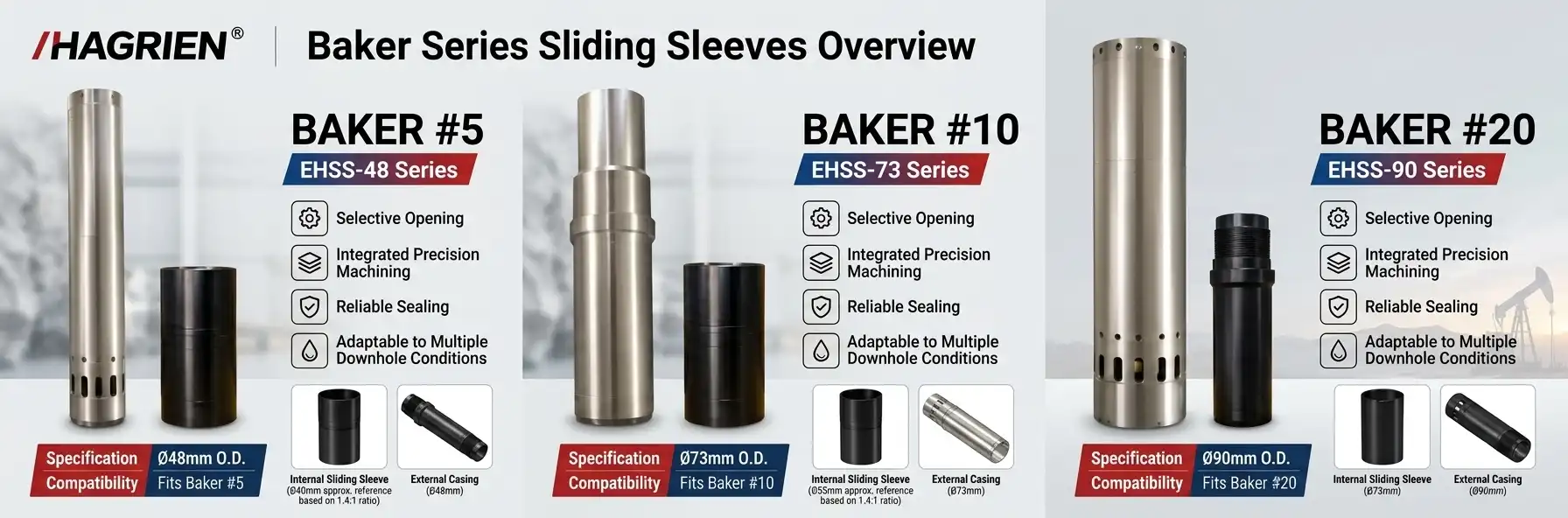
HAGRIEN is based in Xi'an, China, and reports company and service presence in the United States. Its stated capabilities include alloy melting and metallurgy control, extrusion, precision machining, and the manufacture of dissolvable magnesium alloy bars and related downhole tools.
The company reports having 3,600-ton and 5,600-ton extrusion presses and supplying dissolvable magnesium alloy bars in diameters up to Ø300 mm. It also identifies dissolvable bridge plugs, setting tools, packers, and related components within its product range. These capabilities may be relevant when a completion program requires both material supply and downhole-tool engineering.
However, the availability of alloy-processing equipment or dissolvable components does not, on its own, establish the design, actuation, pressure rating, or performance of a key-activated sliding sleeve. Those characteristics must be confirmed from the technical documentation for the specific sleeve model.
HAGRIEN reports production and validation experience dating from 2019. For procurement, the useful next step is to establish which manufacturing and inspection stages are performed in-house, which activities involve external providers where applicable, and what traceability records are available for the proposed product.
A clear engineering workflow should connect the customer's well parameters to a reviewed drawing, a defined product specification, and an agreed inspection and documentation plan. This helps reduce ambiguity before production and supports a more consistent handover from design review to procurement.
Dissolvable Sealing Elements and Predictable Isolation
Dissolvable sealing elements may be used in certain completion systems to provide temporary isolation and reduce the need for some later intervention steps. Their role differs from that of a key-activated sliding sleeve: the sleeve controls a flow path through mechanical movement, while a separate sealing element may provide isolation between zones.
HAGRIEN describes its dissolvable magnesium alloy capabilities in terms of adjusting alloy systems and process parameters for specified operating conditions. Relevant factors may include bottomhole temperature, fluid chemistry, salinity, required mechanical properties, and the intended dissolution window. The actual performance of a component depends on its composition, manufacturing process, geometry, exposure conditions, and qualification evidence.
A material's ability to dissolve under selected laboratory conditions does not automatically establish the isolation performance or dissolution time of a finished downhole component. Large-diameter extrusion capability also does not, by itself, prove the performance of a completed sealing element or a sliding sleeve.
For a proposed application, ask for the technical data and validation evidence relevant to the finished component, including the test conditions, acceptance criteria, and known limitations. HAGRIEN states that its HTHP laboratory supports validation; confirm the laboratory's current accreditation scope and whether the requested test falls within it.
Where a key-activated sliding sleeve and dissolvable sealing elements are used in the same completion, the interface, operating sequence, pressure conditions, and timing requirements should be evaluated at the system level. Share the well's temperature range, fluid chemistry, isolation requirements, and completion drawings so the engineering team can determine whether the proposed components are compatible.
Support for Solution Designers and Regional Partners
Solution designers and regional partners need clear technical information, defined responsibilities, and a practical process for resolving questions before equipment is deployed. HAGRIEN states that it offers application engineering, remote technical support, and OEM/ODM engineering to specification. The exact scope should be confirmed for each project, including drawing control, prototype review, product changes, and production release.
For its dissolvable magnesium alloy bars, HAGRIEN reports typical lead times of two to four weeks for standard sizes and four to eight weeks for customized solutions, subject to the applicable order conditions. These figures relate to the stated bar-product offering and should not be treated as confirmed lead times for a finished key-activated sliding sleeve. Confirm the schedule for the actual product, order quantity, technical requirements, testing, and shipping destination.
Project communication can be organized around agreed milestones, such as technical review, drawing approval, production release, inspection, and shipment. Distributors and integrators can also discuss private-label or regional cooperation arrangements where available.
For a new completion design, a practical path is to review the well data, establish product compatibility, resolve open technical questions, and agree on the required validation and documentation. If a prototype or single-well trial is appropriate, the scope and acceptance criteria should be defined before the trial begins.
Conclusion
A key-activated sliding sleeve uses a mechanical key-and-profile mechanism to control access to a designated flow path in a completion string. Its potential value lies in selective mechanical actuation and an operating sequence that can be tailored to the specific completion design.
The right choice depends on more than the activation mechanism. Casing compatibility, minimum drift, pressure and temperature conditions, fluid exposure, sleeve spacing, shifting procedures, and the verification method all affect suitability. Comparisons with ball-drop, plug-and-perf, and hydraulic systems should account for the complete completion architecture and operating workflow rather than relying on generalized advantages.
Installation and operation should follow the approved product instructions and well program. Field data can help assess whether the observed response matches the expected opening event, but a single pressure change should not automatically be treated as proof of successful shifting. Where dissolvable sealing elements are also used, their isolation function and qualification evidence should be evaluated separately from the sliding sleeve's function.
Supplier evaluation should focus on model-specific drawings, traceable inspection and test records, applicable certifications, realistic delivery commitments, and engineering support. A complete technical inquiry gives the supplier a stronger basis for confirming compatibility and identifying unresolved requirements before quotation or production.
FAQ
1. How does a key-activated sliding sleeve choose which stage opens?
A key-activated sliding sleeve uses a shifting profile designed to engage a compatible key. The key-and-profile arrangement can allow a designated sleeve to be targeted, provided the profile design, sleeve placement, and operating sequence support the intended selection. Confirm the actual selection logic and operating limits against the specific product documentation.
2. Do I need wireline runs or perforating guns?
The need for wireline operations or perforating guns depends on the completion design and the function being performed. A key-activated sliding sleeve may avoid certain wireline or perforating steps associated with other completion methods, but it does not mean that every intervention or ancillary operation is eliminated. Confirm the full operating sequence for the selected HAGRIEN configuration before planning the job.
3. How do crews confirm an opening event?
Crews should follow the manufacturer's and operator's approved verification procedure. Depending on the system, relevant information may include depth, treating pressure, pump rate, fluid acceptance, and other available monitoring data. The observed response should be compared with the expected operating behavior; pressure changes alone may not conclusively establish the sleeve's final position.
4. What data do you need for a quotation?
Provide the casing dimensions and connection, minimum drift requirement, stage count, intended opening sequence, operating and test pressures, temperature range, fluid chemistry, port requirements, applicable standards, quantity, and target delivery schedule. Drawings and interface specifications are useful when available. HAGRIEN can then review the stated requirements and identify which details need confirmation before the product configuration and quotation can be finalized.
Request a Key-Activated Sliding Sleeve Quotation from HAGRIEN
To request a technical review, send your application details to HAGRIEN at cyrus@us-hagrien.com. Include the casing dimensions and connection, minimum drift requirement, planned stage count and opening sequence, pressure and temperature window, fluid information, and any applicable drawings or standards.
The engineering review should establish whether the proposed configuration matches the stated requirements, identify any outstanding technical questions, and confirm which drawings, inspection records, tests, and other documents are available. Pricing and delivery should then be confirmed against the final specification, order quantity, testing requirements, and shipping arrangements.
For a key-activated sliding sleeve supplier, prioritize a clearly defined product configuration, verifiable quality documentation, and technical support appropriate to the completion design. Visit us-hagrien.com for HAGRIEN product information and contact the team to discuss your application.
References
1. American Petroleum Institute, Hydraulic Fracturing Operations: Well Construction and Integrity Guidelines (API Guidance Document HF1), 2009.
2. U.S. Energy Information Administration, Hydraulic Fracturing Accounts for About Half of Current U.S. Crude Oil Production, 2016.
3. Economides, M. J. and Nolte, K. G., Reservoir Stimulation, 2000.
4. Economides, M. J. and Martin, T., Modern Fracturing: Enhancing Natural Gas Production, 2007.
5. International Organization for Standardization, ISO 14310, Petroleum and Natural Gas Industries — Downhole Equipment — Packers and Bridge Plugs, 2008.
6. International Organization for Standardization, ISO 9001, Quality Management Systems — Requirements, 2015.

USER EVALUATE
Here is the customer's evaluation of us