_1776908283214.jpg)




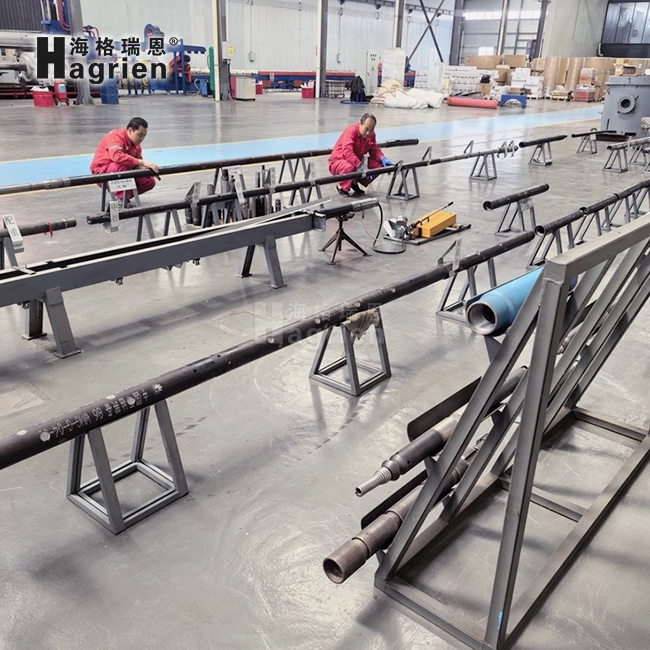
High Load Setting Tool
Form: Customizable
Dissolution rate: Adjustable by alloy design and test condition
Documents:CNAS Inspection/ COA/COC available.
- Product Description
High Load Setting Tool - Enterprise-Grade Completion Equipment
When you're running high-pressure completion operations, you need equipment that won't let you down. Our High Load Setting Tool is engineered specifically for demanding downhole environments where standard tools simply can't deliver. Manufactured by Shaanxi Hagrien Energy Technology, this tool features advanced magnesium alloy construction with customizable form factors and adjustable dissolution rates tailored to your well conditions. Designed to handle loads exceeding conventional setting equipment capacity, it provides the reliability you need for complex plug setting programs. With complete traceability documentation (COA/COC) and support for application-specific configurations, you get a solution built around your operational requirements, not industry averages.
Why Choose Our Heavy-Duty Setting Equipment?
You face unique challenges in every well. That's why we built this tool differently.
Our setting equipment addresses the critical gap between standard tools and extreme-load applications. You're not just getting a piece of hardware—you're getting a customizable solution that matches your specific downhole conditions.
The tool incorporates our proprietary magnesium alloy technology. This material choice isn't arbitrary. We control the entire manufacturing process from alloy melting through precision machining, giving you consistency that imported components can't match.
What makes this different?
You get adjustable dissolution characteristics. Depending on your reservoir temperature, salinity, and fluid chemistry, we engineer the alloy system to perform exactly as your completion timeline requires. No guesswork. No premature failures.
The form factor is completely customizable. Whether you need modified geometries for restricted wellbore profiles or enhanced structural features for ultra-high loads, our closed-loop manufacturing system delivers what you specify.
Performance Advantages That Matter Downhole
Let's talk about what this High Load Setting Tool actually does for your operations.
Engineered for Higher-Load Requirements
Standard setting tools max out where your toughest jobs begin. This equipment handles the extreme force applications that push conventional tools past their design limits. You're working with deeper wells, higher pressures, and more complex completions. Your equipment should match that reality.
Application-Specific Tool Matching
Every completion program has different force requirements. We support custom configurations that align with your specific setting loads, wellbore geometry, and operational constraints. You tell us what you need to achieve, and we engineer the tool to deliver it.
Non-Standard Project Solutions
Industry-standard catalog items rarely fit specialized operations. When you're dealing with unique well architectures or experimental completion designs, you need a manufacturing partner who can adapt. Our engineering-to-spec capability means you're not forced to compromise your program design because of tool limitations.
Manufacturing Support Throughout Your Project
From initial concept through field deployment, you have access to our technical team. We provide material selection guidance, prototype development, and Factory Acceptance Testing support. This collaboration reduces your trial-and-error costs and accelerates your path to operational deployment.
Technical Specifications
No. | Item Name | *MDM Material Description | Quality Standard | Technical Requirements (Main Parameters) | Lead Time |
1 | Electrically Controlled Setting Tool, 56 mm | Special setting tool, electrically controlled setting tool, 56 mm, 105 MPa, 17-4PH | SY/T 5158-2020 General Technical Specifications for Petroleum Exploration Imaging Logging Systems | 1. Single-core shock-resistant connector. | 60 days |
2 | Electrically Controlled Setting Tool, 76 mm | Special setting tool, electrically controlled setting tool, 76 mm, 140 MPa, 17-4PH | SY/T 5158-2020 General Technical Specifications for Petroleum Exploration Imaging Logging Systems | 1. Single-core shock-resistant connector. | 60 days |
3 | Electrically Controlled Setting Tool, 96 mm | Special setting tool, electrically controlled setting tool, 96 mm, 140 MPa, 17-4PH | SY/T 5158-2020 General Technical Specifications for Petroleum Exploration Imaging Logging Systems | 1. Single-core shock-resistant connector. | 60 days |
4 | Upper Connector | Electric setting tool accessory ETP961032-140A-V10 upper connector | SY/T 5158-2020 General Technical Specifications for Petroleum Exploration Imaging Logging Systems | 1. Single-core shock-resistant connector. | 45 days |
5 | Lower Connector | Electric setting tool accessory ETP961032-140A-V10 lower connector | SY/T 5158-2020 General Technical Specifications for Petroleum Exploration Imaging Logging Systems | 1. Single-core shock-resistant connector. | 45 days |
6 | Intelligent Controller | Electric setting tool accessory ETP961032-140A-V10 intelligent controller | SY/T 6235 General Technical Specifications for Computerized Surface Logging Units | 1. Commitment required that within three months after award, it will be compatible with the perforating surface depth system. | 45 days |
7 | Surface Reset Box | Electric setting tool accessory ETP961032-140A-V10 surface reset box | SY/T 6235 General Technical Specifications for Computerized Surface Logging Units | 1. Operating temperature: -30℃ to 50℃. | 45 days |
8 | Magnetic Collar Locator | Perforating downhole instrument, magnetic collar locator, CCL-73-V10, 73 mm | SY/T 5158-2020 General Technical Specifications for Petroleum Exploration Imaging Logging Systems | 1. Single-core shock-resistant connector. | 45 days |
9 | Electronic Select-Fire Switch | Analog-digital hybrid integrated circuit, electronic select-fire switch, EFS-V30 | Q/SY 02866-2020 Technical Specification for Bridge Plug and Perforating Operations | 1. Commitment required that within three months after award, it will be compatible with the intelligent controller. | 45 days |
10 | Electronic Select-Fire Switch | Analog-digital hybrid integrated circuit, electronic select-fire switch, EFP-FA11-V10 | Q/SY 02866-2020 Technical Specification for Bridge Plug and Perforating Operations | 1. Commitment required that within three months after award, it will be compatible with the intelligent controller. | 45 days |
How This Tool Solves Real Completion Challenges
You've probably experienced these problems before.
Inconsistent Setting Performance
Variable material quality leads to unpredictable tool behavior downhole. When your setting tool's mechanical properties vary from unit to unit, you can't rely on consistent results. Our closed-loop manufacturing eliminates this variability. Every High Load Setting Tool comes from the same controlled process with verified mechanical properties.
Limited Force Capacity
Deeper wells and tighter formations demand higher setting forces. Standard tools designed for conventional applications simply can't generate the loads you need. Our heavy-duty design specifically addresses higher-load setting requirements without sacrificing reliability.
Supply Chain Uncertainty
When you're planning a multi-well program, equipment availability matters. We maintain safety stock for standard configurations and provide predictable lead times for custom orders. You get the tools when you need them, not when a distant warehouse happens to have inventory.
Lack of Engineering Support
Buying catalog items means you're on your own for application engineering. Our approach is different. You work directly with the manufacturing team that designs and builds these tools. When you have questions about load ratings, dissolution timing, or operational parameters, you're talking to people who can actually answer them.
Applications Across Completion Operations
This equipment serves multiple roles in your completion toolkit.
You'll deploy it in high-pressure plug setting programs where conventional tools would fail. The enhanced load capacity handles the extreme forces required for reliable plug activation in deep, high-temperature wells.
It works in complex multi-stage completions where consistent setting performance across dozens of plugs determines program success. The repeatable mechanical properties ensure every plug sets properly, reducing intervention costs.
You can specify custom configurations for experimental completion designs. When you're testing new techniques or working in unusual well geometries, you need tools that adapt to your requirements rather than forcing your program into standard tool limitations.
Quality Assurance You Can Verify
We know "trust us" doesn't work in critical applications.
Every tool comes with complete documentation packages. COA (Certificate of Analysis) provides the actual tested properties of your specific batch. COC (Certificate of Conformance) confirms compliance with your purchase specification. SDS (Safety Data Sheets) cover handling and disposal requirements.
Our CNAS-accredited HTHP laboratory conducts verification testing on material properties, dissolution characteristics, and mechanical performance. You receive the test results with your order.
Batch traceability connects every tool to its source material and manufacturing history. If you need to investigate post-job performance, you have complete visibility into the production parameters that created that specific unit.
Frequently Asked Questions
Q: How do you customize dissolution rates for different well conditions?
A: We adjust the alloy composition and microstructure based on your reservoir parameters. You provide the temperature range, fluid chemistry, and desired dissolution timeline. Our metallurgy team engineers the material system to match those conditions. We validate performance through lab testing before manufacturing your order.
Q: Can you manufacture tools to our proprietary designs?
A: Yes. We offer full OEM/ODM support with drawing-based production. You provide the specifications, and we handle material selection, prototype development, and scaled manufacturing. Our engineering team works with yours throughout the development process.
Q: What's your manufacturing capacity for large orders?
A: We've maintained continuous production since 2019 with the capability to scale from prototype quantities to volume production. For specific volume requirements and delivery schedules, contact our team with your project details.
Q: How do you ensure consistent quality across production batches?
A: Our fully integrated manufacturing system controls every critical process. We operate our own alloy melting, extrusion, and machining facilities. This vertical integration eliminates variability from external suppliers. Each batch undergoes verification testing against documented process parameters.
Q: Do you provide technical support during field operations?
A: We offer pre-deployment consultation and are available for technical questions throughout your program. While we don't provide on-location field personnel, our engineering team supports your operations remotely and can address performance questions or operational adjustments.
Q: What information do you need to quote a custom configuration?
A: Send us your operational requirements: target setting loads, wellbore environment (temperature, pressure, fluid type), dimensional constraints, and dissolution timeline. Engineering drawings are helpful but not required for initial discussions. We'll work with you to develop a specification that meets your needs.
Why Manufacturing Capability Matters
You might wonder why we emphasize our production processes.
Tool performance depends entirely on material consistency. When a supplier outsources material production or critical manufacturing steps, they lose control over the variables that determine downhole reliability.
We built our facility specifically to eliminate that risk. From raw material to finished tool, everything happens under one quality system. When you have a question about material properties or manufacturing parameters, you're talking to the people who actually made your equipment.
This integration gives you another advantage: engineering flexibility. Need to adjust a dimension? Modify material properties? Test a new configuration? We can respond quickly because we're not coordinating across multiple subcontractors.
 Get Started With Your Custom Solution
Ready to discuss your specific requirements for High Load Setting Tool?
Contact our technical team at cyrus@us-hagrien.com for project consultation and detailed specifications.

USER EVALUATE
Here is the customer's evaluation of us
 VIEW MOREExtended Reach Dissolvable Bridge Plug
 VIEW MOREDissolvable Magnesium Alloy Frac Ball
 VIEW MOREDissolvable Magnesium Alloy Ball Seat
 VIEW MOREControlled-Dissolution Magnesium Alloy Hollow Tube
 VIEW MOREAerospace Magnesium alloys rectangular bar
 VIEW MOREAutomotive Magnesium alloy hex bar
 VIEW MOREAerospace Magnesium alloys hex bar
 VIEW MOREAutomotive Magnesium alloy round bar