




A Guide to Choosing the Right Downhole Completion Tools for Your Operations
Choosing the right downhole completion tools can make or break a well completion program. Whether you're running plug-and-perf operations in a Permian Basin horizontal well or completing an HPHT producer in the Gulf of Mexico, the hardware you select directly affects isolation quality, intervention frequency, and ultimate recovery. This guide walks through tool functions, selection criteria, material advances, procurement realities, and maintenance practices — giving supply chain managers, structural engineers, and shop supervisors a shared reference point for smarter, faster decisions.
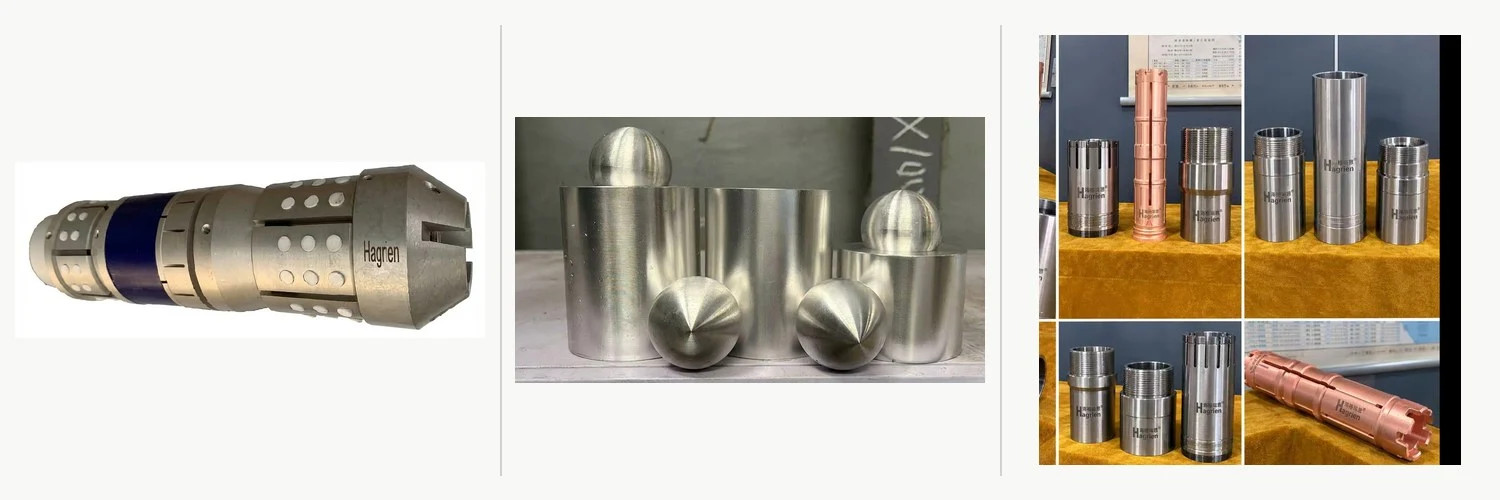
Understanding Downhole Completion Tools: Functions and Types
Without the right isolation, a well is just a hole that costs a lot of money. Downhole completion tools connect a drilled wellbore to an asset that is producing. They do this by controlling flow, separating zones, and keeping the wellbore healthy throughout the well's producing life.
Mechanical Tools: Bridge Plugs, Frac Plugs, and Setting Tools
The most heavy loads are handled by mechanical assemblies. Bridge plugs isolate the whole bore during multiple stages of fracturing, and frac plugs let you stimulate from the heel to the toe without having to retrieve the coiled tubing. Setting tools, whether they are hydraulic or electric line, need to be able to consistently set force across a range of collar weights and pipe IDs. HAGRIEN's line of setting tools can handle up to 15,000 psi differential pressure and 350°F, which is enough for most unusual and HPHT well types found in U.S. operations.
Hydraulic and Inflatable Tools: Packers and Seal Assemblies
Elastomer closing elements are used in both retrievable and permanent packers to keep zones separate when tension, compression, and pressure are all applied at the same time. The temperature, H₂S partial pressure, and CO₂ level of the bottomhole determine which elastomer to use: Viton, Aflas, or Chemraz. Tools made to API 11D1 go through gas-tight validation according to ISO 14310 V0 standards. This makes sure that there is no leakage even under the worst load conditions.
Dissolvable Components: Mandrels, Connectors, and Slip Carriers
Dissolvable components are a new type of hardware that differs from the old ones. After the treatment window is over, magnesium-alloy mandrels, connectors, and slip carriers dissolve in produced brine or stimulation fluid, getting rid of the need for wireline or coiled tubing runs. HAGRIEN makes engineered magnesium alloys that dissolve in downhole finishing tools like mandrels, connectors, and slip carriers. These alloys have controlled dissolution rates that are based on the temperature, salinity, and goal timeline of the well.
 Criteria for Choosing the Right Downhole Completion Tools
Before you can choose the right downhole completion tools, you need to know your working environment. This includes not only the pressure and temperature ratings, but also the fluid chemistry, lateral length, completion architecture, and retrieval philosophy.
Pressure, Temperature, and Material Compatibility
Make sure that the rating of every part in the string goes beyond the highest expected surface treatment pressure, with a suitable safety factor. For bad service, NACE MR0175/ISO 15156 controls the choice of metals and requires proof of resistance to sulfur stress cracking (SSC) and chloride stress corrosion cracking (SCC). Full material test reports (MTRs) for HAGRIEN's alloy steel parts confirm their chemical make-up and mechanical properties at the right temperature ranges.
Dimensional Precision and Assembly Compatibility
Tolerance stack-up is a real risk in tool systems made of more than one piece. If you buy slip carriers, mandrels, or connectors from a company outside of your company, make sure that the cutting tolerances match your design plans, not just the catalog spec sheets. Hagrien uses customer drawings as direct input and uses batch-level dimensional traceability to make sure that every piece that leaves the shop matches the print that your engineers sent out.
Dissolvable vs. Non-Dissolvable: Making the Right Call
When teams have to choose between dissolvable and traditional gear, these are the main trade-offs they should think about:
- Interventionless plug-and-perf: Dissolvable bridge plugs and mandrels eliminate coiled tubing cleanout costs — typically $80,000–$150,000 per well in unconventional programs — by dissolving in situ over days to weeks depending on fluid salinity and temperature.
- HPHT environments: Conventional alloy steel and specialty elastomers remain the standard where bottomhole temperatures exceed the dissolution window of current magnesium alloy systems or where long-term isolation is required.
- Refracturing candidates: Dissolvable slip carriers leave a clean bore for subsequent stimulation, whereas mechanically retrieved components require verified post-retrieval bore gauging before re-entry.
Before you send out an RFQ, you should get feedback from both your buying team and your completion engineers on this choice because it has a direct effect on the total well cost and the risk of intervention.
Latest Technologies and Innovations in Downhole Completion Tools
Engineered Dissolution Windows in Magnesium Alloys
The field has come a long way since the first generation of dissolvable tools, which had unpredictable behavior when they broke down. Modern downhole completion tools for dissolvable downhole completion depend on tuning the alloy composition by changing the amount of rare earths added, the fineness of the grains, and the extrusion parameters. This makes the dissolution rates consistent across certain temperature and salinity ranges. Before any material is sent to a customer, HAGRIEN's CNAS-accredited HPHT laboratory checks the performance of dissolution in conditions that are typical of the field.
Smart Sensor Integration and Real-Time Monitoring
Fiber optic and electronic gages that are permanently placed now let workers keep an eye on pressure, temperature, and flow distribution across each stage without having to pull completion strings. Even though HAGRIEN focuses on the mechanical and material side, the parts we sell are made to fit gage mandrels and fiber feed-through ports that are shown on customer drawings.
Corrosion-Resistant Metallurgy and Surface Treatments
Thirteen-Chrome, Super-13-Chrome, and duplex stainless steel have come a long way, and now industrial tubes and packer bodies in CO₂-rich reservoirs last longer. Also, high-performance coats and phosphate treatments on slip carriers and mandrels have lowered the chances of galvanic coupling in mixed-metal systems. This is especially important when switching from parts that dissolve to parts that don't dissolve in the same tool string.
 Procurement Guide: How to Source the Right Downhole Completion Tools
Accreditation, Certifications, and Documentation
The quality system of a supplier tells you how repeatable their work really is. Check that the process is controlled by ISO 9001, that downhole tool parts are recognized by API, and that mechanical and dissolving testing is done in a lab that is accredited by CNAS or a similar organization. HAGRIEN has ISO 9001, ISO 14001, ISO 45001, API certification, and a laboratory that is recognized by the CNAS. They also include COA/COC/SDS packages with every shipment to help your internal audit and supplier approval processes.
Lead Times, MOQ, and Prototype-to-Production Transitions
When making completion tools, small-batch orders with multiple specifications are the norm, and your supplier needs to be ready for that. HAGRIEN can handle orders with different specifications, works from customer drawings, and helps with the change from prototypes to production using the same set of process controls and documentation. Standard sizes of dissolvable parts ship in two to four weeks; custom-engineered specs ship in four to eight weeks, with faster options for projects that need to be done quickly.
Pricing Structure and Total Cost of Ownership
The price per unit is an input. The total cost of buying includes the cost of rework because of dimensions that don't match up, delays because of missed MTRs, and intervention costs because a tool broke down too soon. The closed-loop method used by HAGRIEN, which combines metal design, extrusion, and precise CNC machining all under one roof, lowers the risk of material-machining mismatches that cause quality problems further down the line. Our U.S. branch helps with planning, communication, and logistics in North America to lower the risk of program performance.
Ensuring Long-Term Success: Maintenance and Operational Tips
Routine Inspection Protocols
Downhole completion tools that have been damaged by surface handling before being used almost never work properly downhole. Set up a pre-run inspection plan that checks the wellsite for thread form, elastomer condition, slip face sharpness, and dimensional checks. For parts that dissolve, make sure that the secure package hasn't been broken and that the parts haven't been exposed to fluids yet.
Troubleshooting Common Field Issues
There are three main reasons why finishing tool kits break down in the field: the wrong make-up torque on threaded connections, elastomer extrusion from annular gaps that are too large, and slip contact failure from worn or dirty cone surfaces. Setting up torque charts and assembly records for each run cuts down on mistakes that happen again and again and gives shop managers a way to measure progress over time.
Documentation and Traceability for Long-Term Reliability
Batch traceability isn't just a box to be checked when you buy something; it's how you can look into a failure, take action to fix it, and keep future wells from having the same issue. HAGRIEN sends all of its machined and dissolvable parts with full batch paperwork, inspection records, and material certifications to help with post-job reviews and failure analysis in the field.
 Conclusion
It takes more than a catalog search to find the right completion hardware for your well. To do this, you need to know your operating window, make sure that the materials and sizes are compatible, and work with a source whose paperwork can stand up to qualification checks and analysis after the job is done. The choices you make during the procurement stage have a direct effect on your overall well cost and finish reliability. This is true whether you are switching from traditional to dissolvable components or getting custom-machined parts for a mixed tool string. The easiest way to get regular, repeated well performance is to follow a set of steps, from choosing the materials to keeping records that can be used to track them.
FAQ
1. What is the difference between a V0 and V3 rated completion tool?
V0 (ISO 14310) means that the seal is gastight and there is no bubble leaking under combined load conditions. This is the highest level of seal integrity. V3 is a standard for testing liquids that allows very little leaking within certain limits. V0-rated packers and bridge plugs are usually used in gas wells and HPHT settings.
2. How do dissolvable bridge plugs dissolve without leaving debris?
Engineered magnesium alloys respond with brine or stimulation fluid that contains chloride. This turns the metal into magnesium hydroxide and magnesium chloride, which can both be dissolved in water. The rate of dissolution is controlled by the type of alloy, the salinity of the fluid, and the temperature of the bottomhole. There is no solid debris that would stop production or make it harder to get back into the wellbore later.
3. Can retrievable packers be reused?
Yes, as long as they are completely taken apart, the elastomer is replaced, and they are successfully re-certified to the original API standards. If you skip any part of the re-certification process, the next run could have an unknown risk.
4. What lead times should I plan for when sourcing custom dissolvable components?
Standard sizes usually take two to four weeks to ship. For special requests like one-of-a-kind OD/ID pairs, designed dissolution windows, or non-standard alloy systems, it usually takes 4–8 weeks from the time the drawing is confirmed until it is delivered.
5. What documentation should accompany each shipment?
A Certificate of Analysis (COA), a Certificate of Conformance (COC), a dimensional inspection report, and a material test report (MTR) should be the bare minimum of paperwork. A dissolution verification report from a recognized laboratory adds another level of approval trust for parts that can dissolve.
Partner with HAGRIEN for Your Downhole Completion Tool Needs
HAGRIEN offers a full range of downhole completion tool parts, including dissolvable mandrels, connectors, slip carriers, bridge plugs, setting tools, and elastomer assemblies. These parts are rated to 15,000 psi and 350°F, and are made with API-recognized quality controls and full batch traceability. We reply to RFQs within 24 hours and give official quotes within 1–3 business days. We are a trusted downhole completion tools maker with seven years of production experience and a U.S. coordination presence. To get a quote package, email your drawings or questions to cyrus@us-hagrien.com or go to us-hagrien.com.
References
1. American Petroleum Institute. API 11D1: Packers and Bridge Plugs. 2nd ed. API, 2015.
2. NACE International. MR0175/ISO 15156: Petroleum and Natural Gas Industries — Materials for Use in H₂S-Containing Environments in Oil and Gas Production. NACE International, 2015.
3. International Organization for Standardization. ISO 14310: Petroleum and Natural Gas Industries — Downhole Equipment — Packers and Bridge Plugs. ISO, 2008.
4. Society of Petroleum Engineers. SPE-179117-MS: Dissolvable Plug Technology for Plug-and-Perf Completions in Unconventional Wells. SPE, 2016.
5. Veil, J.A., and J.R. Smith. Produced Water Management Technology Descriptions. Argonne National Laboratory, 2019.
6. World Oil. Completion Technology Report: Advances in Dissolvable and Degradable Downhole Components. Gulf Publishing, 2022.

USER EVALUATE
Here is the customer's evaluation of us