_1776908283214.jpg)




Dissolvable Magnesium Alloy Grade Selection Guide
A dissolvable magnesium alloy is only useful if it disappears on schedule — and stays strong until then. That dual demand is what makes grade selection the most technical purchasing decision in the dissolvable-tool supply chain. Pick the grade with the highest strength and you may end up with debris that outstays its welcome; pick the fastest-dissolving grade and the part may fail before the job is done.
This guide explains how to read a dissolvable magnesium alloy grade table like a completion engineer: which numbers are guarantees, which are comparative references, and why the strength–dissolution trade-off decides most selections before price ever enters the conversation.
Two Kinds of Numbers — Don't Treat Them the Same
A grade table gives you two families of data, and they mean very different things.
Mechanical values are guaranteed minimums (≥). Tensile strength, yield strength, elongation, and hardness in the table below are lower bounds a grade must meet — not typical or average values. Design against the minimum, not against a middle you hope for. If a component needs 200 MPa tensile as a design floor, the grade you pick must carry a ≥ value above that floor with margin, because this is the number the material is held to.
Dissolution rates are comparative references under controlled lab conditions. Each rate was measured in a specific fluid at a specific temperature — for example 93°C in 3% KCl brine. That rate tells you how one grade compares to another under the same conditions. It does not predict how fast a part disappears in your well, where the fluid chemistry, temperature, flow, and surface-area-to-volume ratio all differ. Treat dissolution figures as relative ranking tools, never as field-timing guarantees.
That distinction is the foundation of everything below.
The Core Trade-off: Strength vs. Disappearance
Across 23 catalog grades, one pattern dominates: the strongest grades dissolve slowest, and the fastest-dissolving grades are mechanically modest. Compare two grades measured under identical conditions (93°C, 3% KCl):
- AML023: tensile ≥450 MPa, yield ≥340 MPa — and a slow dissolution rate of 10–30 mg/(cm²·h)
- AML004: tensile ≥220 MPa, yield ≥160 MPa — and a fast dissolution rate of 130–150 mg/(cm²·h)
Both numbers are from the same test condition, so the comparison is legitimate: AML023 carries roughly twice the guaranteed strength of AML004, while AML004 disappears roughly five to ten times faster. That is the decision in miniature. A load-bearing bridge-plug mandrel lives in AML023's territory; a short-lived diversion ball that must be gone before flowback lives in AML004's.
Fast-Dissolving Grades (93°C / 3% KCl family)
When the part's job is over in hours or days — frac balls, diversion elements, temporary isolation plugs — you want high dissolution with adequate (not maximal) strength. Within the 93°C/3% KCl test family:
| Grade | Tensile ≥ (MPa) | Yield ≥ (MPa) | Elong. ≥ (%) | Dissolution mg/(cm²·h) |
|---|---|---|---|---|
| AML004 | 220 | 160 | 12.0 | 130–150 |
| AML005 | 300 | 200 | 15.0 | 90–140 |
| AML020 | 100 | 60 | 7.0 | 50–100 |
AML004 is the fastest in the whole catalog under this condition. AML005 trades some dissolution speed for a meaningfully higher strength floor (300 vs 220 MPa tensile) — the right call when the temporary part still sees real differential pressure. AML020 sits at the light-duty end: modest strength, moderate speed, suited to low-load temporary elements.
A note on reading the range: "130–150" is a measured band, not a precision target. Use it to rank, not to calculate disappearance to the hour.
Load-Bearing Grades: Strength First, Dissolution Controlled
When the part must hold — setting-tool components, plug bodies, anything that sees service loads before it dissolves — strength minimums drive the pick, and dissolution becomes the controlled variable:
| Grade | Tensile ≥ (MPa) | Yield ≥ (MPa) | Elong. ≥ (%) | Dissolution mg/(cm²·h) | Condition |
|---|---|---|---|---|---|
| AML023 | 450 | 340 | 3.0 | 10–30 | 93°C/3% KCl |
| AML021 | 400 | 300 | 3.0 | 40–60 | 93°C/3% KCl |
| AML018 | 400 | 280 | 4.0 | 40–60 | 93°C/3% KCl |
| AML013 | 370 | 260 | 2.5 | 50–70 | 93°C/3% KCl |
| AML001 | 310 | 220 | 15.0 | 2–10 | 93°C/3% KCl |
| AML026 | 310 | 220 | 8.0 | 0–5 | 93°C/3% KCl |
AML023 is the catalog's strength leader (≥450 MPa tensile) with the second-slowest dissolution rate — the grade for parts that must perform mechanically for the full job window. AML001 and AML026 pair solid 310/220 MPa strength with the slowest dissolution rates in the catalog (2–10 and 0–5 mg/(cm²·h)) — they are the "stay put, then eventually disappear" grades, not the fast-cleanup ones. Watch elongation on the high-strength end: AML013, AML021, and AML023 all carry elongation minimums of 2.5–3.0%, which is the price of that strength — less ductility, less tolerance for bending or impact loads. If the part sees flexure, AML001's 15.0% elongation minimum is the safer mechanical profile despite its lower strength ceiling.
Low-Temperature and Mild-Brine Grades — A Separate Family
A third family of grades was characterized under milder conditions — 50°C in 0.84% KCl, and one grade at 43°C in 0.05% KCl. These numbers cannot be ranked against the 93°C/3% KCl family; different fluid, different temperature, different test. Within their own family:
| Grade | Tensile ≥ (MPa) | Yield ≥ (MPa) | Dissolution mg/(cm²·h) |
|---|---|---|---|
| AML022 | 275 | 200 | 90–110 |
| AML024 | 270 | 220 | 60–120 |
| AML012 | 260 | 210 | 60–100 |
| AML006 | 270 | 190 | 40–80 |
| AML016 | 230 | 180 | 45–65 |
| AML011 | 220 | 170 | 30–60 |
| AML010 | 220 | 170 | 30–50 |
| AML017 | 260 | 220 | 50–70 (43°C/0.05% KCl) |
These grades matter when the application environment is cooler or less saline — shallow wells, surface-handling exposure, or tools that sit in mild fluid before reaching bottom-hole conditions. AML022 is the fastest dissolver in this family; AML006 and AML010 the more measured ones. But repeat the rule: do not conclude that AML022 "dissolves slower than AML004" — the tests are not comparable, and the catalog does not claim they are.
A Practical Selection Sequence
For buyers evaluating a dissolvable magnesium alloy grade, this order avoids the two classic mistakes (over-strengthing into a non-dissolving part, or under-strengthing into a failure):
- Define the mechanical floor first. What is the minimum tensile and yield the part needs, and what elongation does the loading mode demand? Filter the catalog to grades whose ≥ values clear that floor with margin.
- Match the dissolution window to the job — under comparable conditions. Of the surviving grades, rank dissolution speed only within the same test-condition family. Faster is not better; right-speed is better.
- Respect the ductility price. Above ~350 MPa tensile in this catalog, elongation minimums drop to 2.5–4%. Confirm the part's real loading (bending, impact, thread makeup) against that.
- Validate under your fluid and temperature. Catalog dissolution bands are comparative references. Before committing to a grade, ask the supplier for dissolution behavior closer to your actual conditions — and expect a validation conversation, not a catalog lookup.
The Manufacturing Side
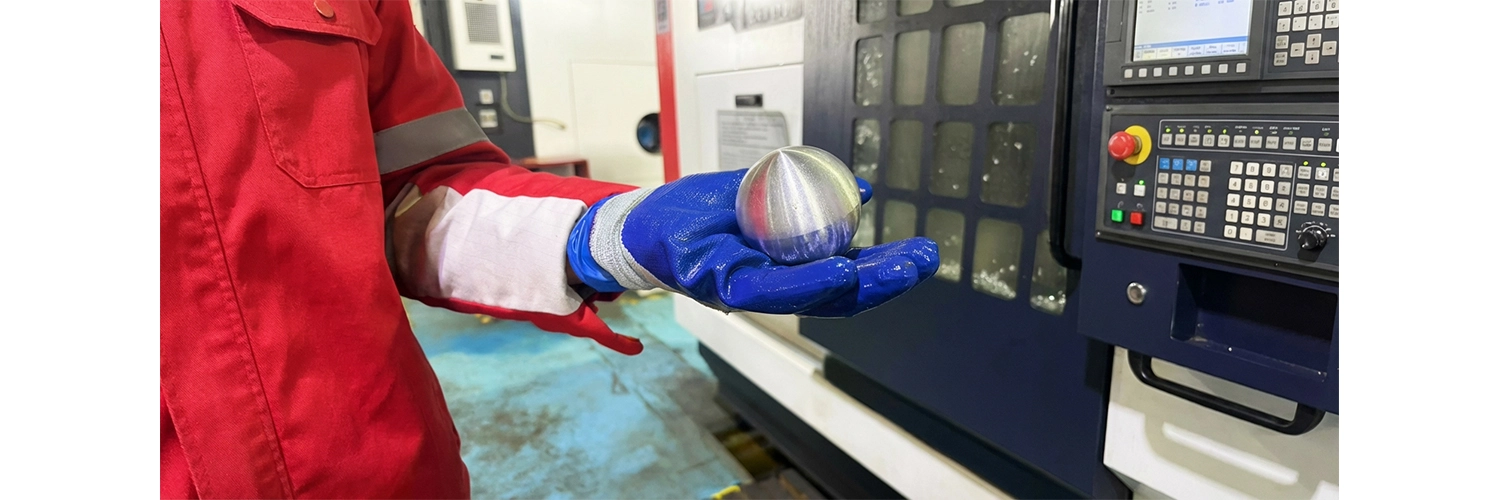
Grade selection ends where manufacturing begins. A dissolvable magnesium alloy grade is a material specification; the part is what goes downhole. HAGRIEN machines dissolvable components in-house from bar stock and billets — CNC machining with batch traceability and COA/COC documentation on every lot — so the grade you select is the grade you can verify, heat by heat.
Talk to HAGRIEN
If your team is selecting a dissolvable magnesium alloy grade for a new tool — or re-grading an existing design that dissolves too fast or too slow — share the mechanical requirements, the well's temperature and fluid conditions, and the target disappearance window. We'll map your requirements against the 23-grade catalog and tell you which candidates actually fit, with the test conditions stated honestly.

USER EVALUATE
Here is the customer's evaluation of us