




Is a Plug-and-Perf Alternative Better for Continuous Pumping?
A plug-and-perf alternative may improve pumping continuity when intervention costs and stage transition time are major factors in well economics. Depending on the design of the completion, sliding sleeves or dissolvable plug systems may obviate the requirement for some wireline operations, perforating logistics or drilling out after fracturing. These benefits are not entirely universal. Conventional plug-and-perf may still be the technique of choice in cases where control of perforation at the cluster level is critical, as well as the knowledge of the operational processes or current service architecture. Do not assume a completion approach without consideration of activation, pressure verification and stage sequencing for continuous pumping. This guidebook instructs the completion managers and consultants on how to examine the solutions using standard technical, operational and economic criteria.
 What a Plug-and-Perf Alternative Is and Why Pumping Continuity Matters
What Counts as a Plug-and-Perf Alternative
A plug-and-perf alternative is a multistage completion approach designed to reduce or change some of the perforating, stage-isolation, or drill-out operations associated with conventional plug-and-perf. The category includes ball-activated sliding sleeves, key-activated sleeves, open-hole packer systems, dissolvable bridge plugs, and coiled tubing-actuated sleeves.
Not all of these technologies function the same way. Sliding sleeves are used to open treatment ports by a shifting action . Dissolvable bridge plugs are meant to be temporary isolation devices that dissolve under certain circumstances. Proper borehole and isolation design is the basis of open-hole packer systems. The processes that are therefore avoided or decreased vary according to the particular system and completion configuration.
The right choice begins with the well design comprising casing or open-hole layout, number of stages, pressure and temperature requirements and future intervention plans. A technique that removes one procedure could impose additional limitations therefore it must be evaluated against the whole completion sequence, not just a single performance promise.
Where a Conventional Program Loses Pumping Time?
A typical plug-and-perf cycle involves setting a plug, running in and firing perforating guns and preparation for the next fracture stage. Time between stages is a mix of wireline deployment, tool handling, perforating operations and associated pressure control procedures. Sequence and timing will depend on the precise well, equipment and technique of operation.
Plugging and perf setups may require grinding and cleaning after fracture. These operations may increase equipment time, fluid requirements and debris management. The magnitude of this load depends on the design of the plug and if there are any further intervention requirements.
Six significant areas to compare are: wireline operations, perforating logistics, plug insertion and drill-out, downhole component limitations, uncertainty of tool status and internal diameter available for future access. Not all of them apply to each completion and the baseline must be a representation of the specific program not a generic cost model.
Why Small Delays Add Up at Scale?
The stage transition time may have a significant influence on a multistage completion timetable as the time of individual operations accumulates over the well.
Hypothetically, if a 40 stage well had 30 minutes of extra wait time every stage, the total wait time would be 20 hours. This is not field data. This calculator shows the impact of repeated delays, but it does not show how much time a given option might save.
The economic importance is dependent on the activities that are included in that wait time, the cost of the active spread, and the possibility of additional work done simultaneously. A realistic comparison must thus distinguish the unnecessary transition time from the pumping time, mandatory safety checks and other activities that would still be necessary under either finishing technique.
For operators evaluating a plug-and-perf alternative, the relevant question is whether the proposed system can reduce total operational time and cost under the planned well conditions. Stage count provides useful context, but it does not establish suitability or savings on its own.
How Sliding Sleeves and Dissolvable Plugs Keep Pumping Moving
Key-Activated Sleeves Open Stages Without Perforating
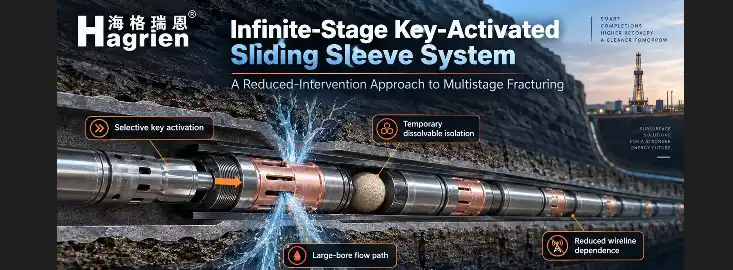
A sliding sleeve contains ports that can be opened through a designated shifting mechanism. In a suitable completion design, opening the sleeve provides a treatment pathway without requiring conventional perforating guns at that stage.
A key-activated design uses a compatible key and sleeve profile to initiate the intended movement. Unlike a conventional ball-drop arrangement that may use progressively sized seats, a key-activated system can avoid that particular source of internal-diameter reduction. Actual access restrictions still depend on the completion geometry and the tools used.
HAGRIEN offers a dissolvable bridge plug paired with a key-activated sliding sleeve as a plug-and-perf alternative. The intended operational benefit is to reduce selected wireline and perforating activities. Whether the design eliminates a particular operation depends on the complete installation, activation, isolation, and treatment sequence.
Reducing the handling of perforating guns may also reduce certain associated personnel exposures, but the overall safety benefit should be evaluated against the hazards and controls of the proposed operating procedure. Before deployment, confirm the sleeve's activation method, pressure requirements, failure response, and compatibility with the well design.
Dissolvable Bridge Plugs Remove the Drill-Out
Dissolvable bridge plugs are used for temporary isolation during stimulation and thereafter disintegrate in certain wellbore circumstances. If the chosen plug provides the requisite performance, the completion may not need a normal post-fracturing milling procedure. Any further cleaning or intervention is based upon tool design and the downhole conditions that are seen.
The dissolution behavior is dependent on the material composition, temperature, salinity, fluid chemistry and exposure period. The findings from one fluid or temperature range cannot be extended to a separate well. Pressure integrity during stimulation and dissolution after treatment are two different performance criteria that should be examined separately.
HAGRIEN says it has in-house melting and extrusion of dissolvable magnesium alloy, with bar diameters up to 300 mm, and modifications to alloy and process parameters for diverse operating needs. Verify the essential requirements, material alternatives available, and the production records for the specific product to be evaluated.
The objective of this plug-and-perf alternative is to reduce selected intervention requirements and simplify the completion workflow. A claim that the plugs will dissolve within a specific window or allow production weeks earlier requires supporting test data and well-specific evidence. Operators should establish acceptable dissolution criteria, the method of verification, and contingency procedures before committing to a field trial.
Where Pumping Still Pauses
No plug-and-perf alternative should be assumed to provide uninterrupted pumping. Depending on the design, crews may still need to activate a sleeve, verify pressure response, confirm stage isolation, or complete other required checks before proceeding.
You also want to think about failure modes that might occur. The sleeve may not operate as designed, and the dissolvable component may react differently in the real well fluid than in laboratory tests. When applicable, fluid sampling and operational methods that are recorded might assist the team assess these uncertainties.
Before the job, determine the allowable sequence of operations, pressure limitations, activation checks and reaction to failed or delayed activation. Where a mechanism of backup exists state the conditions under which it will be utilized and how it will be used. The realistic goal is to minimize unnecessary phase transition time while keeping the essential verification processes.
Any claim of near-continuous pumping must be substantiated by a clear measuring technique and information from a similar application. Shorter transitions may provide an operational gain, but not a replacement for dependable isolation and pressure control.
 Comparing a Plug-and-Perf Alternative With Conventional Completion Methods
An Item-by-Item Cost and Time Comparison
A useful comparison should account for all material differences between the current completion program and each shortlisted plug-and-perf alternative. A single headline savings estimate is not enough to determine whether a different method improves well economics.
Begin with wiring and perforating services. Record number of trips, crew time and equipment expenditures as well as any applicable standby fees. Next, determine the expenses related with plugs, milling, cleanout, coiled tubing, fluid consumption, and debris management if applicable. For sleeve based systems consider tool cost and any change in stage changeover time or extra operational requirements.
Costs associated with risk should be separated from normal operating expenditures. Comparisons may be affected by lost-in-hole incidents, failed activation, stopped milling assemblies and corrective work, but estimations should be based on the operator’s records or explicitly stated assumptions.
Use the same well scope, number of stages, cost period, and service-rate base for both techniques. If an alternative removes an operation, then remove that cost only if the operation is, in fact, unneeded under the suggested design. Include new equipment, testing, training and certification costs when relevant.
This technique provides the project team with a verifiable comparison of estimated cost, operational time and uncertainty without depending on supporting savings figures.
Operating Boundaries: Stages, Rate, and Inclination
Every plug-and-perf alternative has an operating envelope that must be matched to the target well. Relevant parameters include rated differential pressure, temperature range, maximum pumping rate, proppant concentration, casing dimensions, well inclination, lateral length, and planned stage count. Other limits may apply depending on the activation mechanism and completion configuration.
Ask vendors to provide the circumstances covered by their product specifications and accompanying test results. Field experience must be provided in sufficient context to evaluate whether it is applicable to the proposed application. A stated stage count is not a guaranty that the system has been tested under the same pressure, fluid, trajectory, or pumping circumstances.
HAGRIEN is marketing their solution for atypical wells such as extended-reach laterals and certain refracturing programs. Each of these applications must be considered separately, and any deepwater or other specific application needs validation of the exact tool design, operating circumstances and certification criteria.
Give the supplier the well diagram & projected operating parameters. Request a documented evaluation of the relevant limitations, discovered gaps, and any further tests needed prior to deployment. whether the well falls beyond the proved operating envelope, the team should determine if additional qualification is possible, or whether another completion approach is more suited.
Where Conventional Plug-and-Perf Still Fits
In situations where cluster-level perforation placement, stage-by-stage design flexibility, or the availability of existing service infrastructure is crucial, conventional plug-and-perf might still be the optimal option. It may also be economically viable on shorter laterals or fewer stage wells if the potential time saved in interventions does not justify the expense of qualifying and implementing an alternative.
The procedures may also vary depending on how the treatment fluid enters the formation. Changing from perforated clusters to sleeve ports may alter the available entrance sites and stimulation design. Reservoir and completion engineers should assess the consequences for fluid placement, isolation and the planned treatment goals rather than assuming that fewer operations would inevitably provide equal stimulation outcomes.
A plug-and-perf alternative deserves consideration when it addresses a material cost or operational constraint and meets the well's technical requirements. Where the existing method performs reliably and the proposed alternative offers no demonstrated overall advantage, retaining conventional plug-and-perf is a reasonable engineering decision.
Choosing, Piloting, and Verifying a Plug-and-Perf Alternative
Selection Criteria That Matter
The physical and operational requirements of the well—lateral length, measured depth, casing or open-hole design, number of stages, pressure, temperature, fluid system, and future intervention needs—start the selection process. The project team must be aware of the limitations of the available equipment and the established operating practices.
Then you build a list of criteria to measure against. These may include stage transition time, activation success rate, isolation performance, posttreatment access, intervention needs and expense per stage. The specific criteria and the levels of acceptance must be compatible with the goals of completion and must be set in advance for the pilot.
When you compare candidates, do it with the same baseline and same technique of computation as the conventional plug and perf. Recognizes expected benefits and proven outcomes. Note any implicit assumptions you are making in any cost or time estimates.
Supplier certification should include product documentation, uniformity of manufacture, delivery capabilities and technical support. When a recommendation is made the operating parameters and limits for each reference case should be retained so that the client may decide whether the evidence is applicable to the well being suggested.
Running a Pilot Well Without Risking Your Reputation
A pilot of a plug-and-perf alternative should be designed to answer specific technical and commercial questions while keeping operational risks within an acceptable range. Select a well whose conditions are representative of the intended application, and establish the baseline using a comparable offset or a clearly documented existing completion program.
Prior to mobilization: Agree on test scope, acceptance criteria, responsibilities and contingency procedures. The field supervisor and appropriate service teams should examine the operating sequence, activation requirements, pressure checks, protocols for handling fluids, and reaction to unusual tool behavior.
During operation, acquire the data necessary to assess the given goals. Depending on the system, information may include activation outcomes, stage transition duration, pressure behavior, isolation performance, intervention needs and any detected variation from the intended method. Do not only look at the ultimate completion conclusion, but also record successful operations and difficulties.
HAGRIEN says their help includes application engineering, process coaching, training and remote problem shooting. Identify what services are accessible for the particular pilot, who will offer them, how technical difficulties will be escalated in the field execution.
After the study, compare the outcomes to the baseline and note if the technology meets the established criteria. The conclusion might favor continued deployment, more certification, design modifications, or limited usage in a smaller well set. A recorded judgment based upon measurable outcomes is more defensible than a conclusion based just upon the projected advantages at first.
Verification Standards and Documents
Standards and supporting records help establish whether a product has been evaluated against specified requirements. However, the applicable standard, edition, validation category, and product scope must be confirmed before drawing conclusions about a particular plug-and-perf alternative.
ISO 14310 and API Specification 11D1 address packers and bridge plugs. Before relying on a stated validation grade, confirm which standard and edition apply, which product was tested, and what the test documentation actually demonstrates. Do not assume that a reference to V0, or to a particular validation framework, proves that every product in a supplier's range has passed the same requirements.
For material and batch documentation, request the applicable Certificate of Analysis (COA), Certificate of Conformity (COC), Safety Data Sheet (SDS), and traceability records. For dissolvable tools, also request relevant pressure-test results, dissolution data, dimensional checks, and functional test records. The conditions and acceptance criteria associated with each test should be clear enough for the engineering team to assess their relevance to the target well.
HAGRIEN reports ISO 9001, ISO 14001, and ISO 45001 certifications, API-related recognition, and access to a CNAS-accredited high-temperature, high-pressure laboratory. The precise status, scope, and applicability of these credentials should be confirmed through the relevant certificates and supporting documentation. Company-level management-system certification and laboratory accreditation should not be treated as substitutes for product-specific validation.
A complete qualification package allows operators, consultants, and auditors to distinguish verified results from assumptions and determine whether additional testing is needed before field use.

Supply Timing and Technical Support
Supply planning should include product configuration, current inventory, production workload and project mobilization date. The time for completing an order may be influenced by custom measurements, material needs, testing and documentation.
HAGRIEN offers conventional sizes with lead periods of 2 to 4 weeks and bespoke specifications with lead times of 4 to 8 weeks, with accelerated alternatives available as conditions allow. These estimations should be validated against real order needs before inclusion into a well schedule.
The company also said it attempts to confirm needs within 24 hours and give a written price and delivery plan within 1 to 3 business days on most projects. Confirm the relevant service commitment for the particular request (particularly if unique engineering or further certification is necessary). Agreements should also be reached on the reporting of progress, export paperwork and North American cooperation before the order is completed.
OEM & ODM Customization If applicable, we may customize the materials or structure based on the OEM and ODM agreement, as long as it is technically feasible and meets the needed criteria. If you have a bespoke design, it should be thoroughly reviewed and validated and one should not assume that it would behave the same as an existing setup.
For any provider, the foundation for project planning is not an unconditional lead-time commitment, but a clear delivery schedule, defined technical responsibilities and an established method for resolving adjustments.
 Conclusion
A plug-and-perf alternative may improve pumping continuity when wireline operations, perforating logistics, or post-fracturing drill-out requirements make a significant contribution to well cost and schedule. Its potential value depends on the specific completion design, operating conditions, stage count, and future intervention requirements.
Key-activated sleeves and dissolvable bridge plugs address different parts of the completion process. A suitable design may reduce selected operations, but activation, pressure verification, and other required checks still need to be considered. Conventional plug-and-perf can remain preferable when cluster-level perforation control, established procedures, or existing service arrangements provide the better overall fit.
The decision should combine an itemized cost and time model, written operating limits, product-specific technical evidence, and a measured pilot against a documented baseline. Standards, material certificates, batch traceability, and supplier support should be verified within their actual scope. Ultimately, the better completion method is the one that meets the well's requirements and demonstrates its value through evidence, not one that promises the shortest pumping cycle.
FAQ
1. Does a plug-and-perf alternative give uninterrupted pumping?
No. A plug-and-perf alternative may reduce some of the waiting associated with conventional wireline and perforating operations, but activation, pressure checks, stage sequencing, and other required procedures can still interrupt pumping. The actual transition time depends on the completion design and operating sequence. Compare measured cycle times under comparable conditions before concluding that an alternative provides a meaningful improvement.
2. Which wells suit a plug-and-perf alternative best?
Wells with substantial intervention costs, extended-reach requirements, or repeated stage transitions may warrant closer evaluation. Selected refracturing programs may also benefit from reviewing alternative isolation and stage-access methods. However, stage count or lateral length alone cannot establish suitability. The decision should account for pressure and temperature limits, fluid chemistry, completion geometry, isolation requirements, and future access.
3. Can I keep my current service providers?
In many cases, yes. Changing the isolation or stage-access method does not automatically require replacing existing pumping, fluid-supply, or flowback providers. However, the revised operating sequence may change equipment requirements, responsibilities, or service scope. Discuss the proposed workflow with the relevant providers before the pilot to confirm compatibility and avoid scheduling conflicts.
4. What data should I request from a supplier?
Request the rated pressure and temperature limits, applicable casing and completion dimensions, demonstrated operating envelope, activation procedure, and relevant test data. For dissolvable products, ask for dissolution results under specified fluid and temperature conditions, together with the method used to evaluate performance. Also verify the applicable validation standard and grade, product-specific test records, COA and COC documents where applicable, and batch traceability. These records help determine whether the available evidence supports the intended application.
Request a Plug-and-Perf Alternative Review From HAGRIEN
If you are evaluating a plug-and-perf alternative, prepare the well schematic, planned stage count, lateral length, operating pressure and temperature, fluid chemistry, and future intervention requirements. This information provides a starting point for assessing the proposed completion design against your current method.
HAGRIEN offers a dissolvable bridge plug and key-activated sliding sleeve configuration for evaluation as an alternative to conventional plug-and-perf. The suitability of the system, expected reduction in intervention requirements, testing needs, and delivery schedule should be established for the specific project.
Email cyrus@us-hagrien.com to discuss the technical requirements and request the relevant specifications and quotation. Confirm the scope of engineering support, documentation, and delivery commitments with the company before finalizing a pilot plan.
References
1. ISO 14310, Petroleum and Natural Gas Industries — Downhole Equipment — Packers and Bridge Plugs. Verify the applicable edition and the requirements relevant to the product being evaluated.
2. API Specification 11D1, Packers and Bridge Plugs. Confirm the applicable edition and validation requirements before citing a particular grade.
3. SPE 133456, Thirty Years of Gas Shale Fracturing: What Have We Learned? (King), 2010. Verify the publication details and use only for claims supported by the source.
4. Economides and Nolte, Reservoir Stimulation, Third Edition, 2000. Use as background for stimulation engineering where relevant.
5. U.S. Energy Information Administration, Today in Energy: Hydraulic Fracturing Accounts for About Half of Current U.S. Crude Oil Production, 2016. Historical context only; it does not establish the performance or economic value of a specific completion technology.
6. API Guidance Document HF1, Hydraulic Fracturing Operations — Well Construction and Integrity Guidelines, 2009. Verify the edition and relevance before using it to support a technical or operational claim.

USER EVALUATE
Here is the customer's evaluation of us