




Key-Activated Sliding Sleeve for Shale Wells: Key Benefits
A key-activated sliding sleeve can provide selective stage access in multistage shale well completions. Each sleeve is configured to respond to a corresponding activation key so that the completion program can recognize the sleeve to be triggered. Depending on the system design, this method has the potential to remove wireline interventions for opening the stage and allow flexible sequencing. Other validation design concerns on the selected configuration include full-bore access after activation and compatibility with dissolvable seal pieces. This lesson explains how a key-activated sliding sleeve works, how it compares with different finishing methods and what information you need to choose and source it.
Why Shale Wells Need Dependable Downhole Flow-Control Tools?
Multistage shale completions require coordinated control of downhole flow, stage access, and isolation. The appropriate tool depends on the well design, operating conditions, and completion method. Understanding these requirements before selecting a sleeve helps engineering teams assess compatibility and identify potential operational constraints.
The Completion Challenges of Shale Wells
Long lateral horizontal shale wells may have many stimulation periods along the lateral. Formation characteristics may change over time periods, the completion design has to account the anticipated stage sequence, fluid placement, pressure requirements and isolation approach.
Hydraulic fracturing was a major contributor to domestic supply in 2015, when it accounted for almost half of U.S. crude oil production, the U.S. Energy Information Administration stated. King (2010) also details the development of technologies for fracturing shale. These references provide industry background but do not show performance of any specific finishing tool.
All steps should be performed according to well completion program. “More downhole interventions means more equipment, more people, more time and more pressure control needs.” In addition to stage access, operational complexity, compatibility with other finishing components and the presence of supporting evidence for its intended employment, an appropriate flow-control system has to be taken into account.
What a Key-Activated Sliding Sleeve Is
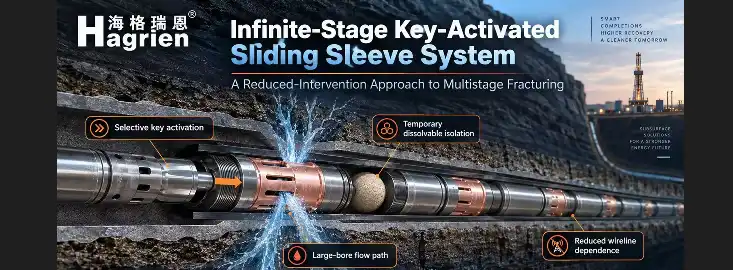
A key-activated sliding sleeve is a downhole completion valve installed as part of a completion string. Its internal sleeve moves when the compatible activation mechanism engages it, changing the flow path through the tool. The exact activation procedure and resulting flow configuration depend on the product design.
A key-activated design employs a matching key to identify and operate the desired sleeve, rather than ball-seat sequences or hydraulic activation. This may provide the operator the option to choose sleeves in a predetermined sequence, not a sequence based on the size of the ball and seat. However, the feasible sequence and the operating method must be verified with the actual tool design and completion program.
The key selection issue for completion engineers is whether the activation mechanism will offer the needed stage access and be consistent with the planned downhole activities.
Main Construction Features and Applications
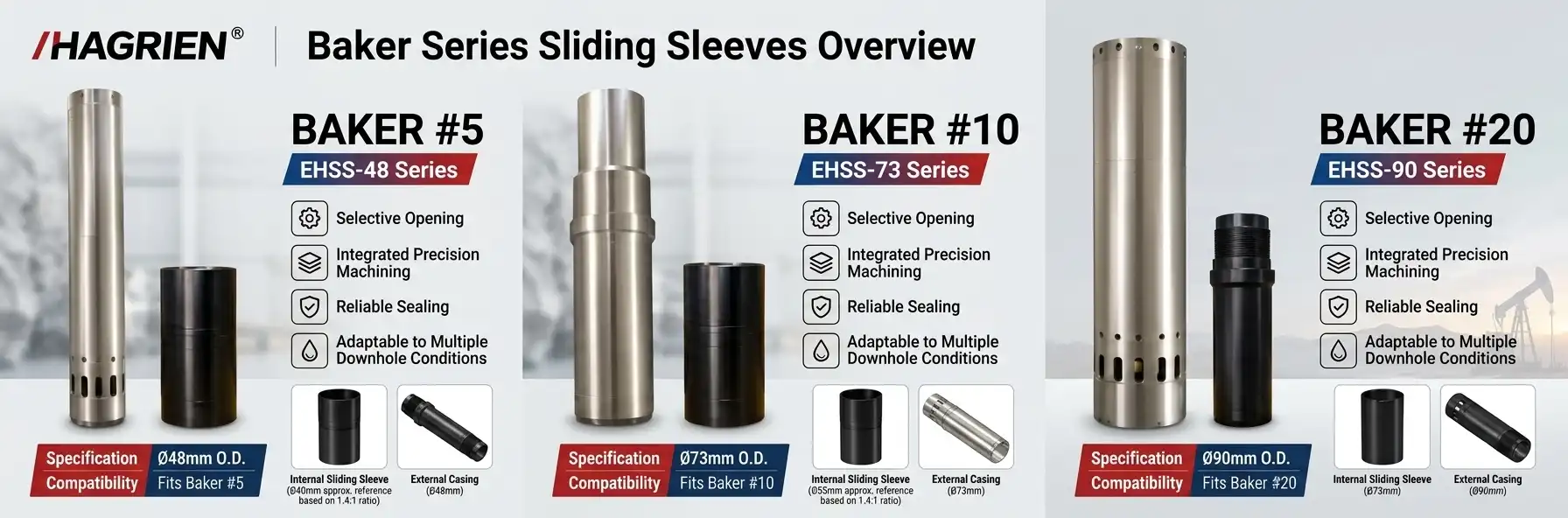
A typical sliding sleeve has an exterior housing, an inner sliding element, flow ports, sealing elements, and an activation interface. Operational limitations, materials, size and configuration are model dependant. Therefore, it is necessary to choose a specific sleeve with the appropriate casing specifications and internal clearance.
The HAGRIEN product configuration should be chosen according on the required internal diameter after opening, the tools that will pass through during the completion and the working conditions. Don't assume that the wide product category implies full bore claims, but verify model specific drawings and minimum-ID or drift information.
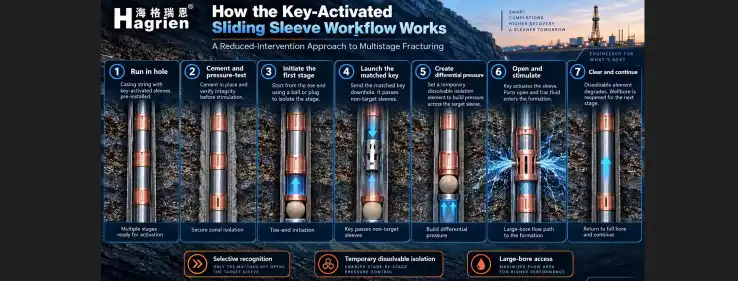
Another design consideration is compatibility with dissolvable seal sections. The sleeve opening mechanism is a separate problem to the sealing element material, required isolation function, exposure conditions and dissolution behavior. If the materials are compatible, the seal element should dissolve under the specified conditions. However, compatibility does not mean that no residue will remain.
Possible applications include multistage fracturing in horizontal wells and completion procedures that need selective downhole access. Re-fracturing, toe-stage initiation, extended-reach wells and deepwater applications should only be considered if the tool design, operating envelope and deployment strategy is suitable for the specific project.
How a Key-Activated Sliding Sleeve Works
The operating principle is based on engagement between the sleeve and its compatible activation key. Successful operation also depends on correct configuration, installation, and adherence to the manufacturer's procedure.
Operating Principle and Selective Opening
In a key-operated system, the activation key is intended to engage the chosen sleeve. When the key is run and operated in the stated way, the inner sleeve rotates to change the flow channel by means of ports thereon. Other sleeves are designed to remain in place until their activation mechanisms are triggered.
This setup may allow non-sequential staging choices if the system is designed for this operating mode. Before using it in a completion program, the operator should verify the key-matching scheme, the intended opening sequence and any limits on access or repetition of operations.
The practical benefit is unfettered access during the planning phase. The efficiency of the stimulation program with this flexibility is completely dependent on the goals of the reservoir, completion design and field operations.
Confirming an Opening Event
An opening event must be examined using the verification method defined for the chosen tool and completion system. Surface pressure, pumped volume and variations in injectivity may be important operational information. Some projects may additionally include acoustic or other downhole monitoring.
However, do not instantly assume these indications are solid evidence that a sleeve has completely expanded. Formation behavior, fluid characteristics, wellbore conditions, and the pumping schedule may also influence pressure and injectivity responses. The correct interpretation relies on the system and the monitoring data provided.
Prior to the operation, the completion team should specify the anticipated indications, the records to be gathered and the criteria for deciding whether the opening process has been successfully completed. The provider should outline the verification procedure for the tool and include the supporting documentation available for the proposed configuration.
Field Controls and Performance Factors
HAGRIEN's product description provides a key-based selective identification method and a series of operations. It also talks about pressure keeping records. During technical review, these descriptions should be compared to existing product documentation, including the appropriate model, test setup, acceptance criteria and operational limitations.
Field performance depends on accurate key matching, compatibility of casing and connection, quality of installation, wellbore conditions and following the operating procedure. Debris or other obstacles may impede tool movement. Function or sealing performance may be impacted by inappropriate operating circumstances.
The completion team should examine requirements for handling and casing preparation before deployment. A pre-job review with the supplier and field team may establish the activation method, anticipated operational indications, contingency procedures and documents necessary for post-job assessment.
Key Benefits of a Key-Activated Sliding Sleeve in Shale Wells
The potential benefits of a key-activated sliding sleeve depend on its design and how it fits into the completion program. Three areas deserve particular attention:
- Selective stage control: A compatible activation key is used to target the intended sleeve. Where the system enables non-sequential operation this allows flexibility in planning stage access. Its practical usefulness relies on the reservoir strategy and the tool’s operational limits.
- Potentially fewer interventions: Selecting a system that opens the desired stages without separate wireline-run opening procedures may decrease the number of interventions connected with stage opening. The exact amount of decrease relies on the whole operational sequence including any additional downhole activities necessary.
- Internal clearance and isolation options: Check the post-opening internal diameter and any dissolvable sealing-element arrangement for the particular configuration. These characteristics may facilitate subsequent access and temporary isolation goals, if suitable, in accordance with design restrictions and operational circumstances.
These considerations help completion teams compare stage selectivity, intervention requirements, and bore access. They should be evaluated alongside pressure and temperature ratings, system compatibility, operating procedures, and supporting test evidence.
Selective Stage Control and Flexible Sequencing
Reservoir properties may be variable throughout a horizontal lateral and the preferred stimulation sequence might be a function of geological interpretation, completion objectives and operational constraints. Where this is applicable to the selected system, a key-activated sliding sleeve may be utilized to allow for a desired opening sequence other than the predetermined sequence of ball seats.
The complete design should indicate which sleeves to operate, the proper activation keys, and the required order of operation. There should also be defined access limitations and contingency procedures in case the planned opening operation cannot be verified.
For background on the creation of fractures and the principles of stimulation see the literature on reservoir stimulation (e.g., Economides and Nolte, Reservoir Stimulation). They do not prove that a particular sleeve will increase production or stimulation efficiency. Such discoveries need data associated with the specific instrument and well conditions.
Full-Bore Access and Reduced Intervention
Internal clearance is crucial when a completion has to provide for further tools, logging procedures or other scheduled interventions. The phrase “full-bore” should be judged against the actual minimum inside diameter and the equipment size that must pass through the sleeve.
A post-opening flow channel may provide access preservation but should not be presumed to remain unfettered under all operational conditions. The completion team should study the sleeve drawing, any limits in other parts of the string, and any drift or passage criteria that may apply.
A system that does not need separate wireline operations for stage opening may also remove certain intervention procedures. However, the total impact on time and expense will be determined by the whole process, the rig or intervention resources, and any extra verification or contingency work necessary.
Compatibility and Serviceability
A sliding sleeve must be adapted to the larger finishing system and not be seen as an independent part. The technical assessment should include casing dimensions and connections, pressure and temperature requirements, fluid compatibility, cementing concerns, activation access and the needed internal clearance .
Where HAGRIEN asserts that its goods include quality-control processes, batch traceability, certified testing or controlled metallurgy, the proof for this should be sought and assessed. This may comprise appropriate drawings, inspection records, test reports, material documents, batch records when accessible. Any claim associated with CNAS should be verified with the appropriate laboratory, accreditation status, and extent of accreditation.
The evaluation should also include a material specification and proof for intended usage of dissolvable sealing elements, if present in the proposed design, under the projected well conditions. Manufacturing capabilities are not the only factors affecting the performance of the built completion tool. The accompanying documentation should be associated with the real component and application.
Key-Activated Sliding Sleeve vs. Alternative Completion Tools
Alternative completion systems differ in activation method, stage sequencing, equipment requirements, and operational workflow. The comparison should use the actual proposed configurations rather than assuming that every tool within a category has identical capabilities.
Comparison with Hydraulic and Ball-Drop Sleeves
Hydraulic sleeves are activated by hydraulic pressure, with the exact pressure route and control arrangement specified by the design of the system. For certain situations, extra control system integration could be needed. What we are interested in is how to actuate the sleeve, what equipment is needed and how can the system certify functioning.
Sleeves are operated by balls and matching seats in ball drop sleeves. In many systems, the order of opening is dictated by the sequence of ball to seat, but the intricacies and constraints are functions of design. Check the stage capacity, seat limits and access after operation to ensure they meet the manufacturer’s standards.
A key-activated sliding sleeve uses a compatible key to engage the intended sleeve. Where non-sequential operation is supported, it may offer more flexibility in stage selection than a system with a fixed ball-seat sequence. HAGRIEN's stated infinite-stage capability should be defined and verified for the specific design before being used as a basis for selection; it should not be interpreted as proof of unlimited practical stage capacity.
The comparison should consider activation reliability, stage count, sequence requirements, internal clearance, installation procedure, contingency planning, and total operating requirements.
Comparison with Plug-and-Perf
Plug and perf is a popular way of multistage stimulation. Perforating equipment is used to get access to a stage, and a plug is used to separate previously treated intervals depending on the process employed. This approach usually requires the use of stage-specific equipment and wireline operations, although the actual workflow relies on the completion design.
For stages that the system is meant to access via its activation mechanism, a sliding sleeve operated by a key may eliminate wireline-run opening procedures. That difference may modify the intervention process, but does not in itself provide a lower overall cost or better result in every well.
Plug-and-perf may provide the flexibility of perforation and cluster location, and operating familiarity might be vital when considering a change in finishing. Depending on design and task requirements, dissipatable plugs may eliminate the necessity for various mill-out operations. The sleeve-based method has a distinct opening and access arrangement therefore the comparison must include stage design, lateral length, intervention needs, bore access and the capabilities of the tools used.
ISO 14310 provides specifications for packers and bridge plugs. This is not to be used as a general qualification standard for sliding sleeves; its relevance for a particular part must be derived from the appropriate technical and procurement criteria.
Summary Evaluation Table
The following table provides a general comparison of common operating approaches. It is not a substitute for reviewing the technical specifications and procedures of the systems being considered.
| Factor | Key-activated sliding sleeve | Hydraulic sleeve | Ball-drop sleeve | Plug-and-perf |
|---|---|---|---|---|
| Stage selection | Compatible activation key | Hydraulic actuation | Ball and seat arrangement | Stage-specific perforating operation |
| Stage order | May support flexible sequencing if designed for it | Depends on system design | Often constrained by ball-seat sequence | Defined by the completion and perforating program |
| Separate wireline opening operations | May not be required for sleeve activation | Depends on system design | Generally not required for ball actuation | Generally required for perforating operations |
| Internal clearance after operation | Verify model-specific minimum ID | Verify model-specific minimum ID | Verify seat and bore restrictions | Depends on plugs, restrictions, and subsequent operations |
| Main selection consideration | Key compatibility and activation procedure | Hydraulic control and system integration | Seat sequence and stage capacity | Perforation flexibility and intervention workflow |
 Selecting, Installing, and Sourcing a Key-Activated Sliding Sleeve
Selection should begin with the well and completion requirements. The objective is to identify a configuration whose dimensions, activation mechanism, materials, operating limits, and documentation fit the planned application.
Selection Criteria for Your Shale Well
Start with the casing program, including casing size, weight, connection type, and required drift or minimum internal diameter. Identify the planned operating pressure and temperature, fluid composition, stage count, and desired opening sequence. The tool's interfaces with the rest of the completion should also be defined.
For sour-service applications, NACE MR0175/ISO 15156 may be relevant to material selection and resistance to cracking in specified H₂S-containing environments. Its applicability must be assessed for the actual material, environment, and service conditions; citing the standard alone does not establish that the complete sleeve assembly is suitable for sour service.
API Guidance Document HF1 addresses well construction and integrity considerations for hydraulic fracturing operations. It may provide useful context for project planning, but the team should confirm the applicable edition and the requirements relevant to the particular well and completion design.
Before approving a tool, request the applicable product drawings, dimensional information, activation instructions, operating limits, material information, and available test and quality records. Confirm the key-matching scheme and any limits on stage sequencing or internal clearance.
Bench testing or a single-well trial may be appropriate where the project risk, design novelty, or qualification requirements justify additional validation. The scope and duration should be agreed by the project team rather than assumed to follow a universal timetable.
Installation, Verification, and Common Risks
Inspect each sleeve on receipt against the purchase specification and approved drawings. Depending on the agreed inspection plan, checks may include the model and serial number, dimensions, ports, seals, threads, and relevant documentation.
During installation, follow the manufacturer's handling, make-up, and running procedures. Record each sleeve's location and orientation as required by the completion program, and confirm that the activation keys and sleeve identifiers correspond to the approved plan.
Potential issues include mismatched dimensions or connections, incorrect key pairing, debris or obstructions, installation damage, and operation outside the specified limits. These should be addressed through preventive checks and a clear operating procedure rather than attributed to a single cause without evidence.
For each opening operation, record the observations required by the approved program, such as relevant pressure and volume data and the outcome of the prescribed verification steps. Supplier pressure-test documentation can help establish the tested configuration and acceptance criteria, but its relevance to field performance depends on the test conditions and the actual application.
Working with a Key-Activated Sliding Sleeve Supplier
A suitable supplier should review the well requirements, identify the relevant product configuration, and explain which requirements can be met and which need further confirmation. For an OEM/ODM or engineering-to-spec project, the review should establish the interface dimensions, activation method, operating conditions, documentation requirements, and any necessary design or qualification work.
HAGRIEN's stated engineering support, remote troubleshooting, and quality-management certifications should be confirmed against the services and valid documentation applicable to the project. If ISO 9001, ISO 14001, and ISO 45001 are cited, verify the certified legal entity, certificate validity, and scope. Any reference to a U.S. entity should also be checked against the contracting and service arrangements for the specific order.
A complete request for quotation (RFQ) should include, where available:
- Casing size, weight, connection type, and relevant dimensional requirements.
- Well depth and the planned pressure and temperature envelope.
- Fluid composition and any material-compatibility requirements.
- Stage count, intended opening sequence, and activation requirements.
- Completion drawings and interfaces with other downhole components.
- Quantity, delivery location, spare-parts requirements, and documentation needs.
The supplier can then review the information, identify any gaps, confirm the proposed configuration, and provide a quotation and delivery estimate based on the project's requirements. Response times and delivery commitments should be confirmed in writing for the actual order.
Evaluate lifecycle requirements as well as unit price. Installation, activation procedures, verification, potential intervention needs, documentation, and compatibility with subsequent operations may all affect the overall project decision.
Conclusion
A key-activated sliding sleeve can provide selective access to stages in a multistage shale completion when the tool and activation procedure are designed for that purpose. Its potential advantages include flexible stage sequencing, fewer separate wireline opening operations in suitable configurations, and a defined post-opening flow path.
These advantages should be verified against the actual product design. Minimum internal diameter, activation compatibility, operating limits, sealing-element behavior, and the required verification procedure are all relevant to selection. Comparisons with hydraulic sleeves, ball-drop sleeves, and plug-and-perf should consider the complete completion workflow rather than relying on a single headline benefit.
Before sourcing a tool, confirm the casing and completion interfaces, operating conditions, planned stage sequence, and available technical evidence. A supplier review supported by model-specific drawings, applicable test records, and traceable documentation can help determine whether the proposed configuration is suitable for the intended well.
FAQ
1. How does a key-activated sliding sleeve choose which stage opens?
The system uses a compatible activation key to engage the intended sleeve. The exact identification and opening procedure depends on the tool design. Confirm the key-matching scheme and operating instructions for the selected configuration before deployment.
2. Can I open stages out of order?
A key-activated system may support non-sequential opening if it is designed for that operating method. Confirm the permitted sequence, access requirements, and any operational limitations with the supplier and completion engineering team.
3. Does the system need wireline runs or perforating guns?
A key-activated sliding sleeve may allow the intended sleeve to be opened without a separate wireline-run opening operation or perforating guns for that stage. The overall completion may still require other interventions or equipment, depending on the system design and operating program.
4. What information should I send for a quotation?
Provide the casing size and weight, connection type, well depth, expected pressure and temperature, fluid composition, stage count, intended opening sequence, and available completion drawings. Include internal-clearance requirements and any relevant material or documentation requirements so the supplier can assess compatibility.
Request a Key-Activated Sliding Sleeve Quote from HAGRIEN
If you are evaluating a key-activated sliding sleeve for a multistage shale completion, send your available casing program, stage count, operating conditions, and completion drawings to HAGRIEN at cyrus@us-hagrien.com.
The technical review should establish whether the proposed configuration matches your dimensional and operating requirements, which supporting documents are available, and what additional information or validation may be needed. Request the applicable drawings, test records, and batch documentation for the specific product under consideration, and confirm the quotation and delivery schedule for your project.
Visit us-hagrien.com for product details, including the key-activated sliding sleeve technical page.
References
1. U.S. Energy Information Administration, Hydraulic Fracturing Accounts for About Half of Current U.S. Crude Oil Production, 2016.
2. King, G. E., Thirty Years of Gas Shale Fracturing: What Have We Learned? Society of Petroleum Engineers (SPE 133456), 2010.
3. Economides, M. J. and Nolte, K. G., Reservoir Stimulation, 3rd Edition, Wiley, 2000.
4. American Petroleum Institute, Guidance Document HF1: Hydraulic Fracturing Operations—Well Construction and Integrity Guidelines, 2009.
5. NACE International and ISO, NACE MR0175/ISO 15156: Petroleum and Natural Gas Industries—Materials for Use in H₂S-Containing Environments in Oil and Gas Production, 2015.
6. International Organization for Standardization, ISO 14310: Petroleum and Natural Gas Industries—Downhole Equipment—Packers and Bridge Plugs, 2008.

USER EVALUATE
Here is the customer's evaluation of us