_1776908283214.jpg)




Multistage Completion System vs Single-Stage: Which Is Better?
When operators ask whether a multistage completion system outperforms a single-stage design, the honest answer depends on reservoir complexity, well geometry, and project economics. For most horizontal shale wells drilled today, a multistage completion system delivers measurably higher stimulated reservoir volume and faster payback than a single-stage approach. Single-stage designs still make sense for short vertical wells with homogeneous pay zones, but once lateral length exceeds 3,000 ft or reservoir permeability drops below 0.1 mD, staged stimulation typically becomes the more productive and cost-efficient path.
Understanding Completion Systems: Single-Stage vs Multistage
What Is a Single-Stage Completion?
The whole productive period is seen as one zone by a single-stage completion. One treatment of hydraulic fracturing or stimulation is given to the wellbore, and that is the only time the reservoir is touched. This keeps the needs for surface tools low and makes operations simple. It works well in pay zones with high permeability that are defined vertically and where one fracture plane can drain the target interval well.
What Is a Multistage Completion System?
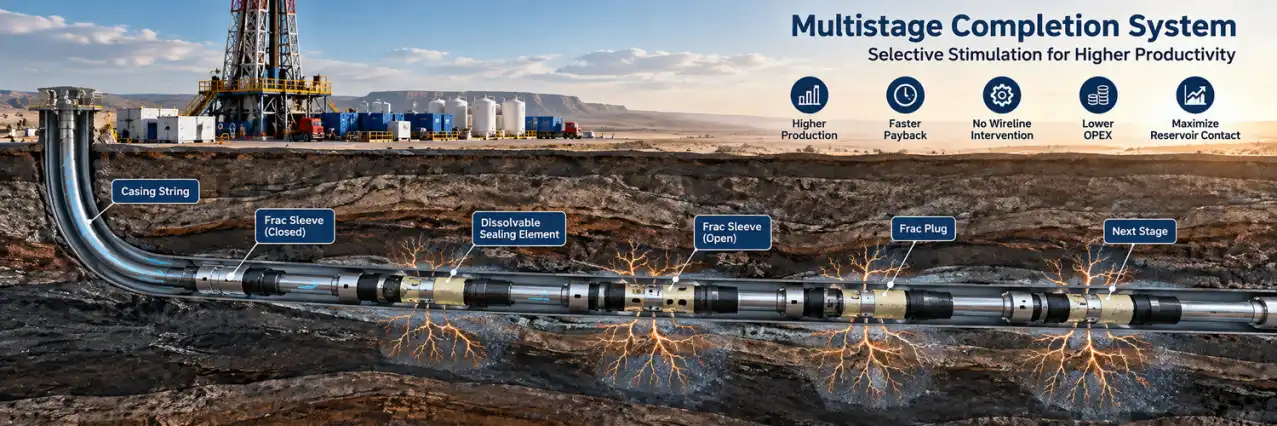
A multistage completion system separates a wellbore, which is usually a long horizontal lateral, into separate areas that can be stimulated separately. Each zone gets its own treatment for fracturing, which makes multiple fracture networks along the wellbore. Techs like plug-and-perf, ball-drop sliding sleeves, and key-activated sliding sleeves can all help reach this goal of divided stimulation. As of now, the U.S. Energy Information Administration (EIA) says that almost all new horizontal wells drilled in tight formations in the US use staged completion designs.
Where Each System Applies
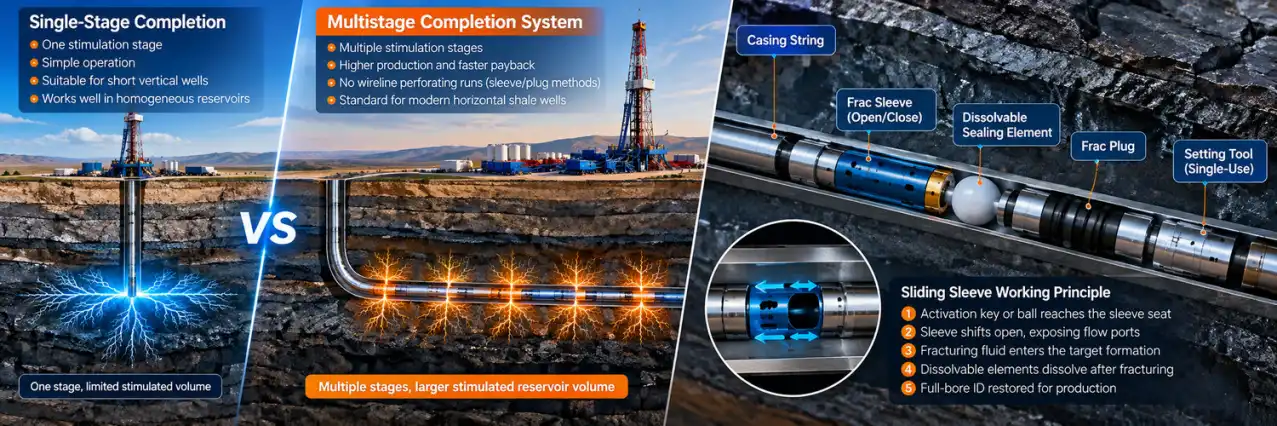 Single-stage completions are used on standard vertical wells that have pay sections that are clearly marked and permeable. In unconventional plays like the Permian Basin, Eagle Ford, and Marcellus, where reservoir permeability is low and lateral lengths often reach 8,000 to 12,000 ft, multistage designs are the norm. Any decision in completion engineering starts with matching the type of system to the properties of the reservoir.
Key Technical Differences and Performance Comparison
Workflow Complexity and Well Integrity
Single-stage completions need fewer parts to be put downhole and take less time to complete. There are more mechanical parts in a multistage completion system, like packers, sleeves, and plugs. This means there are more connections to handle and more chances for zonal isolation failure. Having said that, well-documented data from SPE studies regularly show that multistage designs that are carried out correctly lower the risk of unproductive lateral sections going unstimulated, which is a more expensive way for unconventional wells to fail.
Production Efficiency and Recovery Gains
A multistage completion system lets engineers treat each zone specifically, which is a direct way to deal with the heterogeneity of the reservoir. According to information from the Permian Basin, wells with 30 or more stimulation stages usually produce 40–70% more over the first two years than wells with less than 10 stages in the same rocks. To choose the right stage count, spacing, and fluid design, you need downhole tools that are reliable and can handle pressures and temperatures up to 15,000 psi and temperatures above 450°F for deep or HTHP applications.
CAPEX vs. OPEX Considerations
A multistage finishing method costs more up front than a single-stage job. A lower number of recompletions, lower lift costs per created barrel, and a faster time to peak rate change the OPEX picture, though. Putting all of the material, tool, and sealing-element supply under one qualified vendor cuts down on the cost of project coordination and shortens the time between the start of the project and the first production run.
Evaluating Which System Fits Your Project Needs: F-1 Criteria Screening Approach
The F-1 Screening Criteria
Before choosing a system type, the engineering and procurement teams should rate each project based on five factors: the project's lateral length and trajectory, the reservoir's permeability and heterogeneity, the number of stages that need to be reached, the wellbore fluid's chemistry (temperature, salinity, and H2S/CO2 content), and the readiness of the supply chain. A simple weighted score grid used before the FEED stage keeps expensive system changes from happening in the middle of a project. A multistage completion system is almost always needed for wells that have a lot of lateral length and different types of reservoirs.
Matching System Capability to Project Constraints
Once the type of system is chosen, the specifications of the parts are equally important. Key-operated HAGRIEN slide bands are attached to the casing string and let you open only certain fracture stages without having to use wireline runs or perforating guns. With this design, workers can run all frac steps at the same time, which means that production can start weeks earlier than with traditional plug-and-perf programs. After being activated, the system offers a full-bore internal diameter and can accept dissolvable sealing elements for expected partial zonal isolation. This directly lowers the cost of involvement on long-reach laterals.
Supplier Qualification in the Decision Matrix
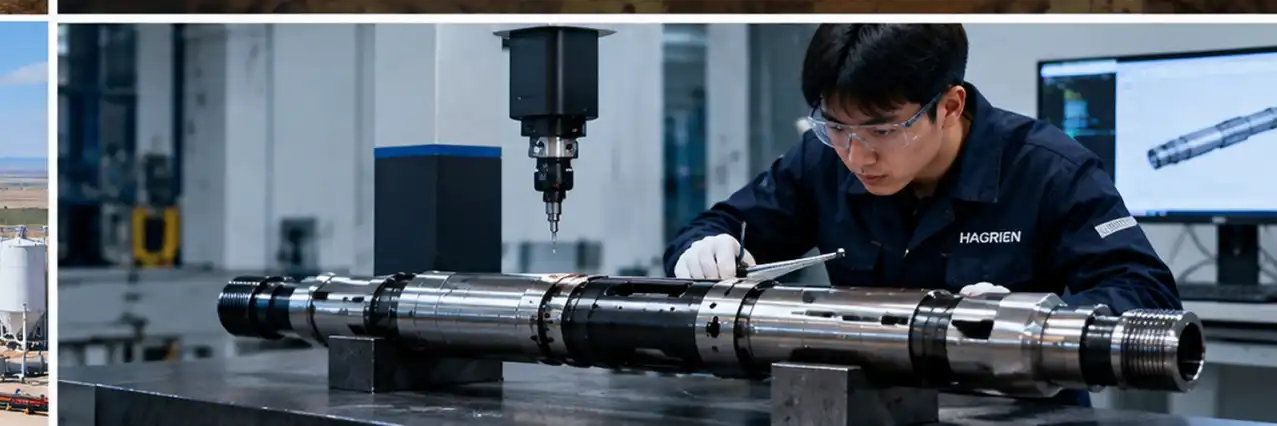 The performance of a system depends a lot on the quality and traceability of its parts. Any multistage completion system provider should have API Spec Q1 registration, ISO 9001/14001/45001 approval, and test validation from a CNAS-accredited facility. These credentials show that the pressure ratings, chemistry, and dissolution behavior of a material have been checked against test records that can be tracked, not just what is written on a datasheet. Documentation that can be checked also helps operators during performance reviews after a job is done.
Practical Application and Case Examples
Horizontal Shale Wells
In horizontal wells in the Permian Basin with 10,000-foot laterals, operators who used key-activated sleeve-based multistage completion methods said that the average time from frac to production was 15–20 days faster than with plug-and-perf programs. Most of that time saves comes from not having to do wireline runs for each step. On some program wells, the need for post-frac coiled tubing cleanout was not needed because of dissolvable bridge plugs and sealing elements that were tested for the right brine chemistry and temperature.
Re-Fracturing and Legacy Well Redevelopment
Within an existing multistage completion system, re-closable sliding sleeves make it possible to selectively stimulate certain zones again without having to do a full workover. A number of independent operators in the Eagle Ford have used this feature to bring back output from areas that weren't stimulated enough in the original program. This has added significant stocks without digging any new wells. For this method to work, parts must be made from corrosion-resistant metals like Super Chrome or Inconel grades according to NACE MR0175/ISO 15156 so they can keep their shape in harsh working conditions.
Supply Chain Integration for Large-Scale Programs
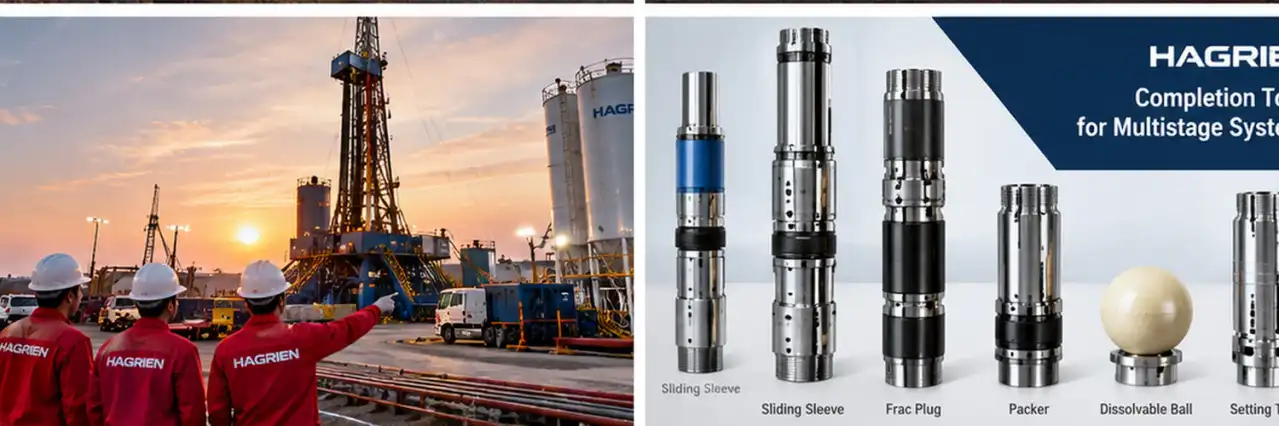 When an oilfield services company delivers the whole completion package to the operator for a multi-well pad project, supply chain consolidation is important. Getting materials, downhole tools, and elastomeric sealing elements from one qualified source instead of three different ones lowers interface risk and gets rid of the gaps in documentation that slow down supplier audits. This model is supported by HAGRIEN, which offers project-based delivery, emergency restocking, and full batch tracking from the melting of the metal to the finished part.
Future Trends in Completion Systems
Interventionless Completion Programs
The industry is moving toward completion designs that don't need any wireline or coiled tubing work after the cementing is done. This direction is based on key-activated and ball-drop sleeve systems. As lateral lengths get longer and offshore projects get bigger, every wireline run that is taken out of the finishing process lowers costs and well exposure time. This change is happening faster because dissolveable temporary separation elements don't need to be mechanically retrieved at all.
Smart Monitoring and Digital Integration
Engineers can see in real time which stages are producing and which are not by using fiber-optic distributed temperature and acoustic sensing with staged completion architectures. This helps make choices about how to optimize production without any extra help. Real-time data lets you close or reopen individual sleeves. This changes the design of multistage finishing systems from a one-time stimulation event to a controlled production architecture.
Sustainability and Regulatory Alignment
Completion design objectives are changing because of government rules on water use, emissions, and well soundness. Environmental audits are easier to do on systems that reduce the amount of fluid used per step, keep equipment's surface area as small as possible, and make full paperwork of how materials can be tracked. When suppliers have ISO 14001 and ISO 45001 certifications, buying teams can show that they follow the rules all the way up the material supply chain.
Conclusion
A multistage completion system is better for most unconventional horizontal wells drilled in the US today than a single-stage approach because it improves production, speeds up time to peak rate, and has better long-term economics. The choice is based on an accurate description of the reservoir, specifications for parts that are compatible with the conditions inside the wellbore, and a supply chain that can deliver full, traceable systems on time for the project. Single-stage designs are still useful for wells with simple geometries, but they are becoming less common in new completions work.
FAQ
1. What is the main difference between plug-and-perf and sliding sleeve systems?
Plug-and-perf lets you have as many stages as you want, but each one needs a fiber run. Sliding sleeve systems, such as ball-drop and key-activated models, allow continuous pumping without wireline intervention at each stage, which greatly cuts the total job time.
2. Can a multistage completion system handle H2S environments?
Yes, as long as the parts are made from L80, 13Cr, or nickel-based alloys that meet the standards of NACE MR0175/ISO 15156 for not breaking under sulfide stress.
3. What causes zonal isolation failure in staged completions?
Some common reasons are not putting the packers properly, rubber breaking down because of chemicals not working well together, and micro-annular cement leaks. These failure modes are less likely to happen when you choose ISO 14310 V0-rated tools and do thorough fluid compatibility testing before the job.
4. How traceable should component documentation be?
For purchase programs that can be checked, each batch should have a COA or COC record, material test reports that confirm the yield strength and chemistry, NDT inspection results, and functional test data.
5. Is re-fracturing possible in an existing staged completion?
Yes. Systems with re-closable sliding sleeves let you re-stimulate only certain areas without having to do a full workover. This makes wells last longer and costs less.
Partner with HAGRIEN for Your Next Multistage Completion Program
In addition to being a recognized API maker and seller, HAGRIEN also has ISO 9001/14001/45001 certification and a CNAS-accredited HTHP laboratory that backs up every part we ship. Our key-activated sliding sleeves, dissolvable bridge plugs, packers, and sealing elements come in a full, trackable package with all the materials, tools, and paperwork you need. Standard sizes take two to four weeks to deliver, while special sizes take four to eight weeks. Get in touch with our team right away to ask for a standard multistage completion system quote package or to talk about a project-specific supply model. cyrus@us-hagrien.com or us-hagrien.com are both ways to get in touch with us.
References
1. Society of Petroleum Engineers (SPE) — Hydraulic Fracturing Technology Conference and Exhibition Proceedings, 2022.
2. U.S. Energy Information Administration (EIA) — Hydraulically Fractured Wells Provide Two-Thirds of U.S. Natural Gas Production, 2016.
3. Economides, M.J., and Nolte, K.G. — Reservoir Stimulation, 3rd Edition, Wiley, 2000.
4. SPE Journal — Optimization of Multistage Hydraulic Fracturing in Horizontal Wells, Vol. 18, 2013.
5. American Petroleum Institute (API) — API Spec Q1: Specification for Quality Management System Requirements for Manufacturing Organizations for the Petroleum and Natural Gas Industry, 9th Edition, 2013.
6. NACE International — MR0175/ISO 15156: Petroleum and Natural Gas Industries — Materials for Use in H2S-Containing Environments in Oil and Gas Production, 2015.

USER EVALUATE
Here is the customer's evaluation of us