




Multistage Fracturing Sliding Sleeve in Shale Gas: Uses and Benefits
When operators push horizontal wells past 50 stages, every minute between stages adds up fast. A multistage fracturing sliding sleeve gives completion teams a way to open individual zones along the lateral without stopping the pump, pulling wireline, or running perforating guns. This article covers how these tools work, where they fit in shale gas programs, and what to look for when sourcing them — including how HAGRIEN's key-activated sleeve system addresses the real challenges engineers face on high-stage-count wells.
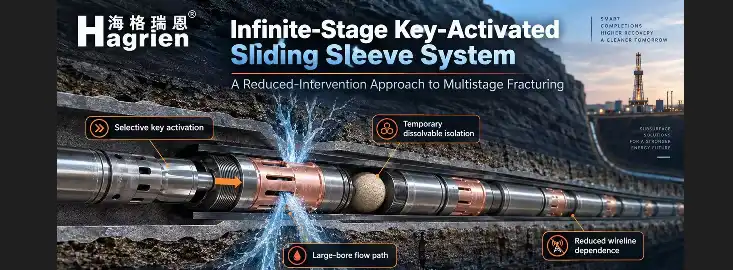
What Is a Multistage Fracturing Sliding Sleeve and How Does It Work?
Basic Definition and Function
As part of the casing string, a multistage fracturing slide sleeve is put in place as a downhole finishing tool. It stays shut while the well is being built, but it can be opened at will to let the fracturing fluid reach the target zone. This kind of limited access is what makes interventionless finishing programs work.
Actuation Methods
Ball-drop and key-activated (also called mechanical moving) are the two main ways to move things. In ball-drop devices, a ball is slid against an internal shape to close off the area below and open the port above. Key-activated systems, like the HAGRIEN sliding sleeve, open each sleeve separately using a shifting tool on coiled tubing or a mechanical key run-in-hole. They don't rely on balls that get bigger at each stage and make the inner diameter smaller.
Why It Matters for Stage Count?
Ball-drop devices are limited by the size of the seat steps. When you get to 20 to 30 stages, even the smallest ball seat stops production and doesn't let you get back in. There is no such limit for key-activated sliding sleeves. It's the same for both stages 8 and 80 because each tube opens to the same full-bore internal diameter.
 Applications and Benefits of Multistage Fracturing Sliding Sleeves in Shale Gas Production
Shale Gas Horizontal Wells
In places like the Marcellus, Permian Basin, and Sichuan Basin, horizontal laterals are now often higher than 3,000 meters. With a sliding sleeve frac system, the crew can pump stage after stage without having to stop for wireline. This greatly reduces the amount of time they have to spend not working. Interventionless sleeve completions have cut overall completion time by 20 to 35 percent compared to plug-and-perf methods in field projects that have been recorded.
Re-Fracturing and Toe-Stage Initiation
Because early completions used wider stage spacing, legacy shale wells often don't work as well as they should. Re-fracturing with sliding covers lets workers go back into certain areas and stimulate them without changing the holes next to them. Toe-stage initiation, in which the first crack is put at the far end of the lateral before the rest of the case is put under pressure, also needs a sleeve that opens easily the first time.
Deepwater and Extended-Reach Laterals
It is much more expensive to do things in deep sea or extended-reach settings than on land. In this case, the intervention budget is cut directly by a multistage fracturing sliding sleeve that doesn't need any wireline runs after installation. The HAGRIEN system works with closing elements that dissolve, so there is no debris left over after stimulation to stop production or future re-entry.
Comparing Multistage Fracturing Sliding Sleeves with Alternative Completion Technologies
Sliding Sleeve vs. Plug-and-Perf
In North America, plug-and-perf is the most common way to finish a well, but each one needs a wireline crew and a coiled tubing mill-out. Both of those steps are not needed with sliding sleeve methods. The upfront cost of the tools is a trade-off that is balanced by the time and money saved on rig time, wireline spreads, and fewer people needed at the well site.
Key-Activated vs. Ball-Drop Sliding Sleeves
There are some main changes in how well the two types of sleeves work:
- Stage count ceiling: Ball-drop systems typically top out around 30 to 60 stages due to seat diameter constraints; key-activated systems carry no inherent stage limit.
- Post-fracture bore: Ball seats reduce the drift diameter after each stage; key-activated sleeves restore full bore after shifting, keeping the wellbore open for production logging and future intervention.
- Contingency: If a key-activated sleeve does not open on the first run, the shifting tool can make a second pass — no additional mill-out required.
If a key-activated sleeve doesn't open on the first try, the shifting tool can make a second pass without having to mill out again.
Supplier Differentiation
Big service companies have their own sliding sleeve products that are backed up by global field crews. For example, HAGRIEN is an independent maker that lets you customize the engineering to your exact needs. They also offer faster sampling processes and direct access to the material and machining teams that made the tool. Being able to talk directly to the manufacturing team is helpful for operators who are working with tool manufacturers on joint development projects or who are using non-standard stage counts.
 Procurement and Installation Insights for Multistage Fracturing Sliding Sleeves
Supplier Evaluation Criteria
It usually takes four to ten months to get a multistage fracturing sliding sleeve for a primary shale asset. The process includes technical evaluation, bench verification, a trial with a single well, and batch adoption. The most important things at each stage are:
- Stage count and bore documentation: Verified records showing the tool operated at rated pressure across a representative stage count, not just a single-point proof.
- Material traceability: Full batch documentation including chemical composition, mechanical properties, and dimensional inspection reports — not just a certificate of conformance.
- Dissolution performance (if applicable): For tools using dissolvable seats or plugs, time-to-dissolution data under representative temperature and salinity conditions.
- Consistency from prototype to production: Confirmation that the first-article inspection standard carries through to batch delivery without tolerance creep.
If a buyer doesn't do the traceability check, they may be surprised when tool remains make it hard to reach the well or record production. During the quotation process, asking for CNAS-approved test records and batch inspection packages weeds out suppliers who can't back up a serious qualification program.
Installation and Operational Readiness
Since sliding covers are put on with the casing string, it's important to make sure that the tool's dimensions are compatible with the liner system before it goes. The design of the thread, connection, and drift all need to fit the shape of the case. HAGRIEN offers a standard quote package with a substitution cross-reference for common casing programs. This cuts down on the time needed for the pre-job engineering review.
Future Trends and Innovations in Multistage Fracturing Sliding Sleeve Technology
Dissolvable Sealing Elements
The most important change in sleeve finish design in the last five years has been the move toward fully dissolvable temporary separation. Using seats and plugs made of dissolvable magnesium metal gets rid of the mill-out run completely, leaving a full-bore wellpath from the toe to the heel after stimulation. HAGRIEN can extrude magnesium alloys in-house, and they can make bars up to Ø300 mm. This lets them make dissolution-controlled parts that are perfect for the temperature, salinity, and time windows downhole.
Infinite-Stage Architecture
No longer is the idea of a "unlimited-stage well" just an idea. With key-activated sleeve systems that don't limit the diameter of the ball seat and fiber-optic distributed temperature sensing for real-time stage proof, finishing teams can go well past 100 stages without affecting entry to the wellbore. This architecture is what HAGRIEN's infinite-stage key-activated sliding sleeve system is based on.
Material and Quality Advances
It's becoming more of a requirement than a differentiator to have closed-loop quality control, which means that the alloy formulation, extrusion, and precision machining are all done in the same building. When the material team and the machine team use the same process standard, the behavior of the material when it dissolves and stays the same size from batch to batch can be repeated.
Conclusion
Completions for shale gas are increasing the number of stages and the lengths of the sides to levels that older tool designs can't cleanly handle. A well-designed multistage fracturing sliding sleeve, especially one that is triggered by a key and has full-bore repair and dissolvable isolation elements, can directly help finishing teams with their time, cost, and access problems. With the right tool and a supplier that can provide traceable paperwork, uniform batch quality, and quick technical support, it's easy to qualify the tool and know what the output results will be.
FAQ
1. How many stages can a key-activated sliding sleeve system handle?
Key-activated devices don't have a stage limit that is tied to changes in ball diameter. HAGRIEN's method is made for uses with an endless number of stages. This means that the well program, not the tool geometry, decides how many stages to use. Field tests have shown that it works reliably for more than 80 steps in a single lateral.
2. What happens if a sleeve does not open on the first attempt?
A fallback shift feature is built into most key-activated designs. The shifting tool makes a second pass, opening the sleeve mechanically without needing a separate mill-out run for coiled tubing or extra wireline equipment on site.
3. Are dissolvable sealing elements reliable under high pump rates?
Yes, as long as the material used for dissolution is right for the environment downhole. The temperature, fluid salinity, and goal time for dissolution are all part of the product standard that HAGRIEN makes. The elements keep the pressure up while pumping and break down in a predictable way after the stimulation stops.
4. What documentation should buyers request during supplier qualification?
Ask for records of each batch's tracking, full material test reports (MTRs), dimensional inspection reports, hydrostatic and gas-tight test records, and any CNAS-accredited lab reports that cover the listed temperature and pressure conditions.
5. Can these sleeves support re-fracturing of legacy wells?
Yes. Because the internal diameter of the bore is full after activation, a shifting tool can go back in and re-open or re-isolate certain stages for re-fracturing programs. This is not possible with ball-seat systems because they leave behind bore restrictions.
Get a Technical Quote from HAGRIEN — Trusted Multistage Fracturing Sliding Sleeve Supplier
HAGRIEN offers key-activated multistage fracturing sliding sleeve that are tested by CNAS-accredited laboratories and are made in a closed-loop system that starts with the metal and ends with the finished tool. Our engineering team gets back to you within 24 hours, whether you need a trial package for a single well or a batch delivery for a big project. To get a detailed information and quote, email us at cyrus@us-hagrien.com or go to us-hagrien.com.
References
1. Economides, M. J., & Nolte, K. G. (Eds.). Reservoir Stimulation (3rd ed.). Wiley, 2000.
2. Society of Petroleum Engineers. SPE 168973: Evaluation of Multistage Fracturing Completion Systems in Horizontal Shale Wells. SPE, 2014.
3. King, G. E. SPE 152596: Hydraulic Fracturing 101: What Every Representative, Environmentalist, Regulator, Reporter, Investor, University Researcher, Neighbor and Engineer Should Know About Estimating Frac Risk and Improving Frac Performance in Unconventional Gas and Oil Wells. SPE, 2012.
4. Daneshy, A. A. SPE 107515: Factors Controlling the Vertical Growth of Hydraulic Fractures. SPE Journal, 2009.
5. Lohoefer, D., Athans, J., & Seale, R. SPE 116414: New Pinnacle Cemented Liner Multistage Fracturing System Improves Efficiency and Provides Cost Effective Solution in the Barnett Shale. SPE, 2008.
6. Montgomery, C. T., & Smith, M. B. Hydraulic Fracturing: History of an Enduring Technology. Journal of Petroleum Technology, 2010.

USER EVALUATE
Here is the customer's evaluation of us