




Selective Fracturing Sleeve in Hydraulic Fracturing: Where It Fits
A selective fracturing sleeve fits in multistage hydraulic fracturing wherever the completion must open chosen stages on purpose instead of in a fixed order.It is a downhole component that is run in the casing or liner string. When engaged, it opens frac ports at one specified interval, so fluid and proppant reach the rock that deserves them. It is applicable to long horizontal shale wells, tight gas reservoirs and layered formation with inconsistent quality. In this essay I show how the tool works, how it compares with other ways and how to configure, test and purchase one.
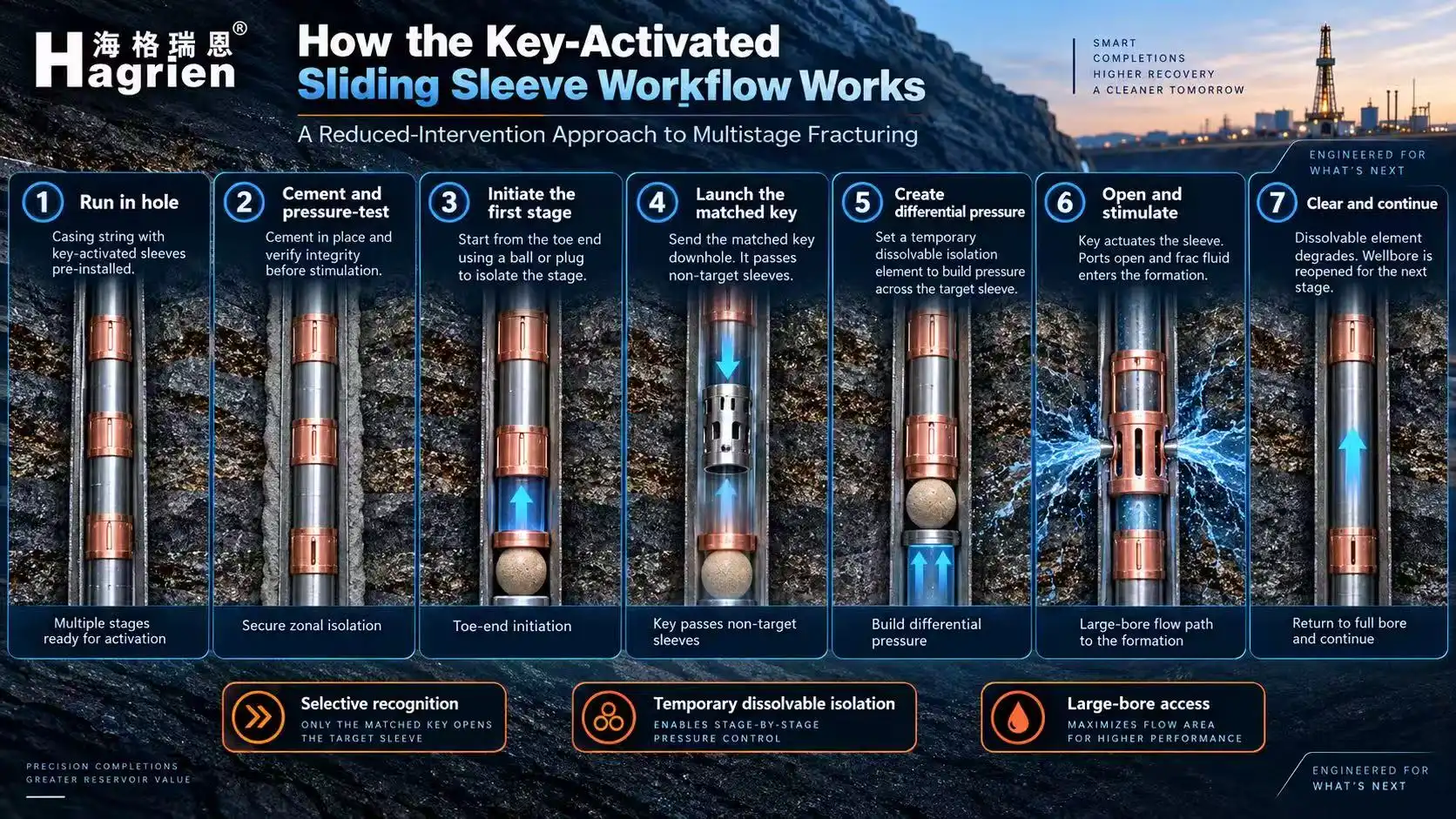
How a Selective Fracturing Sleeve Works and Why It Matters
What the Component Is and What It Is Not
A selective fracturing sleeve is a downhole device that provides access to just one stimulation interval at a time, in a controlled manner. It is run in the casing or liner string. It is used with packers, plugs, balls and surface pumping equipment. Three words are commonly confused, so I’ll keep them distinct. The task is described as a fracturing sleeve that delivers fluid into a planned zone. The opening mechanism is a sliding sleeve . An inner sleeve slides to open apertures . A packer or plug is an isolation device that isolates flow between intervals and ISO 14310 covers packers and bridge plugs. A true completion combines all three notions, and a smart design assigns the proper portion to each duty.
Why a Selective Fracturing Sleeve Helps in Uneven Reservoirs
Rarely do reservoirs act the same along a lateral. Thin pay zones, spontaneous cracks and changing rock stress imply certain periods merit more fluid than others. Evenly spaced stages might place weak rock and strong rock in the same volume . Logs and geology help influence the selection fracturing sleeve that determines which stages open and in what sequence. This also helps to avoid accidental zonal communication which causes wasted water and fluid. Hydraulic fracturing is responsible for over half of today’s U.S. crude oil production, thus stage placement influences a big chunk of domestic production, according to the U.S. Energy Information Administration in 2016. I meet with teams that connect geology with stage design early and save numerous difficulties later.
Activation Methods and Operating Sequence
The sequence starts when the completion string is run and set. After pressure testing, crews open stages one at a time. Depending on the design, a selective fracturing sleeve may open by hydraulic pressure, a mechanical shifting tool, wireline, coiled tubing, or a ball of a specific size. Pressure moves the inner sleeve, the frac ports open, and pumping delivers fluid and proppant to that interval. Ball-activated designs depend on seat diameters, which limit stage count. Shifting-tool designs depend on shifting force and position verification. Before the job, I check debris control and component compatibility, because a small obstruction can stop a sleeve from moving.
Where Selective Fracturing Sleeves Fit in Multistage Completions
Connecting Sleeve Placement to Stage Design
Sleeve location is strongly related to the stage spacing, packer or plug isolation, cluster design and pressure schedule. Engineers choose sleeve depths from logs and put in isolation so each period remains isolated. The sleeve must be opened and the work pumped with surface pressure within casing restrictions. Long reach laterals generate friction thus the margin between opening pressure and these limitations becomes smaller. A selective fracturing sleeve works best when these numbers appear on one page before the string is constructed. Heat, proppant degradation and frequent pressure cycling can impact seals and ports. The design should indicate predicted circumstances. A basic layout of sleeves, isolation elements and target zones assists the team in following the plan.
Open Hole and Cased Hole Requirements
Open hole and cased hole completions are separate questions. In open hole, the isolation elements must anchor and seal against the wall of the formation, and the rock must be sturdy enough to support them. Cement is the problem in the cased hole. It must not penetrate the sleeve mechanism, nor interfere with movement, and must segregate intervals as designed. Each design of selective fracturing sleeve must be tailored to the kind of completion. In both circumstances, access to intervention counts. If workers can get a sleeve later using coiled tubing or a moving tool, they may solve an issue or reopen a stage. Interventionless designs are of added value in areas where access is restricted, such as deepwater or extended-reach wells, since each trip costs money.
Comparing Plug-and-Perf, Ball-Drop, and Selective Sleeves
Here is how the main options differ in practice.
- Plug-and-perf: Crews pump a plug, shoot perforating guns and repeat. It provides adjustable cluster placement and is well known, but each step requires wireline runs that increase time and expense, particularly in lengthy laterals. Plugs generally must be ground out or dissolved before manufacturing. Best for wells requiring bespoke perforation designs.
- Ball-drop sleeves: Seats and open stages from toe to heel are matched to fit balls of increasing size that drop upon them. The technique is easy and requires no wireline. But the number of stages is limited by seat sizes . And the sequence is predetermined . So you can not skip a weak interval without rewriting the string . Thus it is more suitable for uniform reservoirs.
- Selective fracturing sleeves: The operator chooses which stage opens and when, with no set sequence. This is useful for layered or irregular reservoirs and may reduce wireline runs. Each of the stages in designing must be carefully identified and one must prepare to verify that each opening event did occur. No strategy wins everyplace. Geometry is decisive.
Stage count, reservoir variety, and intervention cost should drive the choice, not habit.
 Specifications and Selection for a Specific Well
Technical Specifications That Matter
A selective fracturing sleeve must be fully specified with pressure and temperature ratings, internal and exterior dimensions, connection type, flow area, port shape, body materials, seals, and activation criteria. I tell purchasers to look at the whole pressure-temperature envelope, not one catalog maximum. Fracturing fluid chemistry and proppant erosion also important. Materials should be per NACE MR0175/ISO 15156 sour service guidelines for H2S or CO2 wells. Request dimensions drawings, drift data, interface information and qualification results prior to approval of purchase. These papers are inexpensive to gather and avoid costly surprises on site.
Building a Well-by-Well Selection Checklist
Choosing a selective fracturing sleeve starts with the full well and job: trajectory, lateral length, completion type, reservoir traits, stage count, pump rate, pressure, temperature, fluid system, and proppant loading. Then match the design to those inputs. Check the activation method, sealing approach, flow capacity, materials, corrosion resistance, retrieval needs, dissolution behavior, and tool compatibility. Ball choices follow the goal. Dissolvable balls can reduce post-job cleanout, while ceramic balls are chosen for hardness. Retrievable designs suit wells where later access matters, and permanent designs suit wells where it does not. Write the answers down so the completion engineer, geologist, and service crew all work from the same list.
Weighing Total Cost of Ownership
The cheapest selective fracturing sleeve isn’t necessarily the cheapest to operate. Remember to include installation time, pressure testing, intervention, downtime, lead time, replacement parts and supplier support. Avoiding each wireline run saves rig and crew time, and a faulty sleeve may stop a whole stage. When I compare quotations I get them with the same scope, with product, testing, paperwork, packaging and logistics on distinct lines. It makes the differences evident and maintains the comparison fair. A technical provider that responds promptly also reduces schedule risk, and that has actual economic worth on a multi-well pad.
 Failure Risks, Testing, and Quality Control
Common Failure Risks and Prevention
Failures may interfere with stage sequence, zonal isolation and output. The main hazards include early activation, improper selection of ball, debris interference, leaking of seal, erosion of port or seat, incomplete disintegration and damage during handling. There is a realistic countermeasure to each danger. Activation pressure vs anticipated cementing pressures and circulation pressures. Conduct pressure and fluid compatibility testing. Keep an eye on the pieces in the store and check the measurements before you run the string. Beware of catalog claims as well. "API certified" is an unsubstantiated assertion, not evidence. Ask for documentation, traceability and test results relevant to your application.
Factory Testing and Verification
For a selective fracturing sleeve there should be inspection records from the manufacturer through to the delivery. Factory approval normally includes dimensions inspection, thread and port inspection, drift compatibility, ball- seat measurements, material certifications, heat treatment records, labeling and traceability. Then, pressure and functional tests are performed to check the body integrity, seals, activation pressure and opening behavior. Where risk is high, qualification should recreate the pressure, temperature, fluid chemistry, proppant exposure and cycle the well would experience. HAGRIEN’s sleeves are made using closed-loop quality control, CNAS-certified testing and complete batch traceability. Ask any supplier to display these records before shipping not later.
Learning from Field Data
The task is not over when the pumping stops. Track each selective fracturing sleeve through the work – activation success, stage pressure response, pump rate and any intervention. Compare real opening pressures with the plan and record each step that behaved in an unexpected manner. Use those learnings in the next well design and in the negotiation with the supplier. A pad-by-pad record also lets a team know whether a design is ready for broader distribution. Across a multi-well program, little adjustments may add up.
HAGRIEN Sleeves and How to Buy with Confidence
What the HAGRIEN Sliding Sleeve Offers
HAGRIEN sliding sleeves are key-activated components run-in with the casing string. They enable for selective opening of particular fracturing stages without wireline lines or perforating guns. The system provides infinite-stage capability, full bore internal diameter post-actuation, decreased intervention, and compatibility with dissolvable sealing parts for predictable temporary zonal isolation. This selective fracturing sleeve isolates just the desired phases in a work, which helps prevent unwanted zonal communication and limits the usage of water and fluids. Typical applications include multistage fracturing of horizontal shale wells, interventionless completion programs, re-fracturing of legacy wells, toe-stage initiation, and deepwater or extended-reach laterals when intervention cost is a concern. I would recommend bench verification and a single-well trial before pad-wide usage.
Writing an RFQ That Gets an Accurate Quote
A clean RFQ for a selective fracturing sleeve reduces the road to a usable quotation. Details of casing or liner, dimensions of sleeves, number and location of stages, pressure and temperature, activation technique, ball or tool specifications, fluid and proppant data, standards, inspection requirements, quantity, destination and delivery date. For custom or OEM orders, please provide authorized drawings, change control, qualification plans, and acceptance criteria. HAGRIEN will confirm the requirements and technical lists within 24 hours and a formal estimate and delivery date will be provided within 1 to 3 business days. Complex projects will be confirmed individually. Request separate pricing for product, testing, paperwork, packaging and logistics.
Choosing a Selective Fracturing Sleeve Supplier for U.S. Programs
For overseas purchasers, a supplier’s worth is not only the part itself. Seek for English paperwork, consistent units and tolerances, detailed explanation of pressures and full drawings. HAGRIEN is ISO 9001, ISO 14001 and ISO 45001 certified, API recognized and has an HTHP laboratory approved by CNAS. Since 2019 we have manufactured and verified dissolvable magnesium alloy materials with in-house melting, extrusion and machining which provides us control over dissolvable components. COA, COC and SDS documents are available upon request. One U.S. company is responsible for North America projects. Terms of Trade: EXW, FOB and CIF. Weekly status reports in line with program timeframes. We also provide OEM/ODM work and regional collaboration for distributors.
Conclusion
A selective fracturing sleeve gives operators controlled access to chosen stages in multistage hydraulic fracturing, which matters most in long horizontal shale wells, tight gas reservoirs, and uneven formations. Its worth relies on the complete completion: stage spacing, isolation, pressure schedule, open-hole or cased-hole circumstances. It provides greater flexibility in stage sequence and fewer wireline runs than plug-and-perf and ball-drop sleeves, however no one approach is best in all wells. Specifications should address the whole pressure-temperature environment, erosion, fluid chemistry and sour-service materials. Potential failure modes include premature activation, debris and seal leakage. Testing, traceability and assessment of field data must be recorded. Buying choices are best achieved by balancing overall cost, lead time, and supplier support against pricing.
FAQ
1. What is a selective fracturing sleeve used for?
It opens chosen stages during multistage hydraulic fracturing so fluid reaches planned intervals. It suits horizontal shale, tight gas, and layered wells.
2. How does it differ from plug-and-perf?
Plug-and-perf uses wireline runs, plugs, and perforating guns for each stage. A sleeve installs with the casing string and opens ports without perforating guns.
3. Can a selective fracturing sleeve work in open hole?
Yes, when the isolation elements anchor and seal properly and the formation stays stable. Design depends on pressure, temperature, fluid chemistry, and well geometry.
4. What information is needed for a quotation?
Send casing or liner size, stage count and positions, pressure, temperature, activation method, fluid and proppant data, quantity, and delivery needs to cyrus@us-hagrien.com.
5. Are dissolvable balls better than ceramic balls?
Neither wins everywhere. Dissolvable balls reduce cleanout, while ceramic balls suit conditions that favor hardness. The choice depends on the well.
Request a Selective Fracturing Sleeve Quote from HAGRIEN
Share your well data with HAGRIEN, and our team will recommend a suitable selective fracturing sleeve, testing plan, and documentation package. We support standard, custom, OEM, and bulk orders, and we serve operators and distributors as a selective fracturing sleeve supplier and manufacturer. Email cyrus@us-hagrien.com with your casing size, stage count, pressure, temperature, and delivery needs. Data sheets, drawings, test reports, lead times, MOQ, pricing, and shipping options are available. Learn more at us-hagrien.com.
References
1. U.S. Energy Information Administration, Today in Energy: Hydraulic fracturing accounts for about half of current U.S. crude oil production, 2016
2. Reservoir Stimulation (Economides and Nolte), 2000
3. Petroleum Engineering Handbook, Volume IV: Production Operations Engineering (Society of Petroleum Engineers), 2007
4. Unconventional Oil and Gas Resources Handbook: Evaluation and Development (Ma and Holditch), 2016
5. ISO 14310: Petroleum and natural gas industries, Downhole equipment, Packers and bridge plugs, 2008
6. ISO 15156 / NACE MR0175: Petroleum and natural gas industries, Materials for use in H₂S-containing environments in oil and gas production, 2015

USER EVALUATE
Here is the customer's evaluation of us